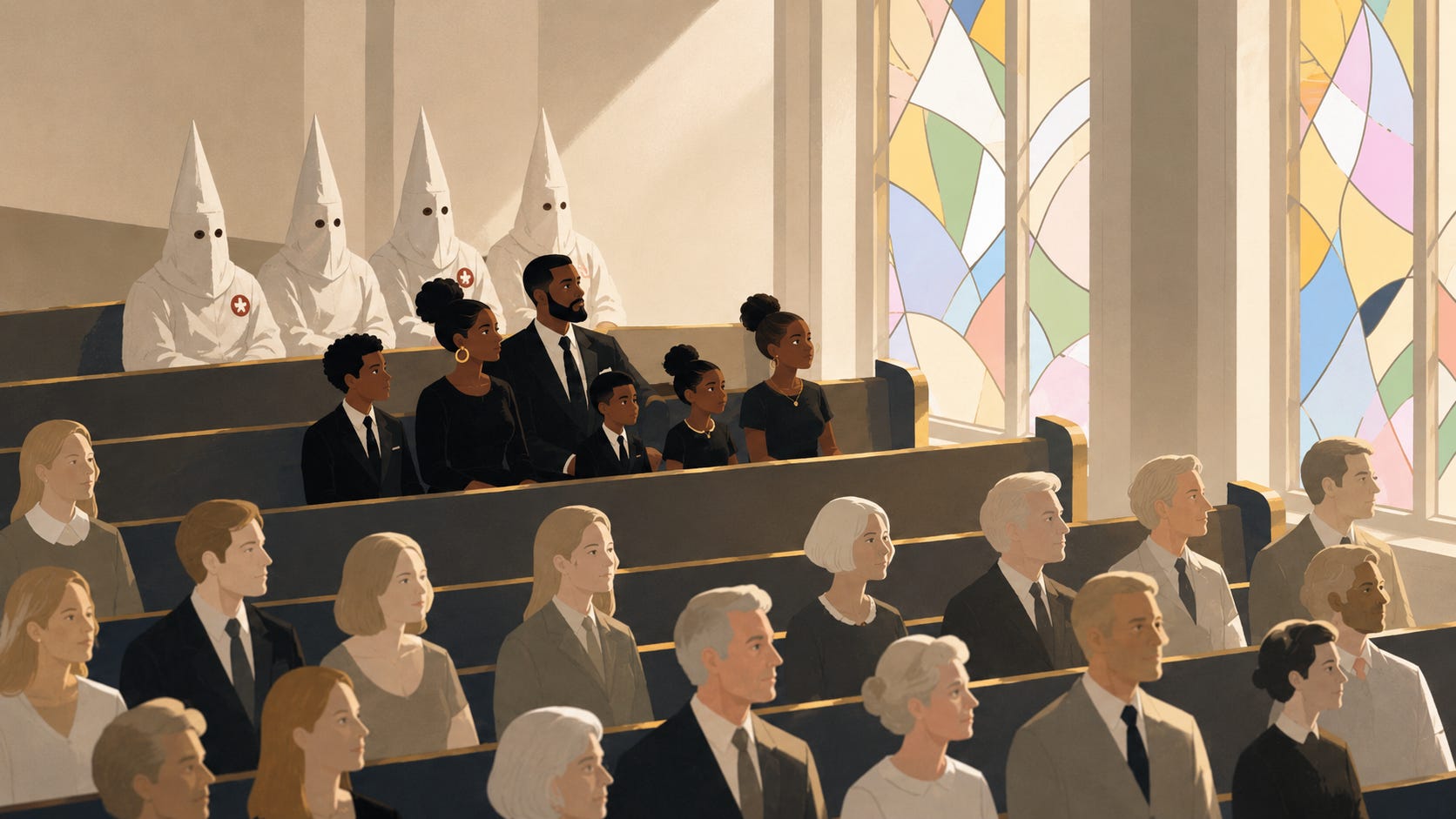
ARE AFRICAN-AMERICANS SAFE IN EVANGELICAL CHURCHES?
A reckoning with silence, history, and the distance between what the American church preaches and how it treats its African-American congregants.
By Zion McGregor
A Black woman I know, a faithful churchgoer for the whole of her adult life, who joined a white evangelical church once told me why she stopped raising her hand in Sunday school. It was not that she lacked an answer. It was that the room had made clear, gently and without a single cruel word, that her answer was not the kind the room was looking for. She kept attending for another two years after that. She kept giving. She kept volunteering in the nursery and singing on the worship team. But she stopped speaking, and eventually she stopped believing that the room was safe for her whole self to be present in it. That story is not unusual. It is, in fact, the ordinary experience of a great many African Americans inside evangelical spaces, and it is the reason the question in this title is not rhetorical. Are African-Americans safe in white evangelical churches? The honest answer requires looking at recent history, distant history, scripture, and the plain facts of who leads, who gives, and who is heard.
The Silence of the Moment
Start with the moment we are in. Since the beginning of the current presidential term, the federal architecture built to track and prevent racially motivated violence has been dismantled piece by piece. The Southern Poverty Law Center has documented the termination of dozens of federal hate crime prevention grants earlier deemed politically inconvenient, along with the elimination of the very term used by federal agencies to classify racially or ethnically motivated violent extremism. The Department of Justice's most recent hate crime data, covering 2024, still recorded Black Americans as the single most targeted racial group in the country, accounting for the largest share of race based hate crimes on record, a pattern that has held for decades regardless of which party controls Washington. In December of last year, a man in Everett, Washington was sentenced to federal prison for detonating a pipe bomb inside a Black couple's car, one entry in a long docket of similar cases moving through federal courts. What has changed is not that Black Americans suddenly became targets. What has changed is the shrinking of the government's will and capacity to name the danger, prevent it, and prosecute it with consistency.
What is worse than the violence itself, and this is the harder thing to say, is the silence that has met it from the evangelical pulpit. Search the sermon archives of many of the country's largest white evangelical congregations for the weeks following any of the last several highly publicized acts of racial violence, and you will often find nothing. Not condemnation. Not lament. Not even acknowledgment. When the subject is raised by a member or a visitor, the response in more than a few congregations has not been silence but something sharper: a defensiveness that treats the mention of racial harm as itself the offense, a dismissiveness that waves away lived experience as political noise, occasionally an open hostility toward the very idea that the church has anything to answer for. A pulpit that will preach boldly against personal sin and cultural decay but goes quiet or combative the moment the subject turns to the safety and dignity of its Black members is not neutral. It is making a choice, and the choice is legible to the people watching it.
The Testimony of History
This is not a new posture for white congregations in America. It has a long and uncomfortable lineage, and honesty requires naming it plainly rather than treating racial violence connected to white religious and civic life as an aberration with no history behind it. On September 28, 1868, in Opelousas, Louisiana, white citizens, many of them church members and community leaders in good standing, launched a two week campaign of terror against Black residents who had begun voting and organizing politically after Reconstruction. Conservative estimates place the dead at over one hundred, other historians place the number closer to two hundred, nearly all of them Black.¹ On September 15, 1963, members of the Ku Klux Klan bombed the Sixteenth Street Baptist Church in Birmingham, Alabama, killing four young girls, Addie Mae Collins, Cynthia Wesley, Carole Robertson, and Denise McNair, as they prepared for Sunday worship.² On June 17, 2015, a young white man who had been welcomed as a visitor into a Wednesday evening Bible study sat with the members of Emanuel African Methodist Episcopal Church in Charleston, South Carolina for nearly an hour before murdering nine of them, hoping, in his own stated words, to ignite a race war.³ These three episodes span more than a century and a half. What links them is not simply violence against Black bodies. It is the setting: a school, a sanctuary, a Bible study, spaces that should have been the safest rooms in America and were made instead into killing grounds, often by men who considered themselves Christians in good standing.
Missionary Work Aboard But Not Domestic
Set against that history is a quieter but no less telling pattern: the sheer lack of curiosity many evangelical institutions have shown toward the African American experience as a subject worth studying at all. Seminary curricula routinely treat Black church history, and the particular biblical hermeneutics that grew out of the African-American tradition as an elective at best, an afterthought at worst, never as core formation for every pastor regardless of the congregation he will one day lead.
Conferences build entire tracks around apologetics, church planting, and cultural engagement while rarely convening a serious, sustained conversation about why millions of Black Christians have concluded that the white evangelical world is not safe or interested in them.
Interest follows investment, and the evangelical world has invested enormously in reaching the world's nations while remaining strangely incurious about the nation within its own borders that it has worshipped alongside, unevenly, for four hundred years.
The Church Jesus Modeled
All of this stands in stark contradiction to the life and teaching of Jesus Christ. This is a Messiah who was born to a family displaced by state violence, who made a Samaritan the hero of His most famous parable specifically to indict religious respectability, who touched lepers, dined with tax collectors, and rebuked His own disciples for trying to silence children and foreigners who sought Him. Jesus did not organize His ministry around comfort for the powerful. He organized it around proximity to the excluded.
A church that gives its Black members a seat but not a microphone, a task but not a title, cannot claim to be following the pattern of a Savior who handed the first testimony of His resurrection, the central event of the entire Christian faith, to women whose legal testimony was not even admissible in a first century court.
A church that gives its Black members a seat but not a microphone, a task but not a title, cannot claim to be following the pattern of a Savior who handed the first testimony of His resurrection to those the world refused to hear.
The Diversity of the Biblical Church
The contradiction extends to the New Testament itself and to the lives of the men who wrote it. Paul, writing to a Galatian church fracturing along ethnic lines, did not counsel patience with the status quo. He said there is neither Jew nor Greek in Christ, and he said it to correct a real and present failure to live that unity out, not to describe an accomplished fact.⁴ Peter, the same man who had to be publicly rebuked by Paul for withdrawing from Gentile believers under social pressure, later wrote to a scattered, marginalized, frequently persecuted church that it was being built together as a spiritual house, a chosen race, a holy nation.⁵ The book of Acts records a church whose leadership, from its earliest chapters, included Simeon called Niger, an African, and Lucius of Cyrene, another African, serving alongside Jewish and Hellenistic leaders in Antioch, the very congregation that first sent out cross cultural missionaries.⁶ The apostles were not comfortable men building a comfortable institution. Nearly all of them died for refusing to let the gospel be domesticated by the political and ethnic loyalties of their day. An American evangelicalism that asks its Black members to give, volunteer, vote a certain way, and stay quiet about the rest is not simply falling short of a modern ideal. It is falling short of the New Testament's own explicit vision of the church and the example of the men who bled for it.
With all of that said, the question the title asks becomes unavoidable. Are African Americans safe in evangelical spaces, spaces where they are frequently encouraged to give but rarely invited to lead, welcomed to volunteer but seldom hired onto paid staff, told with great confidence how they should vote while the room shows little interest in how those same policies land on their families, their neighborhoods, and their children. Safety is not only the absence of physical violence, though that must never be assumed as a given. Safety is also the presence of dignity: a fair hand in decision making, a genuine curiosity about one's experience, a pulpit willing to name harm when harm has been done. By that fuller measure, a great many African Americans have already answered the question with their feet, and the pews they have left behind are the evidence.
To the African American reader currently sitting in one of those pews, weighing whether to stay or go, this is written for you directly. You do not owe an institution your gifts simply because it once extended you an invitation. There is another inheritance available to you, older than the modern evangelical movement itself, forged in praise houses and brush arbors by people who had every reason to abandon the God their captors claimed to serve and instead built something truer. The African American church was never a lesser room down the hall from the real one. It is a full and historic expression of the body of Christ, a place where your gifts are not merely tolerated but expected, where leadership has never been withheld on account of your skin, where your vote and your voice are treated as connected to your actual life rather than abstracted from it. It is a place where word and witness are not at odds. If you have been waiting for permission to go home, let this be it. The door has been open the whole time, and the family on the other side of it has been waiting.
______________
FOOTNOTES
1. Rebecca Onion, "The Deadliest Massacre in Reconstruction-Era Louisiana Happened 150 Years Ago," Smithsonian Magazine, September 28, 2018; Equal Justice Initiative, "Opelousas, Louisiana," Reconstruction in America report series, eji.org.
2. Diane McWhorter, Carry Me Home: Birmingham, Alabama, the Climactic Battle of the Civil Rights Revolution (New York: Simon & Schuster, 2001); Federal Bureau of Investigation, historical case summary, "1963 Birmingham Church Bombing."
3. United States Department of Justice, press materials and court record, United States v. Dylann Roof, District of South Carolina, 2015–2017; Jennifer Berry Hawes, Grace Will Lead Us Home: The Charleston Church Massacre and the Hard, Inspiring Journey to Forgiveness (New York: St. Martin's Press, 2019).
4. Galatians 3:28, NASB.
5. Galatians 2:11–14; 1 Peter 2:9–10, NASB.
6. Acts 13:1, NASB.


