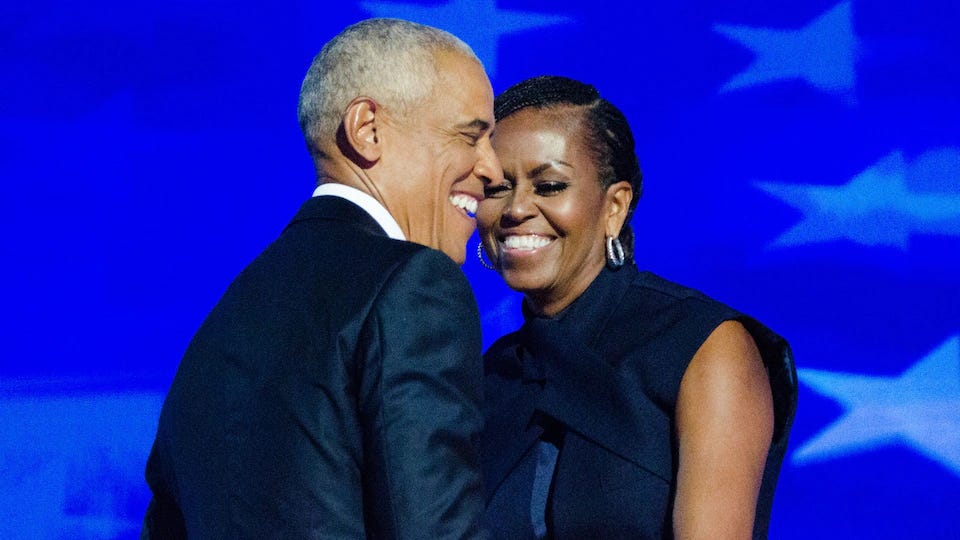
Called to Go Higher
When Dignity Becomes Witness: The Obamas and the Christian Response to Hatred
There are moments in the life of a nation when the contrast between barbarism and grace becomes so stark that it illuminates something essential about the human condition. Last week provided such a moment. On February 5, 2026, during Black History Month, President Donald Trump's Truth Social account shared a video depicting former President Barack Obama and former First Lady Michelle Obama with their faces superimposed on the bodies of apes—a racist trope with roots stretching back to the darkest chapters of American history, when such dehumanization was used to justify slavery and Jim Crow.
The backlash was swift and bipartisan. Senator Tim Scott, the only Black Republican in the Senate, called it "the most racist thing I've seen out of this White House."¹ Representative Mike Lawler termed it "incredibly offensive."² Even as the White House initially defended the post as an "internet meme," the weight of public condemnation—from Democrats and Republicans alike—eventually forced its removal. Yet Trump himself declined to apologize, saying only, "No, I didn't make a mistake."³
Such a depiction coming from the highest office in the land represents more than a lapse in judgment; it is a degradation of the office itself, a disgrace to the presidency of the free world. As Proverbs 11:9 reminds us, "With their mouths the godless destroy their neighbors, but through knowledge the righteous escape." Words and images have power. They have the power to build up or tear down, to unite or divide, to honor the image of God in others or to desecrate it.
What strikes me most profoundly about this incident is not the offense itself, we have, sadly, become accustomed to such provocations, but rather the response, or more precisely, the non-response, of the Obamas themselves. While lawmakers from both parties issued statements, while civil rights leaders condemned the imagery, while the nation engaged in yet another exhausting debate about racism and presidential conduct, the Obamas remained conspicuously silent. Barack Obama's only public statement in the days following came in a post about the Winter Olympics: "To all the athletes representing TeamUSA: I'm so proud of you."⁴
This silence is not weakness. It is the embodiment of a principle Michelle Obama articulated nearly a decade ago, one that has become a proverb in its own right: "When they go low, we go high." In a recent interview, Mrs. Obama clarified that this philosophy is not about passivity but strategic intentionality. "Going high is about being strategic," she explained. "That doesn't mean you don't feel it emotionally. That doesn't mean you don't get angry, but our response needs to have a goal beyond just being angry. I don't want to waste my anger."⁵
In their measured silence, in their refusal to respond to the searing white hot sin of hate, or every godless and unregenerate insult, the Obamas model something increasingly rare in our public discourse: a pure Christian deportment. I do not claim to know the state of their worship, that is between them and God. But I can recognize the outward manifestation of their walk. We should know Christian principles when we see them lived out. And what we see in the Obamas' response is precisely what scripture calls believers to model.
The Biblical Template for Dignity Under Fire
Jesus himself taught this counterintuitive ethic. In Luke 6:35, he instructs his followers: "But love your enemies, do good to them, and lend to them without expecting to get anything back. Then your reward will be great, and you will be children of the Most High, because he is kind to the ungrateful and wicked." This is a confusing and hard teaching, one that runs contrary to every instinct of self-defense and retaliation that courses through our veins.
Yet Jesus doubles down on this teaching in Matthew 5:11: "Blessed are you when people insult you, persecute you and falsely say all kinds of evil against you because of me." Notice that Jesus does not say "if" people insult you, but "when." He assumes that his followers will face contempt, that the world will hurl its worst at those who bear his name. The blessing comes not from avoiding such treatment but from responding to it with a grace that transcends human understanding.
Peter, who himself experienced brutal persecution, offers further guidance in his first epistle. In 1 Peter 3:16, he writes: "keeping a clear conscience, so that those who speak maliciously against your good behavior in Christ may be ashamed of their slander." The Greek word translated as "conscience" here is syneidēsis, which literally means "co-knowledge", a consciousness that we are being observed not just by other people but by God himself. It refers to that inner witness that testifies to the alignment between our professed values and our actual conduct.
What does this look like in practice? It looks like maintaining dignity when dignity is denied. It looks like refusing to descend into the mud even when others fling it at you. It looks like understanding that our character is shaped not by what happens to us but by how we respond to what happens to us. Peter's logic is profound: when we maintain good conduct in the face of slander, we eventually shame those who attack us. Not by matching their vitriol, but by maintaining a composure that exposes the emptiness of their accusations.
This principle matters immensely to our witness to the world. The watching world, skeptical, cynical, often hostile, judges Christianity not by our doctrinal statements but by our lived example. When Christians respond to hatred with more hatred, to insult with insult, to barbarism with barbarism, we confirm the world's worst suspicions about our faith. We demonstrate that our gospel is merely tribal loyalty dressed in theological garb. But when we respond to evil with good, to curse with blessing, to contempt with dignity, we point to something transcendent, a power not our own that transforms human nature from the inside out.
The Witness of Restraint
The Obamas serve as an unlikely but illuminating case study in this Christian ethic. They have endured years of attacks that would break most people: the birther conspiracy that questioned Barack Obama's very legitimacy as an American; the countless racist caricatures; the relentless questioning of Michelle Obama's femininity and dignity; and now this latest indignity, during Black History Month no less, depicting them as subhuman.
Through it all, they have largely refused to engage. Not because they lack the means to fight back, Barack Obama commands global platforms and Michelle Obama's voice could rally millions, but because they understand something profound about power: that true strength lies in self-control, not self-assertion. They seem to grasp what the ancient Stoics knew and what Christianity perfected: that we cannot control what others do to us, but we can control how we respond.
This restraint is not natural. It is cultivated. It requires what the old saints called "mortification", the deliberate putting to death of our worst impulses. In our age of instant social media responses, of clapbacks and dunks and viral takedowns, the discipline of silence is revolutionary. It says: I will not let your hatred set the terms of my life. I will not let your contempt determine my conduct. I will not give you the satisfaction of dragging me down to your level.
This is what makes the Obamas' example particularly instructive for Christians in our current moment. We live in a time when the loudest voices in Christian public life often seem the angriest, when partisan fury frequently trumps spiritual fruit, when the line between Christian witness and political combat has become perilously blurred. The Obamas, whatever their personal faith commitmentsdemonstrate through their public conduct what Christian deportment is supposed to look like: measured, dignified, oriented toward long-term moral credibility rather than short-term emotional satisfaction.
Growing Toward Christ-Like Deportment
So how do we grow toward this kind of character? How do we learn to embody the biblical principles we profess? Here are several practices worth cultivating:
First, we must practice the discipline of delayed response.
In the age of social media, the pressure to react immediately is immense. But wisdom requires reflection. Before responding to an attack or insult, we should ask ourselves: What am I trying to accomplish? Will this response build or destroy? Am I acting from strength or from woundedness? The discipline of waiting, even just 24 hours, can transform our interactions.
Second, we must remember that we are always on display.
This is not paranoia but biblical realism. Our lives are "letters from Christ...known and read by everyone" (2 Corinthians 3:2-3). The world watches how Christians handle adversity, disappointment, and malice. Our witness is most powerful not when we're preaching from a position of strength but when we're suffering from a position of weakness—and still maintaining grace.
Third, we must cultivate what the Bible calls "long-suffering" or patience.
This is not a passive resignation but an active choice to endure difficulty without becoming bitter. It requires us to take the long view, to understand that vindication often comes slowly, that character is built through repeated choices over years, not through single dramatic moments.
Fourth, we must learn to distinguish between justice and vengeance.
The Bible commands us to pursue justice, to speak up for the oppressed, to confront wickedness, to stand against evil. But it also commands us to leave vengeance to God. This is a crucial distinction. We can work for justice while refusing to nurse grudges. We can confront wrong while maintaining personal dignity. We can pursue accountability while extending grace.
Finally, we must recognize that our ultimate audience is God, not people.
When we understand that we will give an account to God for how we've lived, for how we've loved our neighbors and our enemies, it changes everything. We stop performing for human approval and start living with an audience of One. This is the meaning of syneidēsis, that co-knowledge with God that Peter speaks of. When we know that God sees everything, that nothing is hidden from his sight, we become less concerned with winning arguments and more concerned with maintaining integrity.
What This Means for the Lost and the Nation
The stakes of our conduct are higher than we often realize. For the lost, those outside the faith, our behavior is often the only Bible they will read. When they see Christians responding to hatred with more hatred, matching insult with insult, they conclude that Christianity offers nothing transformative, nothing that couldn't be found in any political ideology or tribal allegiance. But when they see Christians maintaining dignity under fire, extending grace to enemies, refusing to be diminished by those who attack them, they encounter something genuinely countercultural. They glimpse the kingdom of God breaking into this broken world.
For the nation, the witness of Christian character offers something desperately needed: a vision of citizenship that transcends partisan warfare. Our country is tearing itself apart precisely because we have lost the ability to disagree without dehumanizing, to oppose without demonizing, to fight for our convictions while maintaining our humanity and recognizing the humanity of our opponents. Christians should be leading the way in modeling a better path, not because we're better people, but because we serve a Lord who commands us to love our enemies and pray for those who persecute us.
The tragedy of last week's incident is not just that a racist video was shared from the presidential account—though that is tragic enough. The deeper tragedy is that such incidents have become routine, that we have normalized the abnormal, that cruelty and contempt now pass without serious consequence. In such a moment, the example of those who refuse to participate in the degradation becomes all the more vital.
The Obamas are not perfect, no one is. They are not called to be our moral exemplars in every respect. But in this particular dimension of public life, in their refusal to answer every attack, in their commitment to maintaining dignity when dignity is denied, they offer a template worth studying and, dare I say, emulating. I'm preaching to myself now.
This is what it means to go high when others go low. Not to be silent in the face of injustice, but to respond to injustice in ways that heal rather than harm, that build rather than destroy, that witness to a kingdom not of this world. It means remembering that our ultimate calling is not to win arguments but to bear witness—to lives transformed by grace, to souls that have learned to love enemies, to consciences kept clear before God and man.
In the end, this is the only kind of witness that endures. Political victories are temporary; partisan triumphs are fleeting. But the testimony of a life well-lived, of grace extended in the face of hatred, of dignity maintained when dignity is denied, this echoes into eternity. This is the calling of every Christian, in every age, in every circumstance: to be people of the high road, even when the low road beckons, even when the cost is great.
The Obamas remind us, through their silence and their measured responses over the years, that there is a better way. Not an easier way, nothing about this path is easy. But a better way. A way that honors the image of God in all people, including those who attack us. A way that keeps our conscience clear and our witness credible. A way that, in the fullness of time, shames injustice not through retaliation but through righteousness.
This is the way of Christ. This is the call to go higher. May we have the grace to follow it.
---
Footnotes:
1. Gomez, Justin et al. "Trump says he didn't see full racist video before it was posted, says he won't apologize." ABC News, February 6, 2026. https://abcnews.go.com/Politics/trump-shares-video-includes-racist-depiction-obamas-sparking/story?id=129918626
2. Gomez, Justin et al. "Trump says he didn't see full racist video before it was posted, says he won't apologize." ABC News, February 6, 2026.
3. Colarossi, Natalie and Contreras, Russell. "Trump says 'I didn't make a mistake' after racist video of Obamas removed." Axios, February 6, 2026. https://www.axios.com/2026/02/06/trump-racist-video-barack-michelle-obama-truth-social
4. "Obama Breaks Silence After Trump's Racist Video." Creebhills, February 8, 2026. https://creebhills.com/2026/02/obama-breaks-silence
5. "Michelle Obama Updates Her Iconic 'When They Go Low, We Go High' Philosophy: 'Be Strategic, Not Just Mad.'" Shine My Crown, August 15, 2025. https://shinemycrown.com/michelle-obama-updates-her-iconic-when-they-go-low-we-go-high-philosophy-be-strategic-not-just-mad/


