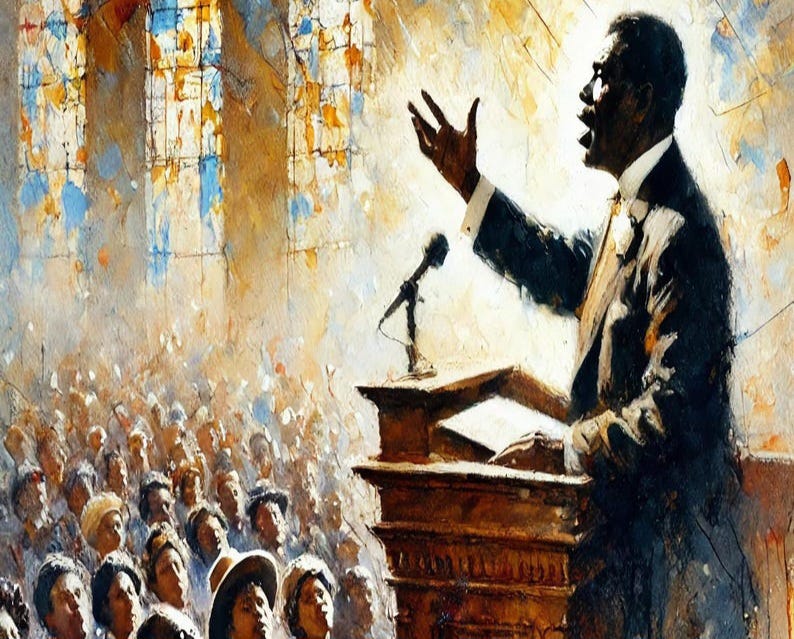
Distinguished Gentleman: Statesman of the Pulpit
On the Office, the Vessel, and the Word That Would Not Return Void
There is a particular kind of person who does not merely speak about God but speaks for God, who does not simply announce the news of heaven but stands as its credentialed representative in the geography of human suffering. This was the pastor-statesman. And before we mourn his passing or celebrate his memory, we must understand who he was in the most fundamental sense: he was an ambassador.
The Apostle Paul captures the weight of this office with startling economy in 2 Corinthians 5:20: "Now then we are ambassadors for Christ, as though God did beseech you by us: we pray you in Christ's stead, be ye reconciled to God." The Greek word is presbeuomen, to serve as an elder representative, a plenipotentiary of the heavenly court. The preacher does not stand in the pulpit as a motivational speaker, a community organizer, or a purveyor of good feelings. He stands as the living, breathing emissary of the Most High God.
But this ambassadorship is clothed in peculiar humility. The preacher carries infinite treasure in a cracked and common vessel. Paul again, in 2 Corinthians 4:7: "But we have this treasure in earthen vessels, that the excellency of the power may be of God, and not of us." The Greek ostrakinos, a clay pot, a disposable household item of Roman antiquity, becomes Paul's metaphor for the minister. God does not use marble monuments but breakable jars. The ambassador of heaven is, by design, conspicuously mortal. This is not an accident of theology. It is the genius of a sovereign God who insists that the glory belong to him.
WHAT HE CARRIED: THE MESSAGE THAT OUTLASTS THE MESSENGER
The pastor-statesman did not represent himself. He represented a gospel, a euangelion, good news so comprehensive and so subversive of every earthly pretension that no human system has ever been able to contain it. In Isaiah 61:1, the prophet announces the anointing that would reach its fullest expression in the person of Jesus of Nazareth, who in Luke 4:18 stood in the synagogue at Nazareth and read that same passage back to a stunned congregation: "The Spirit of the Lord is upon me, because he hath anointed me to preach the gospel to the poor; he hath sent me to heal the brokenhearted, to preach deliverance to the captives, and recovering of sight to the blind, to set at liberty them that are bruised."
The men whose lives illuminate these pages understood that they were carriers of this very proclamation. The Reverend Dr. Manuel L. Scott, Sr., whose sermons possessed a poetic brilliance matched by few in any generation, understood the gospel not as a sedative for the suffering but as dynamite in the hands of the dispossessed. Named twice among America's fifteen greatest Black preachers, Scott preached with the precision of a surgeon and the passion of a prophet, serving Calvary Baptist Church of Los Angeles for thirty-three years and St. John Baptist Church in Dallas for thirteen more. His gospel had geography. It had address. It showed up in the ghetto and announced that the Nazarene had been there first.
The Reverend Dr. A. Louis Patterson, Jr., whom his peers called the "Godfather" of expository preaching in African-American circles, understood that what the preacher represents is not a philosophical system but a person. Patterson, who served Mount Corinth Missionary Baptist Church in Houston for forty-four years and was recognized five times as a living legend among his colleagues, preached a Christ so concretely biblical that to hear him was, as one colleague wrote, "like standing under a refreshing waterfall of biblical wisdom." His three books, Prerequisites for a Good Journey, Joy for the Journey, and Wisdom in Strange Places, chart the terrain of a man who understood that the minister is the keeper of the Word that will not return void (Isaiah 55:11).
The pastor-statesman did not represent an institution or a denomination. He represented a rescue mission still underway, a kingdom breaking into history from above.
The Reverend Dr. C. A. W. Clark, Sr., of Good Street Baptist Church in Dallas, who preached at the Houston Astrodome to forty thousand souls, represented in his compact five-foot frame the paradox of the kingdom: that the least shall be great (Matthew 20:26), that God confounds the wisdom of the world through the foolishness of preaching (1 Corinthians 1:21). Clark spent fifty-eight years at Good Street, founding credit unions and day-care centers and legal clinics, conducting forty revivals a year even as he shaped the civic infrastructure of a major American city. He represented what the church at its finest has always represented: the single institution in a fallen world that answers to a higher authority than any government or market can provide.
HOW HE STOOD: THE DEPORTMENT OF THE STATESMAN
The question of how the pastor-statesman represented God is inseparable from the question of how he conducted himself in the world. The preacher's character was not incidental to his message. It was, in a very real sense, the message's first sermon.
Ezekiel 33:7 is unsparing in its demand: "So thou, O son of man, I have set thee a watchman unto the house of Israel; therefore thou shalt hear the word at my mouth, and warn them from me." The watchman is not free to be careless in his private life while alarming in his public proclamation. He is set, appointed, positioned at the wall. His posture matters. His attentiveness matters. His courage matters enormously, because the safety of those inside the city depends on his unwillingness to be either distracted or intimidated.
Gardner Calvin Taylor, grandson of emancipated slaves and born in Baton Rouge in 1918 into the heat of a segregated South that treated Black humanity as negotiable, never allowed the contempt of that world to diminish the dignity of his calling. Time magazine named him one of the seven greatest preachers in the country in 1979. Baylor University's survey in Newsweek identified him among the twelve most effective preachers in the English-speaking world. President Bill Clinton awarded him the Presidential Medal of Freedom in 2000. But Taylor's most remarkable credential was not a citation or an award. It was forty-two years of faithful pastoral presence at Concord Baptist Church, marrying the couples, burying the dead, counseling the despairing, and Sunday after Sunday opening the Word of God with the authority of a man who had himself been broken and mended by it. When Gardner C. Taylor rose in the pulpit of Concord Baptist Church of Christ in Brooklyn and the great organs of his voice shook the rafters of Bedford-Stuyvesant, men and women did not go home marveling at Taylor. They went home awed by Taylor's God. The earthen vessel is transparent. The treasure shines through precisely because the clay cannot produce it on its own.
The Reverend Dr. Harry S. Wright, Sr., who served at Cornerstone Baptist Church in Brooklyn and whose tenure at Bishop College shaped generations of America's finest pulpiteers, four of whom would become presidents of national Baptist conventions, modeled what (1 Peter 5:2-3) demands: oversight not by compulsion but by genuine willingness, leadership not as domination but as example. Wright understood that how a man comports himself in the classroom, in the community, in the corridors of institutional power, is not separate from how he preaches but is its extended text. His students did not merely learn homiletics. They watched a man who meant what he said.
The Reverend Dr. J. Harrison Jackson, who led Olivet Baptist Church on Chicago's South Side from 1941 until his death in 1990 and who served as president of the National Baptist Convention for nearly three decades, was a figure of towering institutional seriousness, a missionary, diplomat, scholar, and churchman whose papers now constitute one of the most significant archives of African-American religious life in the twentieth century. He governed with gravity, that he considered the office of pastor-statesman to demand of its occupants something more than the ordinary, that the preacher must be, as (1 Timothy 3:2) insists, "blameless, the husband of one wife, vigilant, sober, of good behaviour, given to hospitality, apt to teach." Jackson was, above all, a man who took the pastoral office at its full weight.
THE PREACHER AND HIS PEOPLE: FROM BONDAGE TO BALLOT
To understand what the pastor-statesman meant to Black Americans across the arc of their sojourn in this republic is to understand something irreducible about the relationship between the gospel and the condition of the oppressed.
During the long horror of American chattel slavery, the enslaved people of this nation were systematically denied every institution of civil society. They could not own property, form contracts, testify in courts, or assemble freely. They had no newspapers, no political parties, no civic organizations that could survive the scrutiny of their captors. What they had, often in secret, hidden in the brush arbors and praise houses of the antebellum South, was the Word of God and the preacher who dared to preach it without sanitizing its revolutionary contents.
The same Exodus that became the liturgical center of the spirituals, "Go Down, Moses," was not a safe theological abstraction for the enslaved. It was a political manifesto. The God who heard the groaning of Israel in Egypt (Exodus 2:24) and sent Moses to Pharaoh's court was the same God who, they believed, was watching the auction blocks of Charleston and the cane fields of Louisiana. The preacher in the hush harbor was not merely offering comfort. He was maintaining a vision of human dignity that the entire machinery of the slave system was designed to extinguish. Acts 10:34 was radical theology in that context: "God is no respecter of persons." That sentence, faithfully preached, was an act of defiance.
"Is not this the fast that I have chosen? to loose the bands of wickedness, to undo the heavy burdens, and to let the oppressed go free, and that ye break every yoke?" (Isaiah 58:6)
During Reconstruction, when the brief and brutal experiment of Black political participation was being dismantled by terrorism and legislative chicanery, the Black pastor became what no other institution could be: a source of educated leadership, civic formation, and moral vision. The church was the school, the bank, the courthouse, the senate chamber, and the sanctuary all at once. The preacher who mounted the pulpit on Sunday morning was, by Monday afternoon, negotiating with city councils, writing petitions, organizing mutual aid societies, and training a generation of leaders who had no other pipeline to social capital.
During the Civil Rights Movement, Rev. Caesar Clark opened the doors of Good Street Baptist Church to King himself in 1956. Rev. A. Louis Patterson fought for human dignity from his Houston pulpit even as he mentored a generation of young pastors in the craft of expository faithfulness. These men understood that Micah 6:8, "to do justly, and to love mercy, and to walk humbly with thy God," was not a suggestion available to comfortable Baptists on pleasant Sunday mornings. It was the marching order of the covenant community.
The Black pastor was not merely a preacher. He was the keeper of his people's memory, the custodian of their dignity, and the interpreter of their suffering in the light of a God who had promised not to abandon them.
The deportment of these men inspired generations precisely because it was recognizably costly. They were not wealthy men performing religiosity from a safe distance. They were shepherds who smelled like the sheep, who visited the hospital at midnight, who sat with the widow in her grief, who challenged the mayor on Monday morning and knelt in prayer on Monday night. They commanded the scriptures and the gospel's message of hope not as inherited intellectual property but as the hard-won conviction of men who had tested the Word in the furnace of their own experience and found it unburnable.
THE DIMINISHMENT: WHEN THE OFFICE LOST ITS GRAVITY
Something has happened in recent years to the public perception of the preacher, and it would be dishonest to pretend otherwise. The television camera, social media platforms, and the prosperity gospel's grotesque inversion of the biblical witness have conspired to produce a version of the minister that the saints of previous generations would not recognize and might not be willing to occupy the same room with.
The pastor is now, in too many quarters, primarily a personality, a brand, a content creator whose theological convictions are calibrated to maximize engagement rather than to confront sin and announce grace. The earthen vessel has become the exhibition. The treasure inside it has been renegotiated. The watchman of Ezekiel 33 has, in some corners of the visible church, descended from the wall to sign autographs in the courtyard below. Paul warned Timothy that the time would come when people "will not endure sound doctrine; but after their own lusts shall they heap to themselves teachers, having itching ears" (2 Timothy 4:3). What Paul described as a future danger has, in measurable ways, become a present condition.
"For they being ignorant of God's righteousness, and going about to establish their own righteousness, have not submitted themselves unto the righteousness of God." (Romans 10:3)
This is not primarily a cultural crisis, though it has cultural dimensions. It is a theological crisis. When the preacher loses his sense of ambassadorial accountability, when he forgets that he will give an account not to his congregation's approval ratings but to the God who called him, the office hollows out and what remains is performance. The congregation is no longer being fed; it is being entertained. The difference, as Taylor and Clark and Patterson and Scott understood, is the difference between a shepherd and a showman.
THE MERCY OF THE CLAY: WHY GOD STILL SENDS PREACHERS
And yet the Word of God endures. The treasure has not evaporated because the vessels have sometimes cracked. God, who could fill the earth with the knowledge of his glory through angels or burning bushes or handwriting on walls, has chosen, in his sovereign and somewhat baffling mercy, to do it primarily through preachers. Through human beings. Through earthen vessels.
Paul asks in Romans 10:14: "How then shall they call on him in whom they have not believed? and how shall they believe in him of whom they have not heard? and how shall they hear without a preacher?" The chain of salvation that Paul traces through Romans 10 is not the chain of religious programming or digital content or inspirational posting. It is the chain of the proclaimed word, the living human voice, the body in the pulpit who stands between a holy God and a fallen world and says: reconciliation is available. Come home.
God uses earthen vessels because the incarnation itself was an earthen venture. The eternal Son of God took on flesh, tabernacled among us, grew tired and hungry and weary, wept at a tomb in Bethany, bled at Golgotha. John 1:14 is the original defense of the earthen vessel: "And the Word was made flesh, and dwelt among us, and we beheld his glory." Every preacher who mounts the steps to a pulpit is, in some measure, participating in the scandal of the incarnation: the infinite condescending to reach the finite through the medium of the mortal.
And this is why, in our own diminished hour, the recovery of the pastor-statesman is not a project of nostalgia. It is a project of faithfulness. The same God who called Taylor from Baton Rouge and Clark from Shreveport and Patterson from Granger, Texas and Scott from Waco and Jackson from Rudyard, Mississippi is still calling men and women from every unlikely geography. He is still looking for earthen vessels that will not mistake themselves for the treasure, still searching for watchmen who will not leave the wall, still sending ambassadors who understand that the word they carry is not their own.
The pastor-statesman becomes, in death, what he had always been in life: a witness to the inexhaustible sufficiency of the Word of God.
Jeremiah heard it this way: "Before I formed thee in the belly I knew thee; and before thou camest forth out of the womb I sanctified thee, and I ordained thee a prophet unto the nations" (Jeremiah 1:5). The call precedes the vessel. The appointment precedes the appointment. God had preacher-statesmen in mind long before there were brush arbors or Brooklyn sanctuaries or Dallas megachurches or Houston revivals. He had in mind men who would carry the eternal in the temporary, the invincible in the fragile, the everlasting in the mortal.
The earthen vessels break eventually. Taylor at ninety-six. Jackson at ninety. Clark at ninety-three. Scott and Patterson, their voices now silent in this world. But the treasure does not break with them. It keeps shining through the next generation of cracked and called and consecrated clay.
That is the mercy of it. That is the audacity of God.


