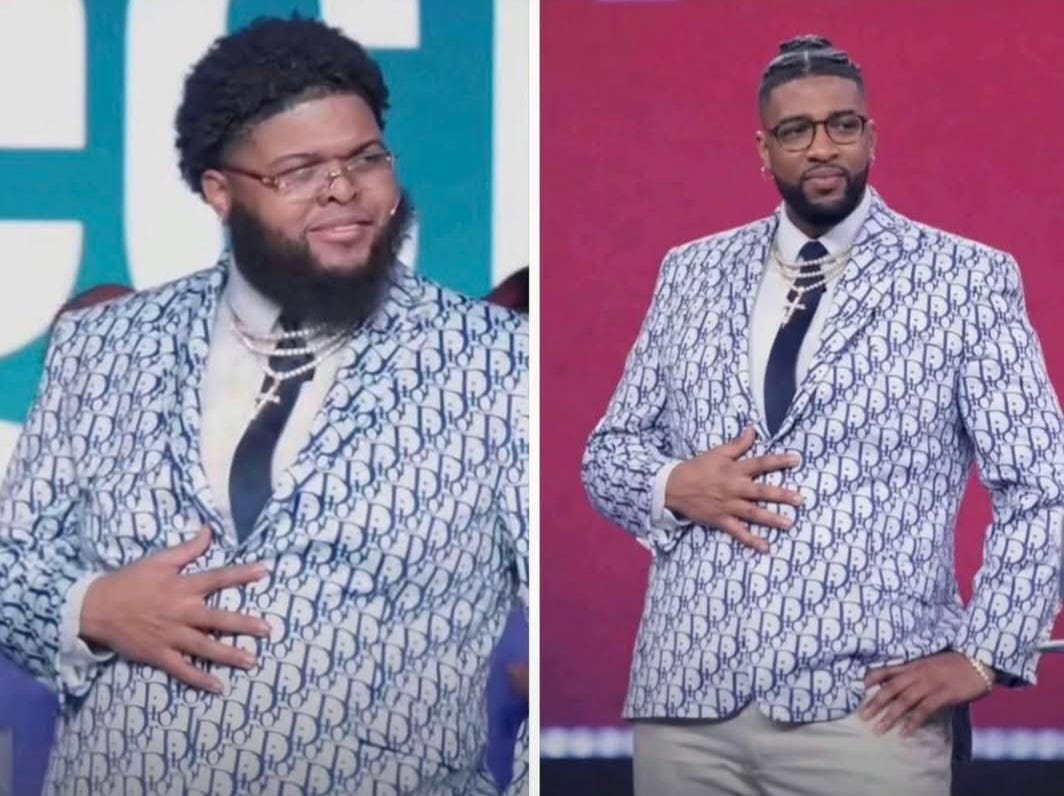
Druski And The Rebuke The Church Needed
When mockery becomes the response to moral authority, something profound has lost.
There's a particular quality to laughter that tells you everything about a culture's relationship with its institutions. It's not the laughter of recognition—the warm chuckle that says "I see myself in that." It's the laughter of dismissal, the kind that comes when something once sacred has become so transparently hollow that ridicule feels not cruel but necessary. This is the laughter now greeting the American church, and it echoed most recently through the millions who watched comedian Druski's devastating parody of megachurch culture.
In Druski's skit, which dropped on social media this week, he plays a megachurch pastor suspended by wires above his congregation, surrounded by smoke machines, draped in Christian Dior and Christian Louboutin. His fictional church is called "Collect & Pray," and he demands his congregation raise four million dollars before anyone can leave.[1]
He explains his designer wardrobe by noting the brands have "Christian" in their names, then flips his foot to show red-bottom soles: "I walk in the blood of Jesus."[2] The skit ends with the pastor counting cash backstage, then refusing to pray for a congregant who hasn't tithed. The video went viral not because it was outrageous, but because it was accurate. And that's the crisis.
The Weight of What Was
To understand what we're losing, we must remember what the church has been—particularly the Black church, which served as the beating heart of African American life when every other institution was hostile or closed.
During Reconstruction, when four million formerly enslaved people faced the impossible task of building lives from nothing, the Black church became the foundation of Black civil society. These churches created the first schools for Black children across the South, establishing educational networks that would educate tens of thousands by the 1890s. They formed burial societies when white-owned cemeteries refused Black bodies. They organized lending circles when banks wouldn't serve Black customers. They created mutual aid networks that functioned as informal government, providing services that white civic institutions systematically denied. The church wasn't where you went on Sunday; it was where you learned to read, where you pooled resources, where you built the infrastructure of dignity and survival.
The Civil Rights Movement elevated the church's moral authority to its apex. It was no accident that the movement's greatest orator was a reverend, that mass meetings convened in sanctuaries, that freedom songs were hymns. The church provided more than logistics—it provided the moral vocabulary that could call America to account. When Dr. King spoke from the steps of the Lincoln Memorial, he drew on a prophetic tradition that gave his words authority beyond personal charisma. He spoke with the weight of an institution that had earned its moral standing through generations of faithful service. The church could say to the nation: your laws may be unjust, but there is a higher law. Without that institutional credibility, the Civil Rights Movement would have been merely political calculation. With it, it became a moral crusade.
Even in recent memory, during the crack epidemic's devastation of urban communities in the 1980s and '90s, churches filled the void left by government abandonment. While policy oscillated between neglect and mass incarceration, urban congregations opened recovery programs, established after-school centers, and provided the community infrastructure that helped neighborhoods hold together through catastrophe. They did the unglamorous work of showing up, day after day, when no one else would. This history matters because it establishes what is now being squandered through spectacle and scandal.
The Thirty-Year Unraveling
The collapse didn't happen suddenly. It has been a slow-motion train wreck spanning three decades, each scandal adding another crack to the foundation of credibility.
The televangelist implosions of the 1980s and '90s—Jim Bakker's fraud, Jimmy Swaggart's prostitution scandal, the private jets funded by Social Security checks—created the template. Perhaps, the public began to suspect, the whole enterprise was performance. Then came the prosperity gospel's full flowering, which transformed Christianity's teachings on sacrifice into guarantees of material wealth. Prayer became transaction, God became cosmic banker, and preachers promised that faith would yield dividends. The megachurch movement provided the stage for this theology of consumption, and suddenly pastors were celebrities with personal brands, leadership books, and stadium-sized audiences.
The Catholic Church's sexual abuse scandal delivered perhaps the most devastating blow to religious authority in modern American life. Here was not merely individual moral failure but systematic institutional corruption—the sacrifice of the most vulnerable to protect the institution's reputation. Trust, once broken at that level, doesn't easily rebuild.
For the Black church specifically, the scandals multiplied. Bishop Eddie Long's misconduct allegations. The ostentatious wealth of celebrity pastors—the private jets, the luxury cars in reserved parking spaces, the designer wardrobes worth more than most congregants earn in a year. Each scandal confirmed a pattern: this isn't aberration; this is the business model.
The past year alone has been particularly brutal. Atlanta rapper T.I. recently shared his opinion on Kirk Franklin's podcast that he doesn't believe the church is real, calling it "a business" and "like a show, like public speaking, like a TED talk," accusing clergy of twisting scripture for personal benefit. His comments went viral not because they shocked but because they resonated.
Then came what the internet dubbed "Dressgate." Pastor Jamal Bryant's wife, Dr. Karri Turner Bryant, wore a black-and-nude illusion gown to the United Negro College Fund's Mayor's Masked Ball, sparking intense online debate [3] about appropriate attire for a pastor's wife. The incident seems trivial until you realize what it represents: the church is now discussed with the same tone as reality television, where everything becomes spectacle and nothing remains sacred.
At the 2025 BET Awards, comedian Kevin Hart made Kirk Franklin's twerking "the butt of a joke," warning the gospel legend not to twerk onstage when accepting his Ultimate Icon Award adding: "The Lord didn't ask for that." A generation ago, mocking a gospel icon at a major awards show would have been unthinkable. Now it's just content, and the audience—including many churchgoers—laughed along.
Over the past twenty-five years, film and television have increasingly portrayed clergy as hypocrites, con artists, or buffoons. We've moved from respectful portrayals to savage satire, from characters who embodied moral authority to punchlines who embody moral bankruptcy.
The Pastor Who Made Mockery Easy
Which brings us back to Mike Todd, whose Transformation Church in Tulsa has become emblematic of everything wrong with celebrity megachurch culture. Todd went viral in January 2022 when he spat into his hand multiple times and rubbed it on a man's face during a sermon, attempting to illustrate that "receiving God's vision can sometimes be nasty." He later apologized, acknowledging it was "disgusting" and "a distraction."
But he didn't stop there. In 2024, Todd poured syrup and whipped cream over a Bible during a sermon about caring for one's body, prompting critics to note that everything happens with Bibles in church except reading them. His 2023 Easter service featured an extravagant production with demons discussing their physical features, characters pulling Jesus off the cross, and pyrotechnics designed to resemble hell—a spectacle that drew accusations of blasphemy even as defenders claimed hundreds were saved.
The pattern is clear: Todd has confused virality with ministry, mistaken social media engagement for spiritual transformation. His sermons are designed to trend, not to transform. Thus, when Druski created his megachurch pastor character, Todd was the obvious template. And that's the tragedy—not that the parody was unfair, but that it was so painfully accurate.
What the Laughter Means
Online reactions to Druski's skit were sharply divided, with one commenter writing: "He's not mocking God. He's mocking your pastors," while others felt it crossed a spiritual line. But the most telling responses came from those who laughed at first, then realized the joke only worked because the behavior felt believable.
This laughter of recognition is more dangerous than hostility. It signals that the battle for credibility is already lost. When mockery feels appropriate rather than cruel, when satire cuts because it's true, the institution being mocked has forfeited its moral authority.
The immediate consequence is evangelistic paralysis. How do you invite someone to church when church has become a punchline? How do you speak of transformation when pastors are treated like reality TV personalities? Young people, particularly young African Americans, are leaving organized religion in unprecedented numbers. They grew up watching the scandals, seeing the prosperity gospel grift, observing the celebrity culture. They're not angry—they're just done.
But the crisis extends far beyond attendance numbers. Institutions aren't merely organizational structures; they're repositories of social trust and moral vocabulary. When an institution loses credibility, a society loses certain kinds of conversations, certain moral resources.
The Black church has historically provided a language for justice that transcends political calculation—a moral framework that could judge American society by standards higher than its own laws. When Dr. King spoke, he drew on a prophetic tradition that gave his words weight beyond personal charisma. What happens when that voice loses authority? We're left with only political power and economic interest as arbiters of right and wrong, stripped of the ability to make claims that transcend immediate self-interest.
For individuals, the loss is equally profound. Whatever one's theology, religious communities have provided social infrastructure that modern life hasn't replaced: intergenerational community, regular rhythms of gathering, frameworks for understanding suffering, practices of forgiveness and reconciliation. As church attendance declines, loneliness, anxiety, and social atomization rise.
The church, despite its many failures, provided something therapy, social media, and self-help culture haven't replicated: community bound by something beyond affinity, where you encountered the full spectrum of human life and practiced being human together. When we mock the church into irrelevance, we're not simply discarding outdated superstition. We're dismantling a form of social organization that served functions we haven't acknowledged and haven't replaced.
The Path Forward
The church's response cannot be defensive posturing or better branding. The mockery isn't baseless. The solution requires a fundamental return to what made the church credible: incarnational presence, sacrificial service, and authentic community.
First: abandon the celebrity pastor model entirely. Churches should be led by pastors whose lives are integrated with their congregations, whose children attend local schools, who are neighbors rather than celebrities. The prosperity gospel's promise that faith yields wealth must be replaced with Christianity's actual teaching about sacrifice and service to the vulnerable.
Second: return to works that build credibility—serving communities in tangible ways without self-promotion. The historical Black church was trusted because it share the gospel, met people where they were, and did uncompromising work when no one else would. Contemporary churches must ask: What are we actually doing beyond Sunday services? Are we addressing the importance of marriage (Hebrews 13:4), supporting the widow (1 Timothy 5:16) feeding and clothing those in need (Matthew 25:34-40), taking interest in the orphan (James 1:27)? Service without spectacle builds trust; spectacle without service deserves mockery.
Third: embrace radical financial transparency and structural accountability. Every megachurch should make available to tithing members an annual report of major ministry expenditures. The Pastor anf Elders should take seriously guarding pastoral integrity. Sunlight is the best disinfectant.
Fourth: recover the prophetic voice—speaking moral truth even when unpopular, even when it costs members or influence. The church's authority came from willingness to stand for principle against power. When churches become indistinguishable from partisan political operations or remain silent about injustice to preserve status, they sacrifice what made them matter.
Finally: accept what you have be entrusted with. The megachurch model assumes bigger is better, that influence is measured in attendance and followers. But the church's power has never been primarily in size but in depth—in the quality of community, the authenticity of transformation, the credibility of witness. A hundred people genuinely living differently because of their faith is more powerful than ten thousand watching a show.
Beyond the Punchline
Druski's skit is devastating because it's true. The church in America—particularly the visible, celebrity-driven version that dominates public perception—has become exactly what its critics claim: a business, a show, a con.
But here's what the laughter misses: despite everything, despite the scandals and the grift and the spectacular failures, there remain thousands of congregations doing the quiet work of community, churches that never make headlines because they're too busy actually serving. The question is whether these faithful remnants can reclaim the narrative, whether substance can outlast spectacle.
The church won't recover through better marketing or hipper worship or more viral moments. It will recover through the slow, unglamorous work of actually being what it claims to be: a community of broken people being made whole, serving the world not for applause but because that's what love requires.
The rebuke of laughter is a gift, if the church will receive it—a painful but necessary reminder that credibility must be earned through integrity, that authority flows from authenticity, that you cannot demand respect while living in ways that deserve mockery.
The path back from being a punchline to being a moral force requires something simple and impossibly difficult: the church must become, once again, what it was always meant to be. Not a show, not a business, not a celebrity platform—but a community of people taking seriously the call to love God and neighbor, whatever the cost, whoever is watching. Until then, the laughter will continue. And perhaps it should.
___________________________________
1 https://thegrio.com/2026/01/13/druski-mega-church-skit-modern-black-church-debate/
2 Ibid
3 FOX 5 Atlanta. https://www.fox5atlanta.com/news/atlanta-pastor-jamal-bryant-speaks-out-wifes-gala-dress)


Druski’s skit is opening our eyes that the church is getting to be a joke. And a mockery. This should apply to celebrity christians too.
You really laid it down with the Path Forward. Another great piece!!!👏🏾👏🏾👏🏾