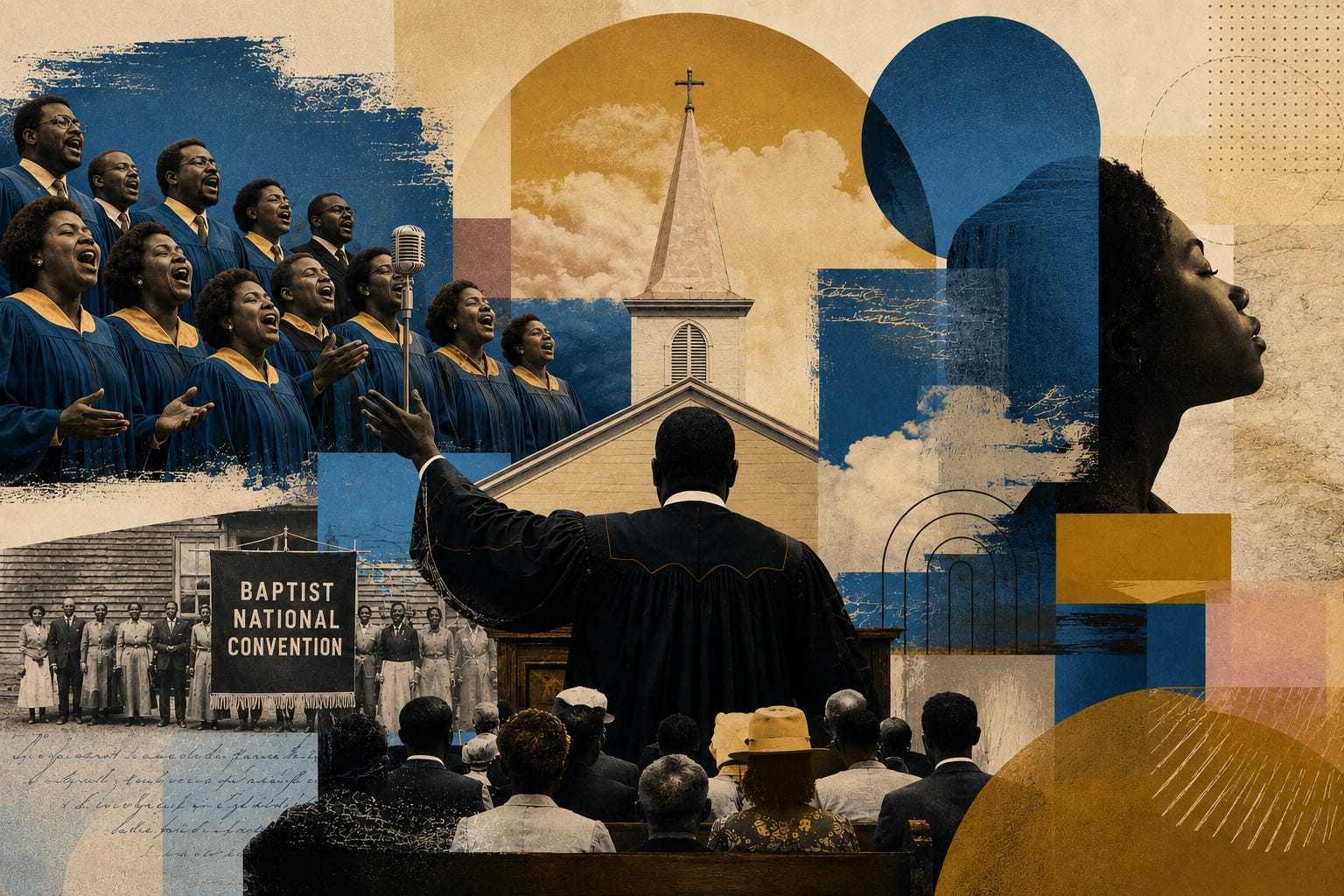
On a September day in 1895, in a church in Atlanta, a scattered and only recently freed people did something audacious. They built a national voice out of almost nothing. The national body cannot be everywhere, and it should stop trying to be. Its genius is not proximity but altitude, and to reclaim that genius we should first remember what it was built to do.
WHAT THE FOUNDERS BUILT
That day at Friendship Baptist Church, three older organizations, the Foreign Mission Convention of 1880, the American National Baptist Convention of 1886, and the National Baptist Educational Convention of 1893, merged into the National Baptist Convention and elected Elias Camp Morris its first president.1 Its stated objective was plain and expansive: to do mission work in the United States, in Africa, and elsewhere abroad, to foster the cause of education, and to promote the publication and circulation of religious literature.2 Within a year the Convention had founded its own National Baptist Publishing Board, so that Black Baptists could at last read Sunday school lessons and hymnals written by their own hands rather than depend on presses that had once slammed the door in their faces.3 This was a people building institutions of self-determination out of almost nothing: schools founded, missionaries sent, a national voice raised, and a publishing house that became one of the largest Black-owned enterprises in the nation. The altitude was the point.
CAST VISION, AND GUARD THE FAITH
Someone must lift eyes above the local horizon and name where the whole people is going. Scripture praises “the sons of Issachar, men who understood the times, with knowledge of what Israel should do” (1 Chronicles 12:32). A national convention that merely administers the past has failed. Its first task is to understand the times and tell the churches what to do. Its second, and higher, task is to guard the deposit of faith itself, to affirm, defend, and maintain adherence to the biblical, historic, orthodox teaching of the Christian faith. Jude did not think this optional:
Beloved, while I was making every effort to write you about our common salvation, I felt the necessity to write to you appealing that you contend earnestly for the faith which was once for all handed down to the saints. (Jude 3)
And here our tradition should stand taller than it does, for the orthodoxy we are called to defend is not a European imposition but, in no small part, an African achievement. The doctrine of the Trinity and the canon of Scripture were hammered out with decisive help from the African fathers: Tertullian of Carthage, who gave the Latin church its very vocabulary; Athanasius and Cyril of Alexandria; Cyprian of Carthage; and Augustine of Hippo, the North African bishop who remains the most influential theologian in Western history. To contend for orthodoxy is, for us, to reclaim an inheritance that was ours before it was anyone else’s.
TELL THE TRUTH ABOUT THE NUMBERS
A national convention should be the place where the churches are handed sober data about the state of Christianity in the West, so that no pastor is left to guess. The truth is bracing. The share of Americans identifying as Christian fell from roughly seventy-eight percent to sixty-four percent in a single decade.4 Christianity is now declining as a share of population across the whole Western world, with Europe the only region on earth where the absolute number of Christians is actually shrinking.5 And yet, in the same hour, the center of gravity of the global church has swung decisively south. Sub-Saharan Africa, which held perhaps one percent of the world’s Christians in 1900, is now home to roughly a third of them, and its share is projected to keep climbing toward forty percent by mid-century.6 The faith is not dying. It is relocating. For a Black Baptist people whose spiritual and intellectual roots run straight back to Africa, this is not merely data. It is a summons.
THE NATIONAL-SCALE WORK
From that altitude the national convention should drive foreign and domestic missions initiatives worthy of the founders who first cooperated in order to reach Africa; fund scholarships for ministers and musicians, the two vocations we most need and most neglect; extend loans and grants for major congregational and community projects no single church could finance; and speak, with prophetic clarity and biblical grounding, through social-justice advocacy that carries forward the tradition of a church that was midwife to the freedom movement. The same body that once ran a corridor of the Underground Railroad has no business falling silent now.
To these I would add a few the founders could not have imagined but would have blessed: a denominational research and data office, so that we lead with knowledge rather than nostalgia; a church-planting arm that resources new congregations instead of merely mourning old ones; a national digital and media platform that gives our best preaching a reach the independents have monopolized for too long; and a serious theological-education fund to keep sound, historically grounded, Spirit-filled preaching flowing into our pulpits. Every one of these is simply the old objective of 1895, missions, education, and the circulation of sound literature, translated into the language of our own moment.
WHY IT MATTERS
What is at stake across this series is not an administrative wish list. It is whether the next generation of African American Baptists will inherit a living inheritance or the memory of one. The young pastor who wants the partnership without the politics is not asking for something novel. He is asking, without knowing it, for the thing the framework was invented to be in 1834: a cord of three strands, a body with connected members, a fellowship that lifts the one who falls. He has been handed a machine, and he is asking for a family. That is not too much to ask.
The structures are not sacred; the mission is. Scaffolding that no longer serves the building should be rebuilt without sentimentality. But the mission underneath, the gathering of small and vulnerable churches so that together they can educate, evangelize, and endure, is as urgent now as it was on the day free Black Baptists first knit their churches into a road to freedom. The Lord’s promise over that whole enterprise has not expired: “I will build My church; and the gates of Hades will not overpower it” (Matthew 16:18). He will build it. The only question on the table is whether we will still be building alongside Him, together, or each of us alone. He has been handed a machine, and he is asking for a family. That is not too much to ask.
___________________
NOTES & SOURCES
Scripture quotations are taken from the New American Standard Bible (NASB). Sources are listed in order of first appearance.
1. “National Baptist Convention of America International, Inc.,” Encyclopædia Britannica; “National Baptist Convention (1895– ),” BlackPast.org.
2. “About Us,” National Baptist Convention of America, Inc. (NBCA), quoting the 1895 constitutional objective.
3. “National Baptist Convention (1895– ),” BlackPast.org (founding of the National Baptist Publishing Board, 1896).
4. Pew Research Center, “How the Global Religious Landscape Changed from 2010 to 2020” (U.S. Christian identification declining from 78.3% to 64.0%).
5. Pew Research Center, “How the Global Religious Landscape Changed from 2010 to 2020” (Europe the only region with an absolute decline in the number of Christians).
6. Pew Research Center, “Projected Changes in the Global Christian Population” (sub-Saharan Africa’s share rising from 24% in 2010 toward 38% by 2050); “Sub-Saharan Africa is now the demographic center of global Christianity,” noting roughly 1% of the world’s Christians lived there in 1900.


