Moral Leaders Matter
Why Competence, Charisma, and Strategy Fail Without the Compass of Character
By Z.M.D. McGregor
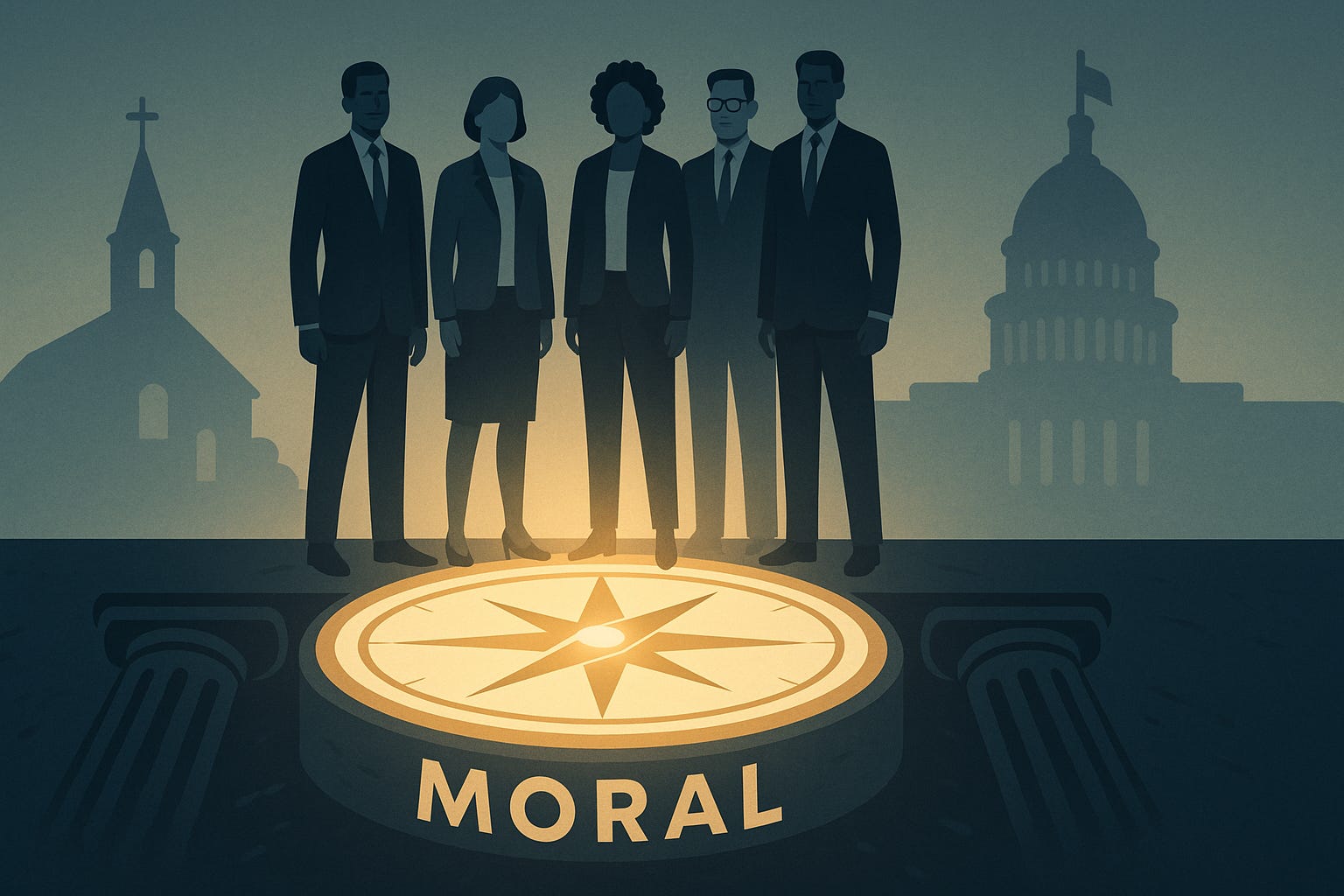
We live in an era starved for good leadership. The bookstore shelves are heavy with manuals about vision casting, strategic excellence, and the subtle art of networking. Corporate boards prize results; politicians tout charisma; even religious institutions have not escaped the spell of celebrity and performance. But beneath all these competing criteria for what makes a “great leader,” there remains one factor that endures when all the glitter fades: moral character.
And yet, what happens when the leader fails the character test? Who's responsible for the appointment? If we're honest, the surprise isn’t that leaders disappoint us; it’s that we’re still surprised. From the local school board to the halls of Congress, we hire, elect, or ordain people because they look impressive on paper — an Ivy League degree here, a quarterly earnings streak there, a zesty TikTok presence everywhere. Then a revelation about money, sex, or power snaps us awake, and we wonder why our institutions feel so brittle.
Consider three examples that reveal the divergent standards by which we often select our leaders.
First, in the corporate world, we have lionized figures like Elizabeth Holmes of Theranos, whose brilliant storytelling outshone the inconvenient reality that her technology did not work. Investors were seduced by the dream rather than anchored by due diligence. The criterion was audacity, not integrity.
Second, in politics, the last decade has seen a spate of leaders whose popularity stemmed less from policy acumen than from the ability to dominate the news cycle. We’ve witnessed candidates who converted social media spectacle into electoral success. The criterion was visibility, not virtue.
On the other end of the moral spectrum in politics stands Angela Merkel. Her 16-year stewardship of Germany was not electric; it was resolute, grounded in what colleagues call her “moral compass” — a deliberate devotion to human dignity that guided her through the euro crisis and the refugee surge. When fire-brands banked votes on fear, she staked her capital on compassion, proving that quiet rectitude can steady a continent.
Third, even in religious communities, leadership selection sometimes tilts toward rhetorical giftedness and outward success. A pastor with a swelling congregation may be elevated while warning signs of private misconduct go unheeded. The criterion becomes platform, not purity.
Earlier this year the Southern Baptist Convention mothballed its promised database of abusive pastors, fretting over legal fees and donor backlash. Survivors called the retreat “a hall of mirrors.” An institution founded to preach repentance could not muster the moral courage to name predators in its own ranks. [1]
And there it is. No sphere reveals this disconnect more painfully than the life of the church or a nation. While organizations can limp along under the burden of moral compromise, a community that entrusts itself to leaders without character is, over time, hollowed out from within.
Scripture spoke to this long before LinkedIn. Jethro advised Moses to appoint “capable men … men who fear God, trustworthy men who hate dishonest gain” (Ex 18:21). The apostle Paul told Timothy that an overseer “must be above reproach” (1 Tim 3:2), because a church’s credibility rests less on hermeneutics than on the integrity of those who teach them. Proverbs distills the civic implication: “When the righteous thrive, the people rejoice; when the wicked rule, the people groan” (Prov 29:2). Morality isn’t a private accessory; it’s public infrastructure. When moral leaders govern—whether a home, a congregation, or a country—people flourish. Trust multiplies. Hope gains traction. But when unscrupulous leaders ascend, cynicism spreads like a contagion.
That holds for nations as well as congregations. Democracies run on invisible fuel called trust. If citizens believe their leaders will exploit loopholes or wink at abuse, they retreat into cynicism, conspiracy thinking, and ultimately tribal rage. Markets seize, school boards fracture, pews empty. Conversely, when a chancellor spends political capital to protect refugees, or when a board chairman courageously publishes a database of abusers, the social fabric tightens. People exhale because virtue, not vanity, is steering the ship.
Moral character matters because it functions as a kind of internal ballast. When storms come—and they always do—leaders without moral weight drift wherever expediency blows. Leaders of character, however imperfect, have a center of gravity that stabilizes them and those who depend on them.
As citizens, church members, and neighbors, we are not powerless in this dynamic. We participate in it every time we choose whom to follow, whom to support, whom to platform. Each of us contributes to a culture that either rewards moral courage or merely celebrates outward success.
Choices have consequences. They ripple outward through institutions and generations. The leaders we select today become the examples our children will emulate tomorrow. So let us be vigilant, not merely about a leader’s competence or charisma, but about the quiet virtues—humility, honesty, compassion—that sustain communities over the long haul.
We therefore face an unsettling but liberating task: choose leaders as if character were the first line of the résumé, not the footnote. Voters must ask harder questions than “Will my taxes go down?” Elders must probe deeper than “Can he draw a crowd?” Investors must examine more than “Is the stock up?” The next recession, scandal, or geopolitical tremor will expose whatever is rotten beneath the veneer.
In the end, leadership is a moral multiplier. Good character amplifies competence; bad character weaponizes it. So whether you’re ticking boxes in a voting booth, a search committee, or a boardroom, remember: choices have consequences, and the most consequential choice is not skill, brilliance, or flash, but virtue.
The world is groaning under the weight of shallow leadership. It is time we prize the one thing that endures: moral character.
__________________
[1]:https://www.christianitytoday.com/2025/02/southern-baptist-abuse-database-pastors-ec-sbc/ "Southern Baptists Abandon Abuse Database - Christianity Today"


