

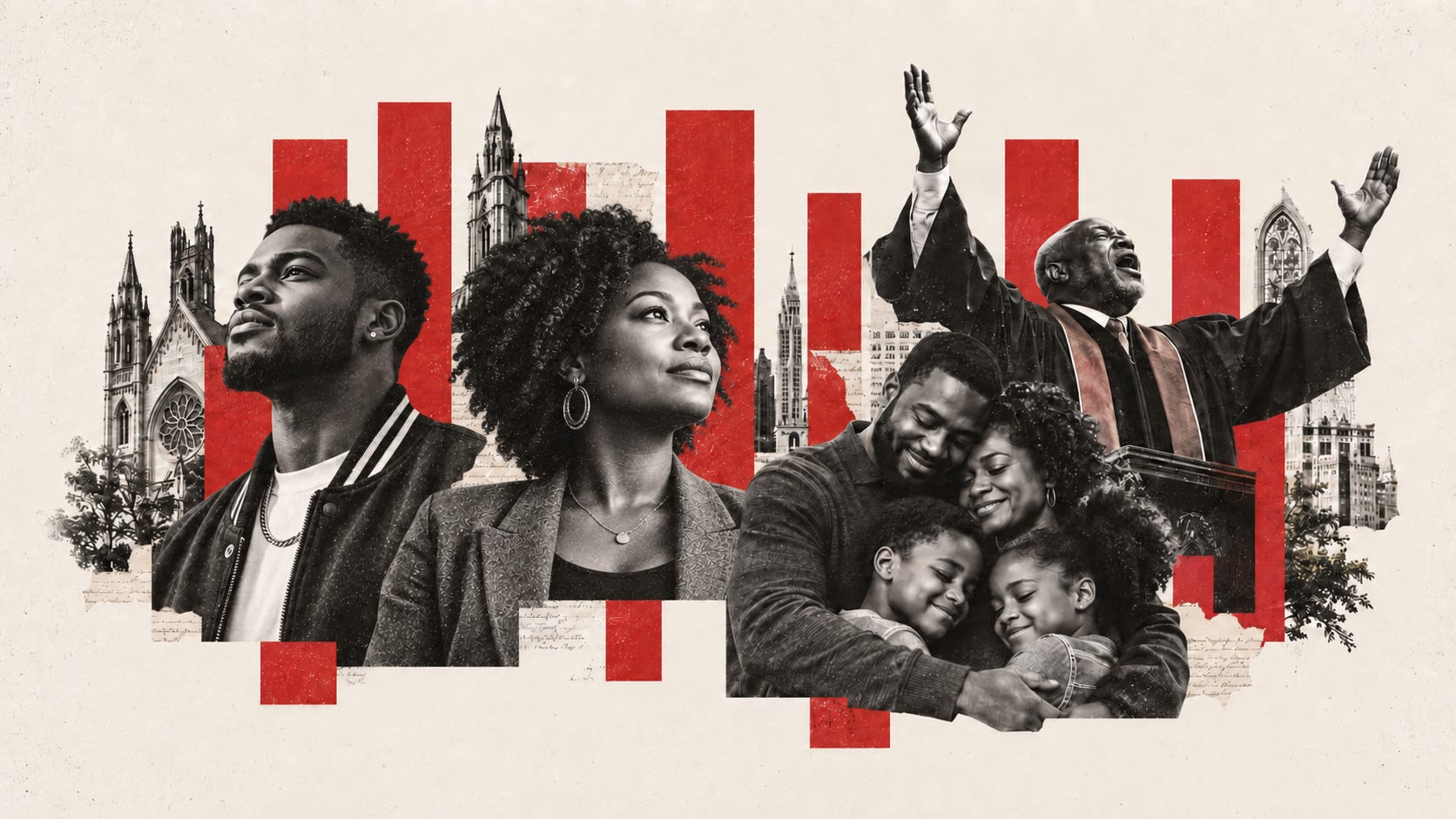
What happens to a tradition of prophetic witness when the prophets grow silent? I asked this question of a young man not long ago, a medical administrator in his early thirties, educated and gainfully employed in one of Cincinnati's largest healthcare systems. He had grown up in a historically African-American church, the kind where his grandparents had found refuge during some of the darkest chapters of American history. We sat and talked about his spiritual life, and he was honest in his assessment: "I don't know where the church stands anymore. I don't know if it stands at all."
His answer haunts me still. It captures something larger than one person's alienation from the very institution that once offered life and community to his ancestors. Across the country, an entire generation of African-American Christians who are educated, gainfully employed, and hold professional standing have found themselves adrift and estranged from the church they once called home. They watch as the structures that once prophetically proclaimed freedom now seem accommodating to those who would diminish it.
The question before us is not merely whether the Black church can survive, but whether it will reclaim its historic purpose and calling at a moment when African-American freedom hangs in precarious balance.
The Erosion We Are Witnessing
Over the past several years we have witnessed what can only be described as a systematic assault on the legal and social victories of the Civil Rights movement. What was once considered settled law now appears negotiable. Civil Rights legislation that cost this nation tremendous moral energy to establish has become a target of intentional dismantling. We have seen executive actions designed to undermine the very frameworks that protect African-American workers from discrimination. We have watched as African-American employees have been terminated from federal agencies and programs with a swiftness that suggests something more coordinated than mere policy adjustment. Educational initiatives designed to address historic educational disparities and create pathways for African-American students have been systematically defunded, eliminated, or prohibited.
This is not new oppression, but it is oppression. Repackaged in the language of merit, efficiency, and colorblindness, this oppression parades the unregenerate banner of searing white hot hate. The methods are different from those of previous eras, but the intent is unmistakable: to reverse the gains of those who fought and died for God equality to be rightly enforced under law.
What is perhaps most troubling is the deafening silence emanating from institutions that claim to speak prophetically for Christ. Trump evangelical pastors, who have built their movements on claims of biblical faithfulness and moral authority, have been largely absent from this conversation. They have not wept with those who weep. They have not called their political allies to account. They have not used their considerable platforms to challenge the racial animus that undergirds so much of contemporary political mobilization and sentiment.
This silence has created a vacuum filled by something far more sinister: the normalization of an empirical white nationalist movements that have become increasingly emboldened to speak openly about racial hierarchy and white supremacy. This movement has explicitly hijacked Christian language and symbolism, corrupting the biblical gospel to serve ethno-nationalist ends. They have found, in certain quarters of evangelicalism, not prophetic opposition but muted accommodation and, in some cases, explicit support despite being anti-Christian in their orthopraxy.
The African-American church, by contrast, has historically understood something fundamental about the gospel that much of American Christendom has forgotten: that Christ came to set captives free, to proclaim good news to the poor, and to establish a community where neither Jew nor Greek, neither slave nor free defines the boundaries of God's redemptive purposes.
Why the Black Church Remains Essential
There is a temptation, in moments like this, to rightly label white evangelicalism as a racist empirical religion, but to wrongly conclude that biblical Christianity has failed and to retreat into purely private spirituality. The young administrator who I spoke with had followed this logic to its conclusion. But to do so is to misunderstand both the history of African-American faith and the present crisis we face.
The Black church is not incidental to African-American freedom. It is foundational. During chattel slavery, the enslaved church offered resistance through worship that could not be controlled by slaveholders. During Jim Crow, the Black church provided community, education, medical care, and spiritual formation in spaces where African-Americans could imagine themselves as the beloved of God in a society that denied their humanity. During the Civil Rights era, the church provided not just the moral language but the spiritual discipline through which ordinary people summoned extraordinary courage.
This was not sentimentality. When African-Americans gathered for worship in local congregations, they gathered as people who had explicitly rejected the false gospel that had been used to justify their oppression. They gathered with the conviction that God's purposes could not be defeated by human malice, that their lives mattered to the divine order, and that freedom was not merely a political project but a spiritual necessity.
This communal practice of faith produced something remarkable: a generation of African-American leaders who understood themselves as accountable first to God and then to their community. The church created the conditions in which prophetic leaders could emerge. It produced the ministerial class that would champion civil rights. It sustained the discipline required to maintain nonviolence in the face of violence. It offered spiritual renewal in the midst of struggle.
When African-Americans remain disconnected from this historically grounded community of faith, they lose access to something that cannot be easily replaced: a tradition of prophetic witness, bible-based spiritual formation, a practice of corporate worship that affirms dignity, and a network of accountability that keeps leadership tethered to community needs rather than personal advancement.
The Current Vacancy and the Call to Leadership
For Black pastors and church leaders, this moment demands courageous reckoning. We must acknowledge that the contemporary Black church has not always retained the prophetic clarity of previous generations. We have, in some instances, become managerial in our approaches, focused on maintaining institutions rather than questioning their faithfulness. We have allowed political parties and personalities to substitute for prophetic witness. We have, in other words, accommodated ourselves to the world in ways that our forebears would have found troubling.
But we must also acknowledge something equally important: the infrastructure for change still exists. The Black church remains the largest voluntary association of African-Americans in this country. The Black pulpit remains one of the few platforms where African-American voices can speak with genuine authority to African-American communities. And the spiritual practices embedded in Black Christian worship remain generative sources of hope, resistance, and renewal.
This suggests that the present crisis calls for concrete strategic action. Black pastors must deliberately create entry points for re-engagement, particularly for the educated, professional class that has drifted from institutional religion. This means more than opening doors on Sunday morning. It means creating spaces where serious theological conversation can happen, where political allegiances can be questioned through the lens of biblical fidelity, and where professional skills can be put to work in service of the community.
It means developing mentorship relationships with young professionals who have resources, influence, and above all untapped spiritual gifts. It means creating task forces and teams where gifted African-Americans can contribute their expertise to congregational life and community problem-solving. It means, at times, creating alternative worship experiences that speak to the particular needs and idioms of educated adults while remaining rooted in the tradition.
The historic power of the Black church has always resided in its ability to forge unity around shared purpose. During the civil rights era, doctors and domestic workers, professors and sharecroppers, all found themselves gathered in the same sanctuaries, united by the conviction that freedom was worth the risk. This was not naive unity that papered over real, and superficial differences. But it was a unity forged through shared prayer, shared scripture study, and shared sacrifice.
What Scripture Teaches Us
In the opening of his ministry, Jesus proclaimed the purpose of his redemptive work in terms explicitly drawn from Isaiah: "The Spirit of the Lord is upon me, because he anointed me to preach the gospel to the poor. He has sent me to proclaim release to the captives, and recovery of sight to the blind, to set free those who are oppressed, to proclaim the favorable year of the Lord" (Luke 4:18, NASB).
This is not an incidental element of the gospel. The liberation of the captive, salvifically first, and as a result, every other way in which one could be held captive, is central to what Christ came to accomplish. The good news announced to the poor stands at the heart of the Christian proclamation. The recovery of sight to the blind speaks to the capacity to perceive reality truly, without the distortions imposed by those with power.
The Apostle Paul writes to the Galatian church with stunning clarity: "For you were called to freedom, brethren; only do not turn your freedom into an opportunity for the flesh, but through love serve one another" (Galatians 5:13, NASB). This is remarkable language. Paul does not counsel the Galatian Christians to accept their social station quietly. He affirms their freedom as a foundational reality of their identity in Christ. But he immediately qualifies this with a crucial directive: this freedom exists not for personal indulgence but for mutual service in community.
The Book of Exodus stands as the primary interpretive lens through which Jewish and Christian faith has always understood God's relationship to oppression. The God of the Bible is consistently portrayed as the liberator, the one who hears the cries of the enslaved, who remembers the covenant made to Abraham, and who acts decisively to break the chains that bind God's people. When Pharaoh attempts to prevent the Hebrew slaves from worshiping God, God acts with power to free them. The exodus becomes the paradigmatic narrative through which Israel interprets all of God's subsequent actions in history.
The African-American church has rightly recognized itself in this narrative. The enslaved preacher who proclaimed the exodus story was not simply repeating ancient history. He was asserting that the same God who freed the Hebrews from Egypt would free African-Americans from bondage. This is not an overreach or a misuse of Scripture. This is faithful interpretation that recognizes that God's commitment to human liberation is not bound to particular historical moments but flows from the divine character itself.
Furthermore, Scripture is insistent that the people of God must embody justice in their communities. The prophets of Israel spoke with devastating clarity against those who lived in luxury while exploiting the poor. Isaiah condemns those who "add field to field and join house to house until there is no more room, so that you have to live alone in the midst of the land" (Isaiah 5:8, NASB). Amos warns that God will not accept worship from those whose hands are stained with injustice (Amos 5:21-27). Micah summarizes the entire ethical demand of the Torah in these terms: "He has told you, O man, what is good; and what does the Lord require of you but to do justice, to love kindness, and to walk humbly with your God?" (Micah 6:8, NASB).
The church that gathers for worship while remaining silent before systemic injustice violates the most fundamental principles of biblical ethics. But equally, the church that understands itself as a community unified around the biblical commitment to justice and liberation gains access to spiritual resources that no social movement, no matter how well-funded or politically connected, can provide. Such a church offers what the world cannot: the conviction that God stands with the oppressed, that history moves toward justice, and that suffering itself can be redemptive when it is borne in union with Christ.
A Pathway Forward
What would it look like for the African-American church to deliberately pursue the reclamation of an entire generation of educated, professionally accomplished African-Americans? Such a strategy would need to operate on multiple levels simultaneously.
First, the pulpit must recover its prophetic voice. This means speaking directly and without apology to the political moment we inhabit. It means naming white supremacy explicitly and identifying the ways in which political platforms and personalities either advance or resist African-American liberation, and thus denying the truth of the gospel. It means refusing the false neutrality that suggests the gospel has nothing to say about the systematic reversal of civil rights protections. A pulpit that cannot distinguish between justice and injustice has abandoned its most essential calling.
Second, the Black church must create intellectual and theological communities where faith can be taken seriously as a framework for making sense of the world. Many educated African-Americans have drifted from the church because they experienced it as anti-intellectual, hostile to questions, and insufficient to the complexity of modern life. The church must prove this assessment wrong by creating Bible studies, theological seminars, and discussion forums where serious people can engage seriously with Scripture and tradition. These should not be dumbed down or simplified. They should assume intelligence, grapple with difficulty, and honor the questions that educated minds bring.
Third, the church must create concrete pathways for professional contribution. A young physician, an engineer, a businesswoman, a policy analyst brings gifts that the church desperately needs. These individuals should not be relegated to fundraising committees and greeting teams. Rather, the church should intentionally deploy their expertise in service of community health initiatives, in planning and facilities, in advocating for justice, in strategic institutional development. When professionals see their work being taken seriously and deployed in service of the church's mission, they experience themselves not as ancillary contributors but as essential partners in God's purposes.
Fourth, the church must honestly reckon with its own complicity and move toward genuine reform. This requires more than apologies. It requires examining the ways in which patriarchy, homophobia, and classism have compromised the church's witness to liberation. It requires disciplining leadership that has turned the pulpit into a personal platform or that has compromised the church's prophetic voice for political access. It requires distributing power more widely and creating accountability structures that prevent the concentration of authority in individual charismatic figures.
Finally, the strategy must operate through relational networks. The professional African-American who has drifted from the church will not return because of a slick marketing campaign or a contemporary worship service. She will return because a pastor she trusts, or a friend she respects, or a mentor she values personally invites her to be part of a community engaged in something worth her time and talent. The re-engagement happens through relationships, through the patient work of invitation and inclusion, through the demonstration that the church takes her seriously as a whole person with all her gifts and questions.
The Larger Stakes
What hangs in the balance is not the survival of the institutional church, though that matters. What hangs in the balance is whether African-Americans will maintain access to the spiritual and communal resources that have historically made their freedom projects possible. A generation of educated, professional African-Americans adrift from the grounding practices of faith is a generation at risk of co-optation, of believing that their individual success represents a complete solution to structural injustice, of losing the capacity to imagine and work toward systemic change.
But if the Black church can recover its prophetic voice and create space for meaningful engagement of gifted professionals, something remarkable becomes possible. Imagine networks of African-American pastors, professionals, educators, and organizers deliberating together about how to respond to the assault on civil rights protections. Imagine the combined intellectual and practical resources of that community deployed in service of justice. Imagine a rising generation experiencing the Black church not as an anachronistic remnant but as essential to their own freedom.
The African-American church at its best has always understood something that the dominant culture tends to forget: that freedom is not a state achieved once and then maintained passively. Freedom is something that must be fought for, defended, and continually reclaimed. And freedom, properly understood, is not merely personal liberty but justice woven into the fabric of community.
This is the hour for reclamation. Not reclamation of a past that cannot be recovered, but reclamation of a tradition of faith that speaks clearly to present crises. Not reclamation through nostalgia, but reclamation through genuine prophetic renewal. The young administrator I spoke with deserves to know that there is a place where her questions can be asked without apology, where her gifts can be deployed in service of something worth her time, and where her faith can remain coherent with her commitment to justice. The Black church must become, again, precisely that place. And the community that accomplishes this transformation will discover that it has recovered not just lost members, but lost power. That power belongs to us. It is time to reclaim it.