Sacred Walls, Fragile Foundations (Part 1)
What the Controversies at Morehouse’s MLK Chapel Reveal About Liberal Theology, and the Church’s Urgent Need to Reclaim Biblical Orthodoxy
April 8, 2026 | Part One
The Controversies, the Architect, and the Deviations
A Portrait Is Worth a Thousand Arguments
There is an old understanding in the life of institutions, churches, colleges, and the sacred spaces that sit at their intersection, that what you put on your walls tells people what you believe about the world. It is not a theoretical statement. It is a confession. The gallery of a chapel speaks before any preacher opens a Bible, before any congregation opens a hymnal. It announces, quietly but unmistakably, who belongs, what is honored, and what kind of god, or principle, you are gathered to worship.
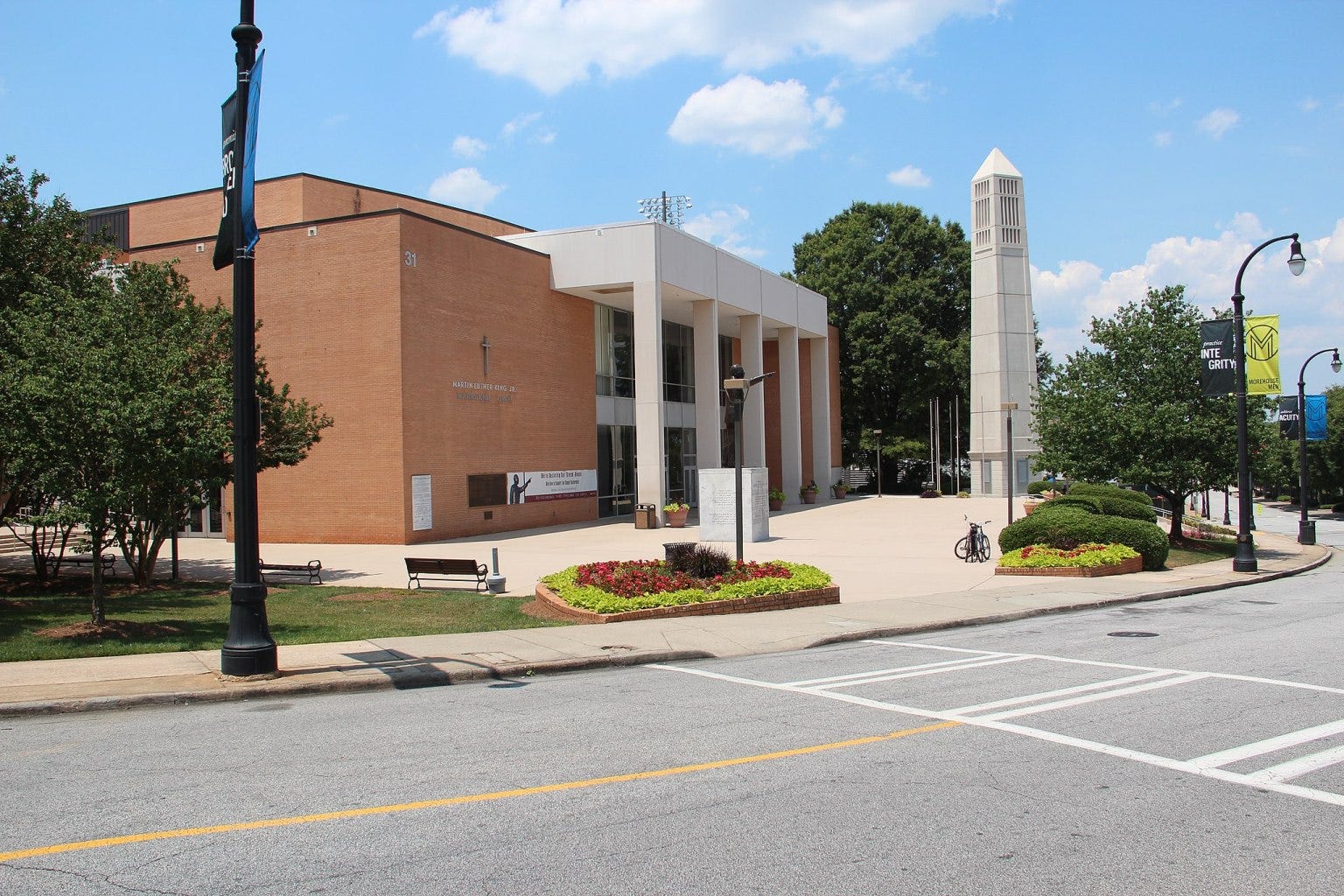
In the early weeks of 2026, the walls of the Martin Luther King Jr. International Chapel at Morehouse College made a series of declarations that sent tremors across the Black church, across evangelical Christianity, and across the long and complicated American conversation about the relationship between faith, race, and institutional integrity. First, on February 1, the first day of Black History Month, the founding dean unveiled an oil portrait of Joseph Smith Jr., the founder of Mormonism, in the chapel’s International Hall of Honor. Then, on March 19, three portraits of openly gay Black clergymen were permanently installed on those same walls, placed alongside Martin Luther King Jr., Mahatma Gandhi, and Abraham Lincoln.
The student body did not receive these decisions quietly. And the questions the students raised deserve a more serious theological answer than they have received. Because what happened in that chapel is not merely a curatorial dispute about whose portrait belongs on a wall. It is a window into the soul of a theological project that has been decades in the making, and a cautionary tale for every Black church leader, seminarian, and believer in America who still believes the gospel is not merely a cultural artifact, but the will of God, realized through HIS only begotten Son, Jesus the Christ, by the Holy Spirit, for the salvation of humanity.
The Controversies
The Joseph Smith Portrait
The portrait that ignited the first controversy, titled “Sunset on Nauvoo,” commissioned by the Church of Jesus Christ of Latter-day Saints, was unveiled at a vespers service on the opening day of Black History Month. The dean presided with enthusiasm, calling Joseph Smith “Lincoln before Lincoln” and praising his 1844 presidential campaign platform, which included a proposal to abolish slavery by having the federal government compensate slaveholders. The dean described Smith’s opposition to slavery as rooted in “a theological certainty: the equality of human souls before God.”

The students, to their immense credit, were not persuaded by this framing. Alonzo Brinson and Damarion King, the president and vice president of the chapel’s own assistants program, drafted a formal letter of dissent within forty-eight hours. They noted that the ceremony gave Smith’s portrait fifteen minutes of dedicated tribute, while the portrait of Harold Bennett, a Black Morehouse professor being honored at the same event, received just four. They noted that Smith had never prevented members of his own church from enslaving people. They noted that the same LDS church that the dean was celebrating had maintained racially exclusionary teachings and practices extending well into the twentieth century. And they noted, with particular force, that none of this had been discussed with students before the decision was made.
One student, Linden Young, put the institutional contradiction plainly: “By honoring Joseph Smith, a man who believed the enslavement of Black people was ordained by God, we have to understand how inconsistent that is with the mission of freedom fighting.” Several generations of Morehouse alumni, Black clergymen of considerable standing, issued an open letter to the same effect. Morehouse has offered no indication that the portrait will be moved.
The Gay Clergy Portraits
Before the Joseph Smith controversy had fully subsided, the chapel proceeded to a second and more theologically freighted series of unveilings. On March 19, 2026, during the Bayard Rustin Crown Forum, oil portraits of Bishop O.C. Allen, Rev. Dr. Brandon Crowley, and Father Darrell Tiller were permanently installed in the Hall of Honor. All three are openly gay Black clergymen. The press release accompanying the unveiling described the moment as “both affirmation and correction,” and framed the portraits as “a permanent witness… that Black queer clergy not only exist, but lead, build, and shape the future of faith and culture.”
The chapel did not present this as a recognition of the pastoral work these men had done within the limits of a contested debate. It presented it as a theological declaration: that openly gay clergy represent a legitimate expression of Christian ministry, and not merely represent it, but embody a tradition of liberation worthy of permanent installation alongside the pantheon of the civil rights movement. The framing was deliberate. The naming of the forum after Bayard Rustin, the openly gay civil rights strategist, was deliberate. The message was clear: the affirmation of homosexual identity and practice is not a deviation from the liberation tradition of the Black church. It is its logical continuation.
“What you put on your walls tells people what you believe about the world. A chapel’s gallery speaks before any preacher opens a Bible. It announces, quietly but unmistakably, who belongs, what is honored, and what kind of God you are gathered to worship.”
This is not an argument about the dignity of gay persons, which every Christian is obligated to affirm. It is an argument about what the church teaches, and whether those who lead its institutions have the authority to declare, by architectural fiat, that the church’s historic sexual ethic has been superseded, or worse, suspende. And it raises an urgent question: Who authorized this declaration? What theological council, what confessional synod, what scripture? The answer, as we shall see, is none of these. It was authorized by a theological framework that has been quietly constructed at Morehouse’s chapel for nearly half a century.
The Architect: Dr. Lawrence Edward Carter Sr.
To understand what happened in that chapel, you have to understand the man who built it. Dr. Lawrence Edward Carter Sr. is, by any measure, a figure of remarkable dedication and institutional consequence. He has served as the founding dean of the MLK International Chapel since 1979, nearly half a century at a single institution, which is itself a kind of extraordinary marker. He built the Hall of Honor from nothing. And he has mentored generations of Black preachers.
But faithfulness to an institution is not the same as faithfulness to a confession. And the theological vision Carter brought to the chapel, and has relentlessly implemented over forty-seven years, is not the biblical historic Christian faith of the Baptist tradition in which he was ordained. It is something considerably more eclectic, European, Indo-Asian, ideological, syncretic, and considerably more accommodating.
The intellectual DNA of Carter’s theology was formed at the Boston University School of Theology, the institutional home of what historians call “Boston Personalism,” a tradition explicitly identified by scholars as “the most coherent school of American liberal theology.” Its founding figure, Borden Parker Bowne, and his heirs, including Dean Walter G. Muelder, who signed Carter’s diploma, built a theological system that placed human personality and moral development at the center of reality, combined an idealistic metaphysics with a pluralistic and nondogmatic theology, and had, as scholars have documented, little patience for Christian orthodoxy or Niebuhrian neo-orthodoxy. It was, from its inception, a tradition that moved from theological liberalism toward a thoroughgoing religious pluralism.
That tradition shaped Carter profoundly. His academic course list at Morehouse, includes: Introduction to Religion, Psychology of Religion, World Religions, the Life and Thought of Gandhi and Daisaku Ikeda, all of which tells a story. His signature publication, A Baptist Preacher’s Buddhist Teacher: How My Interfaith Journey with Daisaku Ikeda Made Me a Better Christian, tells it more directly. Ikeda is the president of Soka Gakkai International, a Japanese Buddhist organization with no place for Christ as Lord or Savior. Carter describes him as a transformative “spiritual mentor”, not because he preached Christ, but because he embodied the universal human values of peace, dignity, and justice. Excuse my personal annotation, but an atheist can embodied these values. A commendation of Carter’s book summarizes his operating principle with stunning candor: “Universal and immanent, truth beckons to us beyond the boundaries of geography, nomenclature, or faith tradition.” The worldview couldn't be more clear.
This is perennialism, the philosophical conviction that all religions access the same ultimate truth through different cultural expressions. It is not Baptist Christianity. It is not any form of confessional Christianity. It is a secular sophisticated, academically credentialed version of the ancient error of reducing the gospel to a universal moral insight available through any sincere spiritual path. This, drawing from the philosophical arguments of the Enlightenment, once again reveals European fingerprints and influence.
Carter also forged an institutional Gandhi-King-Ikeda triad, a Hindu, a Baptist, and a Buddhist, as Morehouse Chapel’s defining moral framework. He commissioned the Gandhi-King-Ikeda Institute for Ethics and Reconciliation, created the Gandhi-King-Ikeda Community Builder’s Prize, and organized a traveling museum exhibit presenting the three figures as equivalent moral giants. In doing so, he quietly demoted Jesus Christ from the center of the institution’s spiritual life, replacing him with an interfaith consortium of ethical exemplars. The chapel’s mission became, in Carter’s own words, “global peacebuilding, ethical inquiry, and interfaith dialogue,” a mission that a Muslim, a Buddhist, or a secular humanist could affirm without reservation, because it makes no exclusive claim about the nature of God or the necessity of Christ.
And yet, the Bible says:
“Jesus said to him, ‘I am the way, and the truth, and the life. No one comes to the Father except through me.’” John 14:6
The Essential Deviations from Biblical Orthodoxy
When Dr. Carter’s theology is assessed not against the standards of academic pluralism, where it flourishes admirably, but against the standards of biblical historic Christian orthodoxy, the departures are substantial and systemic. They are not the departures of a man who has lost his faith. They are the departures of a man who has replaced one faith with another, while retaining a small lexicon of Christian vocabulary.
On the Authority and Sufficiency of Scripture
Historic Christianity, both beyond but particularly in the Baptist tradition, confesses the Bible as the inspired, authoritative, and sufficient Word of God for faith and practice. Carter’s framework treats Scripture as one voice among many in humanity’s spiritual conversation, alongside the Quran, the Dhammapada, and the Book of Mormon. His defense of the Joseph Smith portrait included reading from the Book of Mormon during the vespers ceremony itself. This is not mere academic hospitality. It is a theological statement that the canon of Scripture is not uniquely authoritative, that truth flows through multiple religious texts, and that no single one may claim the last word nor to be inspired by the one true and living God.
And yet, the Bible says:
“All Scripture is breathed out by God and profitable for teaching, for reproof, for correction, and for training in righteousness, that the man of God may be complete, equipped for every good work.” 2 Timothy 3:16–17
On Salvation and the Exclusivity of Christ
Orthodox Christianity confesses that there is salvation in no one else, for there is no other name under heaven given among men by which we must be saved (Acts 4:12). Carter’s pluralistic model treats redemption as a category available through any sincere religious tradition. When he defends the Joseph Smith portrait by asking, “Why do you go to church if you don’t want people saved, redeemed?,” and then proceeds to honor the founder of a tradition that explicitly denies the biblical orthodox Christian understanding of God, Christ, and atonement, he is operating with a definition of salvation that has been functionally evacuated of its New Testament content. Salvation becomes nothing more than moral improvement. Redemption becomes the overcoming of historical failure. Christ becomes one exemplar of what human beings can become when they align with the moral arc of the universe.
And yet, the Bible says:
“And there is salvation in no one else, for there is no other name under heaven given among men by which we must be saved.” Acts 4:12
On the Person and Work of Christ
The Chalcedonian definition, affirmed by virtually every stream of historic Christianity, confesses Jesus Christ as fully God and fully man, the unique, unrepeatable incarnation of the second person of the Godhead (Trinity), who accomplished atonement through his death and resurrection. Carter’s theological heroes, Gandhi, King, Ikeda, supplant this, and form a functional trinity in which Jesus’s unique saving work plays no discernible role. King is included as a moral exemplar and liberation figure, not as a herald of the exclusive gospel of Jesus Christ that both he and his father preached. The God who is worshipped in Carter’s framework is a generalized moral intelligence who manifests in every sincere religious tradition, a God accessible through any path of genuine human striving, but not the God who became flesh, bore sin, and rose bodily from the dead.
And yet, the Bible says:
“He is the image of the invisible God, the firstborn of all creation. For by him all things were created, in heaven and on earth, visible and invisible… And he is before all things, and in him all things hold together.” Colossians 1:15–17
On Human Sexuality and the Ethics of the Body
The biblical witness on human sexuality is not a peripheral doctrinal curiosity. It is rooted in the theology of creation (Genesis 1:27–28; 2:24), reaffirmed by Christ himself (Matthew 19:4–6), and addressed with clarity in the apostolic letters (Romans 1:24–27; 1 Corinthians 6:9–11). The consistent teaching of the church across every major tradition: Catholic, Orthodox, and Protestant, for almost two thousand years has been that sexual union is designed by God for one anatomical man and one anatomical woman in the covenant of marriage. To permanently install openly gay clergy as models of Christian ministry is not merely a pastoral accommodation. It is a declaration that the sexual ethic of biblical scripture is no longer binding, that the church has, in Carter’s framework, evolved beyond the apostolic witness.
And yet, the Bible says:
“For this reason God gave them up to dishonorable passions. For their women exchanged natural relations for those that are contrary to nature; and the men likewise gave up natural relations with women and were consumed with passion for one another…” Romans 1:26–27
“Do you not know that the unrighteous will not inherit the kingdom of God? Do not be deceived… But you were washed, you were sanctified, you were justified in the name of the Lord Jesus Christ and by the Spirit of our God.” 1 Corinthians 6:9–11
These are not minor adjustments at the margins of an otherwise biblical orthodox theology. They are departures at the load-bearing walls. Remove the authority of scripture, and the foundation of the faith is gone. Remove the exclusivity of Christ, and the gospel becomes indistinguishable from moral philosophy. Remove the biblical sexual ethic, and the church’s witness becomes a reflection of the culture rather than a word from beyond it. Each deviation, taken alone, might be rationalized as pastoral sensitivity or academic nuance. Taken together, they describe a different religion, one that borrows the vocabulary of Christianity while quietly replacing its substance.
The Hall of Honor at Morehouse’s MLK Chapel is, in this sense, a theological document. Portrait by portrait, decision by decision, it has been built to tell a particular story about what faith is, who belongs in it, and what it asks of those who practice it. That story, as we have seen, differs substantially from the story the New Testament tells. And the consequences of that difference, for the Black church, for American Christianity, and for the institutions called to equip the next generation of its leaders, are the subject of Part Two.


