Sacred Walls, Fragile Foundations (Part 2)
What the Controversies at Morehouse’s MLK Chapel Reveal About the Soul of Liberal Theology and the Church’s Urgent Need to Reclaim Its Own
April 13, 2026 | Part Two
The Dangerous Trajectory, the Implications, and the Way Forward
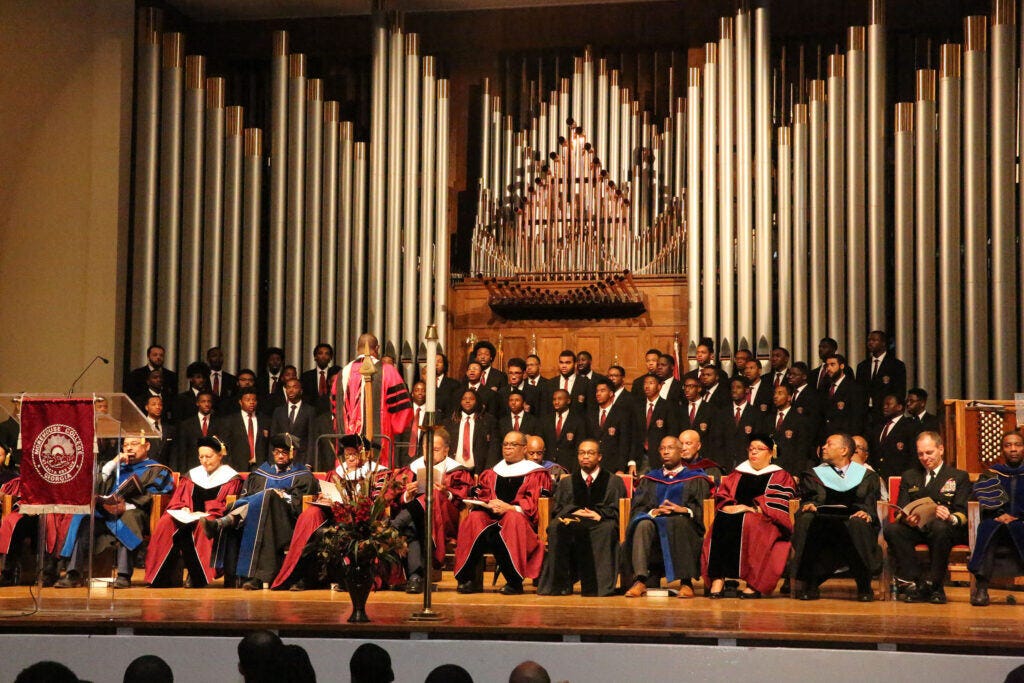
In Part One, we examined the controversies that erupted in early 2026 at Morehouse College’s Martin Luther King Jr. International Chapel. The portrait of Joseph Smith Jr. unveiled on the first day of Black History Month, the subsequent installation of three openly gay clergymen in the Hall of Honor, and the student-led dissent that followed. We traced the theological architecture of the chapel’s founding dean, Dr. Lawrence Edward Carter Sr., and identified four essential deviations from biblical orthodoxy embedded in his vision. Part Two takes up the deeper question: where does this trajectory lead, what does it cost the church, and what must those who care about the faith now do?
Liberal Theology and Its Dangerous Trajectory
It is important to name what we are dealing with precisely. The theological tradition that animates Dr. Carter’s vision has a well-documented intellectual genealogy. Gary Dorrien, in his monumental three-volume history of American liberal theology, traces the tradition from its German idealist origins, Schleiermacher’s grounding of religion in the feeling of absolute dependence, Ritschl’s reduction of Christianity to ethical community, Harnack’s stripping of the gospel down to the fatherhood of God and the brotherhood of man, to its American manifestations in the Social Gospel, the Chicago School, and Boston Personalism. The common thread across all of these is the same: the replacement of divine revelation with human religious experience as the primary source of theological authority, and the translation of the gospel into a program of moral and social improvement.
Roger Olson, in his indispensable work Reformed and Always Reforming, identifies the defining characteristic of liberal theology as the dissolution of doctrinal particularity in favor of ethical universalism: the conviction that what matters in religion is not what you believe about God, Christ, sin, and salvation, but whether your religion makes you more humane, more just, more compassionate. By this standard, a Buddhist who practices nonviolence and a Mormon whose 1844 presidential platform opposed slavery are as worthy of Christian honor as the apostles themselves. The portrait on the wall becomes not a confession of faith but a humanitarian award. And a humanitarian award, by definition, anyone can win.
The European philosophical roots of this tradition matter. Schleiermacher was not a churchman trying to save doctrine. He was an apologist trying to rescue religion from the Enlightenment’s cultured despisers by relocating it from revelation to human experience. Feuerbach, standing one step further down the same road, simply concluded that theology was anthropology, that talk of God was ultimately talk of the highest human values projected outward. Nietzsche drew the logical conclusion about a Europe that had already killed God in its heart while maintaining the forms of worship. Liberal theology in its American expressions never fully reckoned with this genealogy. It borrowed the Enlightenment’s preference for ethics over dogma, its suspicion of supernatural claims, and its confidence in human moral progress, and dressed these convictions in the vestments of the church. The result is an institution that looks like a chapel and functions like a university ethics center.
The Social Gospel without the blood of Christ is not a gospel at all. It is a civic program with stained-glass windows.
This trajectory has an end point, and it is secularization. The sociologist Christian Smith documented what he called the secularization of mainline Protestantism: as liberal denominations progressively accommodated their theology to the moral consensus of the educated professional class, they shed members, lost cultural authority, and gradually ceased to function as distinct religious communities at all. The Episcopal Church, the United Methodist Church, the Presbyterian Church USA, all followed this arc, and all are now shadows of their former institutional selves. The sociological data is unambiguous: theological accommodation to cultural progressivism does not make churches more relevant. It makes them unnecessary.
This is not an abstract concern for a historically Black college whose chapel is named after Martin Luther King Jr. King was a Baptist preacher who believed in the resurrection. He was exposed to Boston's personalism, yes, but he was shaped by the Black church’s fierce, uncompromising insistence that the God of Scripture was on the side of the oppressed, not because justice was a universal human value, but because this specific God, the God of Abraham, Isaac, and Jacob, the Father of Jesus Christ, had declared it so. The prophetic power of King’s witness did not come from a generalized spirituality of human dignity. It came from a particular gospel, proclaimed from a particular Book, about a particular Savior. When you dissolve that particularity in the name of interfaith inclusion, you do not make the chapel more like King. You make it less.
“Beloved, although I was very eager to write to you about our common salvation, I found it necessary to write appealing to you to contend for the faith that was once for all delivered to the saints.” Jude 3

Implications for the Black Church and the Broader Body of Christ
The Morehouse chapel’s trajectory is not an isolated institutional story. It is a parable for what happens when a generation of theologically trained Black leaders absorb the categories of European liberal theology, with its roots in post-Enlightenment skepticism, its discomfort with supernatural claims, its preference for ethical principles over doctrinal confessions, and bring those categories home to institutions that were built on a very different foundation.
The historic Black church in America is not, despite the narrative that has been constructed around it, a naturally progressive institution. It is, at its best, a profoundly orthodox one. Its worship is scripture-saturated. Its preaching is proclamatory. Its theology is Christ-centered. Its moral seriousness is fierce and uncompromising, and that moral seriousness derives precisely from its doctrinal convictions about who God is, what sin is, what Christ has done, and what the church is called to be. The prophetic courage of figures like Frederick Douglass, Harriet Tubman, and Martin Luther King himself was not fueled by a generalized humanitarian ethics. It was fueled by a specific theological conviction: that the God who liberated Israel from Egypt was active in history, that every human being bore the image of that God, and that any social order that defaced that image was under divine judgment.
When institutions like Morehouse’s chapel replace that specific, robust, doctrinally grounded faith with a pluralistic spirituality of human flourishing, they do not merely change their theological commitments. They amputate the very root from which the tree of Black liberation grew. They produce graduates who know how to quote King but have never truly encountered the God King served. They fill pews, or, more likely, empty them, with people who have been taught that religion is a means of moral improvement rather than a response to the living God who has spoken definitively in Christ.
And they send a signal to the broader culture that Christian institutions are, at their core, infinitely negotiable, that the gospel can be updated, amended, expanded, and reframed to accommodate whatever the current moral consensus demands. This signal is heard clearly by a watching world. And the world’s response is not respect. It is indifference. Why attend a chapel whose theology is functionally indistinguishable from a well-meaning NGO? Why submit your life to the authority of a Scripture that the chapel’s own dean treats as one text among many? Why seek the living among institutions that have, however graciously and gradually, made their peace with the absence of a risen Lord at the center of their common life?
The secularization of the mainline was not the result of malice. It was the result of accommodation, one portrait at a time, one concession at a time, one reframing at a time, until the institution that once proclaimed a gospel was left proclaiming only itself. The Black church has survived slavery, Jim Crow, and a century of systemic oppression precisely because it did not make that bargain. It staked its life on a God who was not merely a symbol of human aspiration but the Lord of history who vindicated his people. To trade that God for a hall of honor that includes everyone and therefore confesses nothing is not progress. It is a profound and costly loss.
“For I am not ashamed of the gospel, for it is the power of God for salvation to everyone who believes, to the Jew first and also to the Greek.” Romans 1:16
“But even if we or an angel from heaven should preach to you a gospel contrary to the one we preached to you, let him be accursed.” Galatians 1:8
The Urgent Need: An Orthodox African American Reclamation
The students who protested at Morehouse deserve more than admiration. They deserve an institution. Not an institution that will tell them that the gospel is compatible with every spiritual tradition and that Christian ethics are negotiable in the light of contemporary moral progress. An institution that will tell them the truth: that the God of the Bible is not interchangeable with the Buddha of Soka Gakkai or the god of Joseph Smith’s Nauvoo; that the sexual ethic of Scripture is not the residue of ancient cultural prejudice but the design of the Creator himself; that the Black church’s power to liberate was never sourced in a generalized humanism, but in the specific, costly, resurrection-anchored gospel of Jesus Christ. These students are a sign of hope.
There is a genuine and urgent need in America for a Black-led, historically African American institution of higher learning that maintains, without apology and without compromise, the essential doctrines of the Christian faith: the plenary authority of Scripture, the triune nature of God, the full deity and full humanity of Christ, the reality and gravity of sin, the vicarious atoning death of Christ, the bodily resurrection, justification by faith alone, the new birth by the Spirit, the biblical theology of marriage and human sexuality, and the mission of the church to proclaim the gospel to every nation.
Such an institution would not be parochial or intellectually timid. It would not refuse to engage with Gandhi or Ikeda or the complicated racial history of Mormonism. It would engage all of these with full intellectual rigor, and with a prior theological commitment that cannot be bargained away for donor relationships, academic prestige, or the approval of the cultural moment. It would know the difference between the table of the Lord and a symposium on universal human values. It would know the difference between the prophetic tradition of the Black church, rooted in the God who speaks, acts, liberates, and judges, and the therapeutic tradition of liberal religion, which offers affirmation in place of proclamation and inclusion in place of transformation. And it would train preachers, scholars, and leaders who know that difference too.
The Morehouse students who drafted their letter of dissent, who stood before the oratorical contest and named what they saw, who refused to be silenced by institutional pressure, these young men represent something the church desperately needs: a generation that is not content to inherit a diluted faith. They are asking a question that every Black church institution in America must answer honestly: Is the foundation of this house the gospel of Jesus Christ, or is it the spirit of the age?
That question has always had only one orthodox answer. It has fueled the courage of enslaved Black Christians who held fast to a Bible their masters tried to weaponize against them, and found in it, instead, the God who hears the cry of the oppressed. It has fueled the moral authority of every Black preacher who ever stepped into a pulpit with nothing but Scripture and the Spirit and dared to speak truth to power. And it is the same answer that must fuel the next generation of Black theological institutions, if they are to be worthy of the tradition they claim to carry.
It is time for those who hold that answer to build institutions worthy of it. Not halls of honor that confess everyone and therefore confess nothing. But communities of faith that stake their lives, their academic credibility, and their institutional futures on the one name given among men, and find, as every generation of the faithful has found before them, that it is more than enough.
“For no one can lay a foundation other than that which is laid, which is Jesus Christ.” 1 Corinthians 3:11
“Therefore thus says the Lord God, ‘Behold, I am the one who has laid as a foundation in Zion a stone, a tested stone, a precious cornerstone, of a sure foundation: whoever believes will not be in haste.’” Isaiah 28:16


