State of the Black Church: The Fault Lines Within
Liberal Theology, Artificial Intelligence, and the Formation Crisis in the Black Church
A Four-Part Series on the State of the Black Church | Part 3 of 4
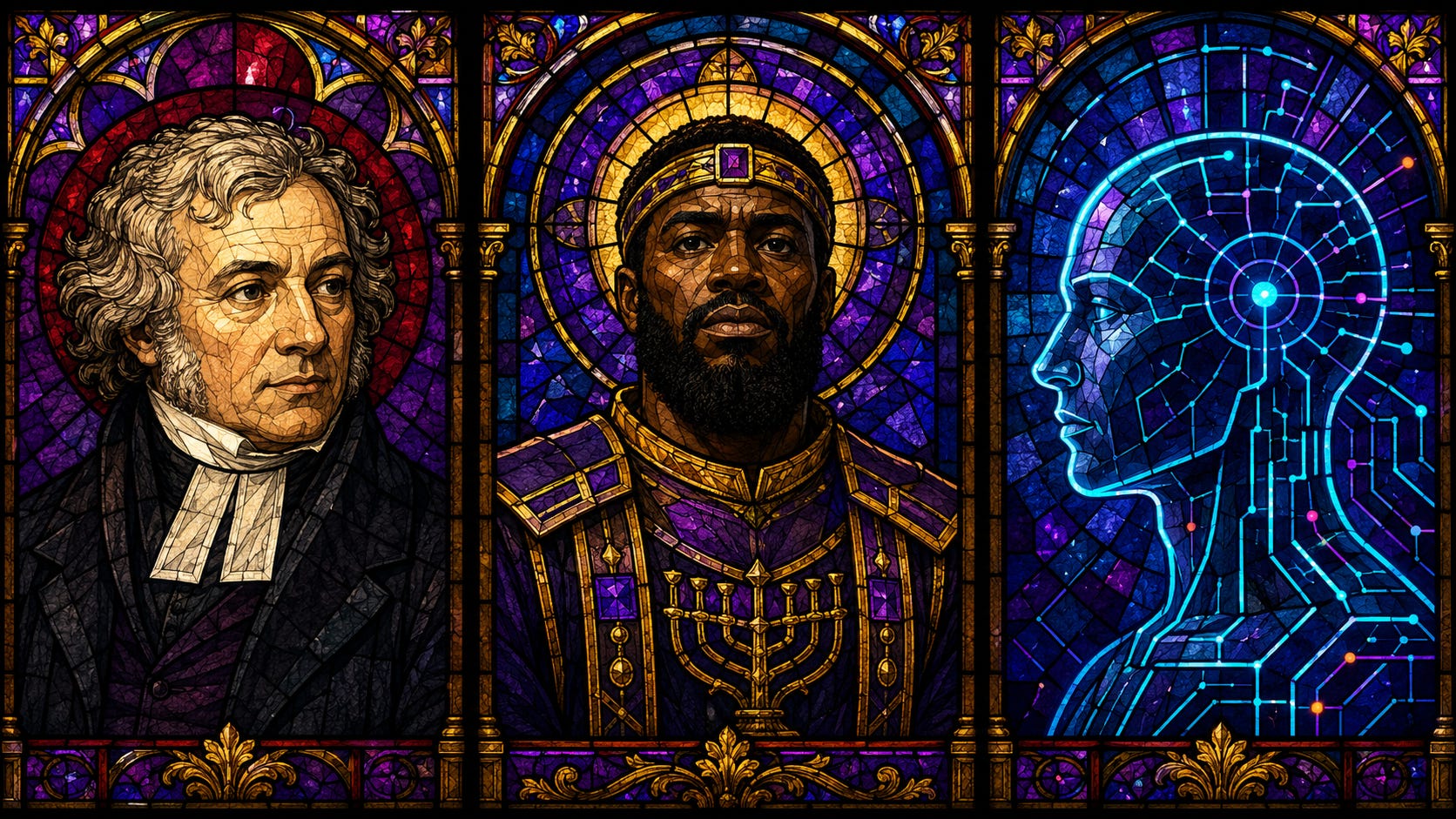
Perhaps the most consequential and least discussed dimension of the Black church's present crisis is not sociological at all. It is theological. Beneath the demographic data lies a doctrinal fault line that has been widening for decades.
The Black church does not speak with one theological voice. It never has. From its earliest formation, it has held a tension between the prophetic tradition, focused on a biblically derived social liberation, community empowerment, and political engagement, and the biblical historical orthodox tradition, focused on personal salvation, biblical authority, and doctrinal fidelity. For most of its history, these two streams ran alongside each other. That balance has grown increasingly precarious.
The influence of liberal theology, rooted in the Enlightenment, Schleiermacher-to-Cone tradition that subordinates scripture to experience and reconstructs doctrine through the hermeneutic of racial identity, has moved from the academy into the pulpit. H. Richard Niebuhr's famous critique of the social gospel applies here with uncomfortable precision: “a God without wrath, brought sinners without accountability, into a kingdom without judgment, through the ministrations of a Christ without the cross.”1
On the other side, a generation of biblically orthodox Black pastors has emerged, trained in sound exegesis, committed to the Rule of Faith, acknowledging the historic creeds, unwilling to trade the scandal of the cross for social relevance. They acknowledge, rightly, that the creeds were forged in North Africa, that the Cappadocian and Alexandrian fathers whose theology anchors Christian orthodoxy were men of great theological depth and devotion, and that the enslaved people who would come a millennium later, sang "Swing Low, Sweet Chariot" were doing sophisticated Christological theology under conditions of extreme duress.
The tragedy is that this theological clarity has not yet translated into institutional scale. The liberal-trending seminaries offer little to no instruction on the African Church Fathers, nor the doctrine that was codified during the first 500 years of the church. The prosperity gospel, neither orthodox nor liberal in any classical sense but a mutation of both, still commands massive platforms and fills the largest sanctuaries.
"For the time will come when they will not endure sound doctrine; but wanting to have their ears tickled, they will accumulate for themselves teachers in accordance to their own desires." 2 Timothy 4:3 (NASB)
ARTIFICIAL INTELLIGENCE AND THE FORMATION CRISIS
And then there is the matter of artificial intelligence, arguably the most consequential cultural force to arrive in a generation, and one the church is still processing at the level of administrative convenience rather than theological urgency.
The 2025 State of AI in the Church survey found that 91% of church leaders now support using AI in some form of ministry. Forty-five percent use it in their work, an 80% increase in a single year. Sixty-four percent of pastors use AI for sermon preparation. Yet 73% of church leaders have no AI policy whatsoever.
These statistics are less alarming than the context around them. Congregation members are already being formed by AI systems operating without any Christian biblical input. Algorithmic news feeds, AI-curated content recommendations, machine-learning platforms that know their users' spiritual anxieties, all of this is happening before the church has developed any coherent theological framework for it.
For the Black church, the stakes are specific and acute. A generation of young Black men is being catechized by YouTube algorithms and TikTok theology that serves a steady feed of Afrocentric spirituality, BRIC movements, anti-Christian apologetics, and identity-based religious alternatives. The church, meanwhile, is debating whether to use AI for its bulletin. The formation gap is not a coming problem. It is the present reality.
AI can generate a sermon. Only the Holy Spirit can regenerate a soul.
The church is perceived, in broad cultural terms, as one option among many. This is historically unprecedented for an institution that, in the African American context, was never merely one option. It was the option. The place where politics, community, mutual aid, education, and worship converged into a single, irreducible institution. To lose that cultural centrality is not merely a statistical problem. It is a civilizational one.
________________
SOURCES AND SCRIPTURE CITATIONS
Research Sources
1. Niebuhr, H. Richard. The Kingdom of God in America. Willett, Clark and Co., 1937. P. 193
2. Christian Research Institute. "Is Orthodoxy Strong in the Black Church?" 2009.
3. Gospel Coalition. "Liberal Theology." Essay, July 2024.
4. Olson, Roger E. Against Liberal Theology: Putting the Brakes on Progressive Christianity. Zondervan Reflective, 2022.
5. Exponential. "AI in Churches 2025: 91% Adoption Rate Reveals Dangerous Policy Gap." November 2025.
6. Deseret News. "AI and Religion: How Will Artificial Intelligence Affect Churches?" October 2025.
7. First Liberty Institute. "Filtered Faith: Religious Freedom in the Age of AI." August 2025.
8. Hartford Institute for Religion Research. "The Continuing Impact of Technology on Congregations." 2025.
Scripture Citations (NASB)
2 Timothy 4:3 (NASB) -- "For the time will come when they will not endure sound doctrine..."

