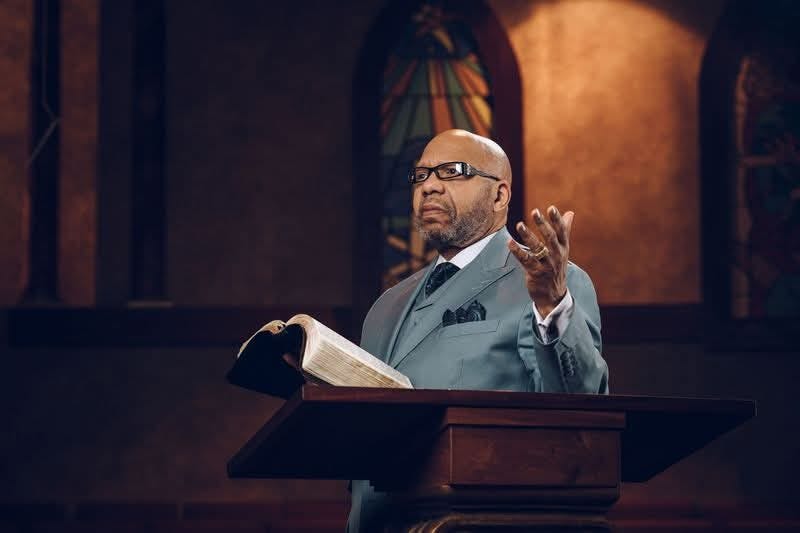
Stay In The Text
Why the Pulpit Must Reclaim Biblical Exposition
There's a moment in most contemporary church services when you can feel the congregation lean forward. The pastor has been working through a passage—perhaps from Romans or one of the Gospels—when suddenly the sermon pivots. A reference to a trending news story, a clip from a popular Netflix series, or a pointed commentary on the latest political controversy. The room comes alive. People nod. Some pull out their phones to take notes. I understand the impulse. As someone who has spent decades trying to make ideas accessible to a broad audience, I know the seductive appeal of the timely reference, the cultural touchstone that promises to build a bridge between ancient wisdom and modern life. But over the past twenty-five years, I've watched something troubling unfold in American pulpits: the bridge has become the destination.
What was once a sermon grounded in Scripture, occasionally illustrated by contemporary life, has inverted into something else entirely—a commentary on current events occasionally punctuated by biblical seasoning. The text has become a launching pad rather than the substance, a devotional appetizer before the main course of cultural analysis. And in this shift, something essential has been lost.
The Drift from the Source
The transformation has been gradual but unmistakable. In the late 1990s and early 2000s, as churches competed for relevance in an increasingly secularized culture, the "seeker-sensitive" movement encouraged pastors to meet people where they were. Noble in intent, perhaps, but the execution often meant trading depth for accessibility, exegesis for entertainment.
By the 2010s, the sermon had become almost indistinguishable from a TED Talk with prayer bookends. You take Joel Osteen out of the pulpit and replace him with Dr. Phil and few would notice the difference. Pastors became known for their takes on politics, their ability to decode pop culture, their facility with the language of therapy and self-help. Some of the largest congregations in America grew around personalities who could deliver a motivational message that felt spiritual without being particularly biblical.
The pandemic accelerated this trend. As churches moved online and competed with an infinite scroll of content, the pressure intensified to be relevant, punchy, applicable. The biblical text—with its ancient contexts, its complex arguments, its sometimes uncomfortable particularity—seemed like a liability rather than an asset.
But here's what we've discovered: you cannot sustain a spiritual life on a diet of cultural commentary, no matter how insightful. You cannot build a church on the shifting sands of what's trending. Stage props are a poor replacement for biblical preaching. Dress talk is no substitute for Jesus. And you cannot form people capable of enduring life's deepest sufferings and greatest joys by giving them principles when what they need is presence—the presence of God mediated through His Word.
The Biblical Case for Biblical Preaching
The irony of this drift is that the very text pastors have been sidelining provides the clearest instruction about its own centrality. Consider how Jesus himself treated Scripture. In the wilderness, facing temptation, he didn't respond with clever reasoning or contemporary analogies. Three times he answered Satan with "It is written," wielding the authority of Scripture as both sword and shield.
Throughout his ministry, Jesus consistently grounded his teaching in the Hebrew Scriptures. "You have heard it said... but I say to you" wasn't a rejection of the text but its deepest reading. When he explained his mission to the disciples on the Emmaus road, he didn't offer a self-help seminar on dealing with disappointment. Instead, "beginning with Moses and all the Prophets, he interpreted to them in all the Scriptures the things concerning himself."
The apostles followed this pattern. Peter's sermon at Pentecost is saturated with Scripture—Joel, David, the Psalms—not as decoration but as the very substance of his proclamation. Paul, writing to Timothy, emphasizes that "all Scripture is breathed out by God and profitable for teaching, for reproof, for correction, and for training in righteousness." His letters are dense with biblical exposition, even when addressing practical problems in local churches.
The writer of Hebrews declares that "the word of God is living and active, sharper than any two-edged sword." Not the preacher's commentary on the word. Not the contemporary application. The word itself possesses an inherent power that our clever additions cannot improve. This is the foundation that has been eroded: the conviction that Scripture itself, properly understood and proclaimed, is sufficient for the formation of Christian disciples.
Why Staying in the Text Matters
The consequences of this drift are not merely academic. When preaching becomes untethered from sustained biblical exposition, several things happen, all of them corrosive to genuine faith.
First, congregations become theologically malnourished. They can quote their pastor's opinions on political figures but cannot articulate basic Christian doctrines. They know catchphrases but not the grand narrative of Scripture. They have maxims for successful living but lack the resources to face suffering, doubt, and death.
Second, the church loses its prophetic voice. When pastors spend their credibility on temporal political and cultural commentary, they squander the authority that comes from speaking God's word rather than their own opinions. The pulpit becomes just another platform for hot takes, indistinguishable from cable news or social media.
Third, people are robbed of an encounter with a reality beyond themselves. The great gift of biblical exposition is that it forces us to grapple with a text we didn't write, expressing priorities we wouldn't naturally choose, revealing a God who exceeds our categories. Cultural commentary, by contrast, tends to confirm what we already suspect about the world. It flatters our existing frameworks rather than challenging them.
Fourth, congregations miss the formation that comes only through sustained engagement with Scripture. Character is not built through weekly inspiration but through the patient work of absorbing a different vocabulary, learning to see through different eyes, having one's imagination slowly reconstructed by a story larger than our own.
The Gifts of Exposition
Those pastors who have resisted the drift and maintained a commitment to biblical exposition report something remarkable: their congregations are hungry for it. Yes, the work is harder. Exegesis requires studying languages, historical contexts, theological debates. It demands wrestling with difficult passages rather than cherry-picking comfortable ones. It means sometimes preaching texts that don't seem immediately relevant to anyone's felt needs.
But this discipline bears distinctive fruit. People learn to read the Bible for themselves, developing skills that serve them long after the sermon ends. They discover that Scripture is far stranger, richer, and more challenging than they imagined. They encounter passages that wound and heal, that comfort and disturb, that reveal both their sin and their belovedness.
Biblical exposition also protects both pastor and congregation from the cult of personality. When the text is central, the preacher becomes a guide rather than a guru, a servant of the word rather than its master. The focus shifts from the preacher's charisma to God's revelation. Moreover, staying in the text provides a kind of protection against the polarization that has ravaged American Christianity. When we gather around Scripture rather than around political tribes or cultural preferences, we're forced to reckon with a word that doesn't align neatly with any contemporary faction. The text refuses to be domesticated by our ideologies.
A Challenge for the New Year
As we begin this new year, I want to offer a challenge particularly to those who stand in pulpits each week: recommit to the text. Not as a complement to your cultural commentary, but as the main thing.
This will require courage. It means preaching some Sundays when you have nothing clever to say about the news cycle, when you must simply open Leviticus or Lamentations or Luke and trust that God's word is sufficient. It means disappointing people who want you to address every trending controversy, who confuse the prophetic voice with political punditry.
It will require humility. You'll need to admit what you don't know, to study when you'd rather rely on intuition, to resist the temptation to make the text say what would be most pleasing or useful to your audience.
It will require patience. Both yours and your congregation's. Deep reading of Scripture is a skill, and like all skills, it must be practiced. Some people will drift away, seeking the quick hit of relevance elsewhere. Others will discover a depth they didn't know they were missing.
But here's what I've observed in communities where pastors have made this commitment: people are formed differently. They develop a kind of ballast, a rootedness that allows them to weather the storms of change without being swept away. They learn to distinguish between what is eternal and what is merely urgent. They discover resources for joy and suffering that no amount of practical advice could provide.
The irony is that by focusing less on immediate relevance, such preaching becomes more deeply relevant. It addresses not just the questions we're asking today, but the questions we'll be asking tomorrow and for the rest of our lives. It forms people capable of living faithfully not just in this cultural moment, but in any cultural moment. So stay in the text. Trust its sufficiency. Believe that the same Spirit who inspired it can illumine it. Give your people not your opinions decorated with Bible verses, but the Bible itself, opened and explored with all the rigor and reverence it deserves.
The world will provide endless commentary on current events. What the world cannot provide is what you, standing in that pulpit, have been called to offer: the living word of God, unfolded and proclaimed with faithfulness and skill. That word, and that word alone, can make people "complete, equipped for every good work." It's enough. It has always been enough. Trust it to be enough again, and stay in the text.


👏🏽👏🏽👏🏽 if you choose not to write another essay this year, this would be enough!
Stay in the text! Great read brother.