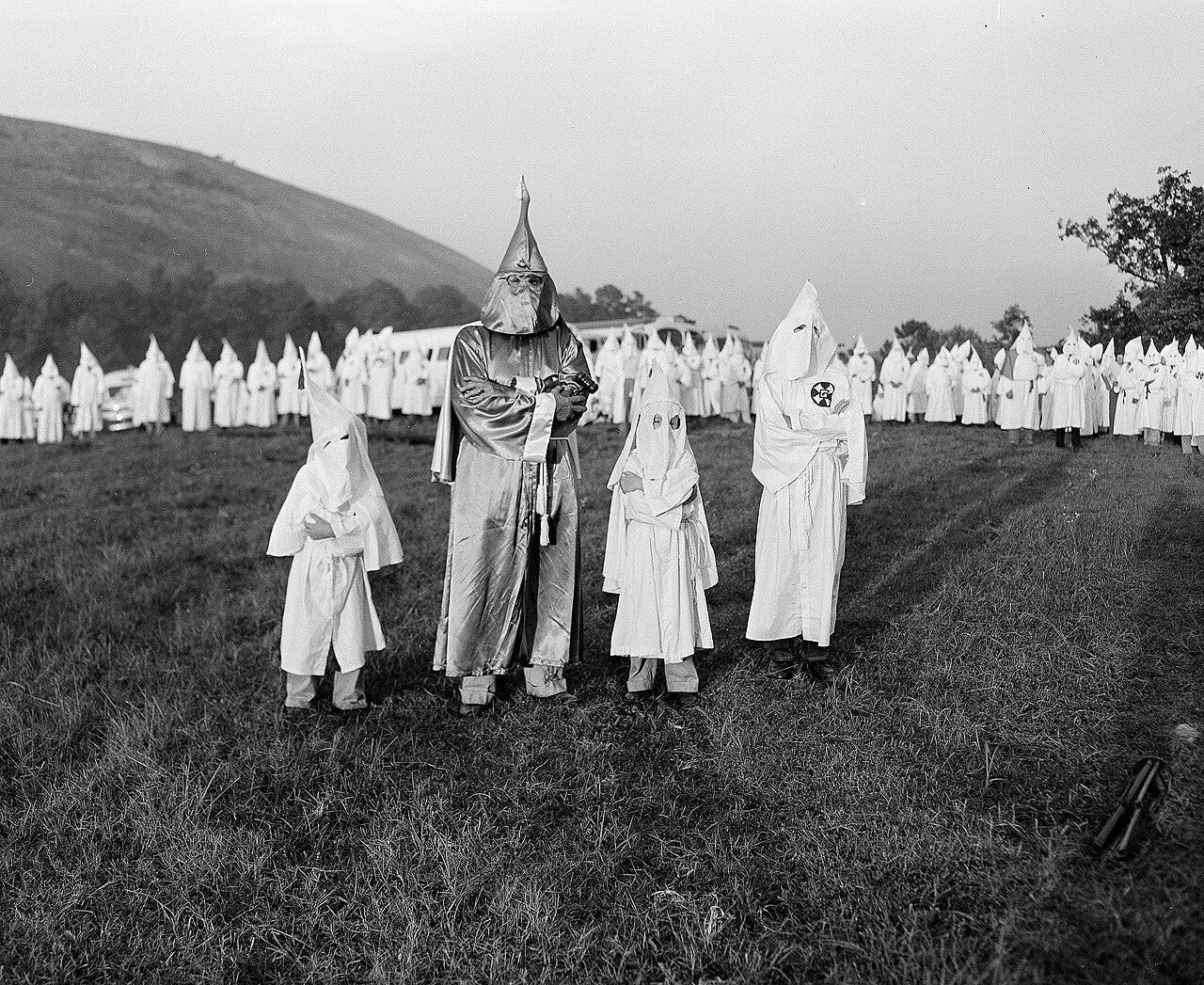
The Anti-Christian Roots of the Klan
When Hate Dons the Robes of the Occult

There's a peculiar tragedy in American history that doesn't receive sufficient attention in our ongoing reckoning with racial injustice. It's not merely that the Ku Klux Klan committed unspeakable acts of terror against African-Americans and Jews. It's that they did so while wrapping themselves in the symbology of a faith tradition—Protestant Christianity—that explicitly condemns everything they represented, all while simultaneously embracing a vocabulary and ritual practice borrowed directly from the occult traditions that same faith tradition has historically rejected as demonic. This contradiction reveals something profound about the nature of evil itself: how it corrupts not through honest opposition to the good, but through grotesque mimicry and inversion of it.
The Klan has always presented a paradox that demands examination. Here was an organization claiming allegiance to a faith rooted in the radical teachings of Jesus Christ—who declared that in Him there is neither Jew nor Greek, slave nor free—while simultaneously constructing an elaborate theological justification for racial hatred. Here was a movement that drew its membership largely from Bible Belt Protestantism, particularly its Calvinist strains with their emphasis on God's sovereignty and the depravity of human nature, while engaging in practices that any serious reading of Scripture would immediately recognize as occult.
The Poisoned Root: Racism's Contradiction to Biblical Christianity
The Klan's foundational ideology—white supremacy rooted in racial hierarchy—stands in direct contradiction to the most basic tenets of Christian orthodoxy. The biblical account begins with the creation of humanity in the image of God, a doctrine known as the Imago Dei. Genesis 1:27 declares: "So God created man in his own image, in the image of God he created him; male and female he created them." This isn't a statement about one ethnic group; it's a declaration about all humanity.
The Apostle Paul, writing to a diverse early church struggling with ethnic divisions, was unequivocal: "There is neither Jew nor Gentile, neither slave nor free, nor is there male and female, for you are all one in Christ Jesus" (Galatians 3:28). In Acts 17:26, Paul preaches that God "made from one man every nation of mankind to live on all the face of the earth." The early church's great controversy, detailed in Acts 15, was precisely about whether ethnic and cultural barriers should divide believers—and the answer was a resounding no.
The Klan's ideology required rejecting these clear biblical teachings in favor of a racialized interpretation of Christianity that had more in common with pagan tribal religions than with the universal gospel. They had to ignore Christ's parable of the Good Samaritan, which specifically challenged ethnic prejudice. They had to overlook the Great Commission's call to "make disciples of all nations." They had to turn away from the vision in Revelation 7:9 of "a great multitude that no one could number, from every nation, from all tribes and peoples and languages, standing before the throne." This wasn't a minor theological disagreement. This was a wholesale rejection of Christianity's core message.
The Burning Cross: Symbol Inverted, Meaning Perverted
Perhaps no practice better illustrates the Klan's occult nature than their signature ritual of cross burning. To anyone with even a passing familiarity with Christian theology, the perversion here is immediately apparent.
The cross in Christian tradition is the instrument of Christ's redemptive suffering—the means by which, Christians believe, God reconciled humanity to Himself. It is a symbol of sacrificial love, of God's willingness to die for humanity's sins. The Apostle Paul wrote in 1 Corinthians 1:18, "For the message of the cross is foolishness to those who are perishing, but to us who are being saved it is the power of God." The cross is not a weapon of terror. It is not an instrument of intimidation. It is not a sign of hatred.
Yet the Klan took this central symbol of Christian faith and transformed it into precisely what Christ's cross was meant to abolish: an idol of terror, a totem of tribal power, a burning threat in the night. The very act of setting the cross ablaze suggests destruction rather than redemption, consumption rather than salvation. It is not merely a pagan practice, it's an exercise in the demonic.
This practice bears all the hallmarks of occult ritual: the nighttime gathering, the mystical significance attributed to the burning symbol, the intent to instill fear through supernatural dread. It is, quite literally, a desecration—taking something sacred and inverting its meaning for malevolent purposes. This is not Christianity; it is pagan magic wearing a Christian mask.
Wizards and Dragons: The Occult Lexicon of Hate
But perhaps most revealing of the Klan's true spiritual nature is the bizarre terminology they adopted for their organizational hierarchy. This isn't the vocabulary of Protestant Christianity, which typically uses terms like pastor, elder, deacon, or minister. This is the language of occultism and pagan mythology.
Consider their leadership titles: Grand Wizard (or Imperial Wizard), Grand Dragon, Grand Titan, Grand Cyclops. These aren't biblical terms. Wizards are practitioners of magic, explicitly condemned throughout Scripture. Dragons, in biblical symbolism, are associated with Satan himself—Revelation 12:9 identifies "that ancient serpent called the devil, or Satan" as "the great dragon." Titans are figures from Greek mythology, the old gods who warred against Zeus. Cyclops are one-eyed giants from Homer's Odyssey.
Members were called "Ghouls"—a term from Arabian folklore referring to demons that rob graves and consume human flesh. Their territories were "Realms"—a term suggesting mystical kingdoms rather than geographic regions.
This vocabulary wasn't chosen accidentally. It reveals a movement that, despite its claims to Christian identity, was fundamentally oriented toward the occult—toward hidden knowledge, mystical power, and the manipulation of supernatural forces for worldly ends. This is precisely what historic Christianity, particularly in its Protestant expressions, has always condemned as witchcraft and devil worship.
The Calvinist tradition from which many Klan members emerged emphasized God's transcendence and the sufficiency of Scripture alone (sola scriptura). Yet here was an organization creating an entire mystical hierarchy, complete with secret rituals, magical thinking about racial bloodlines, and a vocabulary borrowed from paganism and occultism.
Unmasking the Cult: The Evidence of Demonic Influence
When we step back and examine the totality of Klan practice and belief, the evidence points overwhelmingly to an organization under demonic influence, regardless of its claims to Christian identity.
First, there's the practice of operating in secret, behind masks and robes. Jesus said in John 3:20-21, "Everyone who does evil hates the light, and will not come into the light for fear that their deeds will be exposed. But whoever lives by the truth comes into the light." The Klan's entire modus operandi was darkness—literal darkness, spiritual darkness, moral darkness.
Second, there's the emphasis on racial bloodlines and ethnic purity, a form of pride that Scripture consistently condemns. Proverbs 16:18 warns, "Pride goes before destruction, a haughty spirit before a fall." The Klan's ideology was built entirely on pride—specifically, racial pride.
Third, there's the fruit of their actions: murder, terror, destruction, division. Jesus taught in Matthew 7:16, "By their fruit you will recognize them." The Klan's fruit was bitter indeed—lynchings, bombings, assassinations, the terrorizing of entire communities. This is not the fruit of the Holy Spirit, which Paul defines in Galatians 5:22-23 as "love, joy, peace, forbearance, kindness, goodness, faithfulness, gentleness and self-control."
Fourth, there's the cultic nature of the organization itself—the secret rituals, the absolute loyalty demanded, the special knowledge reserved for initiates, the elaborate hierarchy. These are characteristics of occult organizations, not of Christian fellowship.
The Klan represents what happens when ethnic tribalism, racial hatred, and cultural power-seeking co-opt religious language while rejecting religious substance. It is, in the truest sense, an anti-Christian cult—a organization that uses Christian symbols while serving purposes antithetical to Christianity's core message.
A Warning to the Faithful
For Christians today, the Klan's history offers a sobering reminder that claiming the name of Christ while rejecting His teachings is not just hypocrisy—it can become something far more sinister. Scripture offers clear warnings against such associations and the spiritual danger they represent:
1 John 4:20 — "Whoever claims to love God yet hates a brother or sister is a liar. For whoever does not love their brother and sister, whom they have seen, cannot love God, whom they have not seen."
2 Corinthians 6:14-15 — "Do not be yoked together with unbelievers. For what do righteousness and wickedness have in common? Or what fellowship can light have with darkness? What harmony is there between Christ and Belial?"
Ephesians 5:11 — "Have nothing to do with the fruitless deeds of darkness, but rather expose them."
James 3:14-16 — "But if you harbor bitter envy and selfish ambition in your hearts, do not boast about it or deny the truth. Such 'wisdom' does not come down from heaven but is earthly, unspiritual, demonic. For where you have envy and selfish ambition, there you find disorder and every evil practice."
1 Timothy 4:1 — "The Spirit clearly says that in later times some will abandon the faith and follow deceiving spirits and things taught by demons."
The Klan's embrace of occult vocabulary and practices while claiming Christian identity reveals a fundamental truth: evil often works not by opposing religion directly, but by corrupting it from within. The greatest danger to faith isn't always external persecution, but internal perversion—when the language of love is co-opted for hatred, when the symbol of redemption becomes an instrument of terror, when the church becomes indistinguishable from a cult.
For the body of Christ today, the lesson is clear: we must be vigilant not only about what we claim to believe, but about whether our practices, our vocabulary, and above all our fruit reflect the One whose name we bear. The Klan's history stands as a permanent warning of what happens when we fail this test—when Christianity becomes merely a tribal marker rather than a transforming faith, when the cross becomes a weapon rather than a symbol of sacrifice, when the gospel's universal call is replaced by the narrow tribalism of the occult. That is the searing white hot sin of hate from which the faithful must, at all costs, turn away.


So well done! Thank you for the clear Bible references contained within.
Excellent work.