The Black History of Christianity
How Recovering the Faith's Black History Can Restore the Church's Universal Vision
There's a moment in every honest historian's journey when everything they thought they knew suddenly changes, and a new light reveals what was always there but never quite seen. For me, that moment came while reading about the Aksumite Empire's adoption of Christianity in the fourth century not as something forced on them by outsiders, but as a choice made by African kings who saw in the gospel something that spoke to their own desire for meaning and justice.
As Americans, particularly a certain sect of the population, have developed a strange kind of forgetfulness about history. We imagine Christianity as a European religion, picturing Jesus as a figure from a Renaissance painting, and assume the faith traveled from Rome and London to the rest of the world on colonial ships. This vision is not just incomplete; it is a distortion that limits both our understanding of history and our ability to see the church's true diversity. The truth is far more interesting, and far more challenging to what we think we know.
Christianity was an African faith before it was a European faith, and Jewish faith before that. This is not exaggeration or wishful thinking it is simply historical fact. When the infant Jesus fled King Herod's persecution, where did the Holy Family seek safety? Egypt. "Out of Egypt I called my son," Matthew quotes from the prophet Hosea, reminding us that Africa was the place of refuge that protected Christianity's founder. Africa was not secondary to the birth of Christianity; it was central to it. Thomas Oden spent years showing how early Christianity's intellectual foundations were deeply rooted in African soil, arguing that we cannot understand the development of Christian thought without recognizing Africa's essential role.
The early church was shaped by African intelligence and African sacrifice. Tertullian, an African Church Father, gave us the language we use to describe the Trinity. Origen's vast scholarship shaped Christian theology for centuries. Cyprian's ideas about the church influence Protestant and Catholic thinking to this day. Augustine of Hippo, arguab the most infwrote the "Confessions," which invented the very genre of autobiography, and "City of God," which provided the framework for medieval Christian civilization. These were not Europeans who happened to work in Africa. They were Africans, and their African context shaped their theology in ways we rarely recognize. David Wilhite has shown how these North African theologians brought distinctly African perspectives to their theological work, perspectives that were formed by their culture and geography.
Then there were the martyrs. Perpetua and Felicity, whose diary of martyrdom in Carthage remains one of the most powerful documents of Christian courage ever written. When Perpetua's father begged her to deny her faith for the sake of her nursing baby, she refused. When she entered the arena, she did so not as a victim but as a witness, the very meaning of "martyr" in Greek. Her final words, helping to guide the gladiator's unsteady sword to her throat, speak of a dignity and strength that rose above the empire's violence.
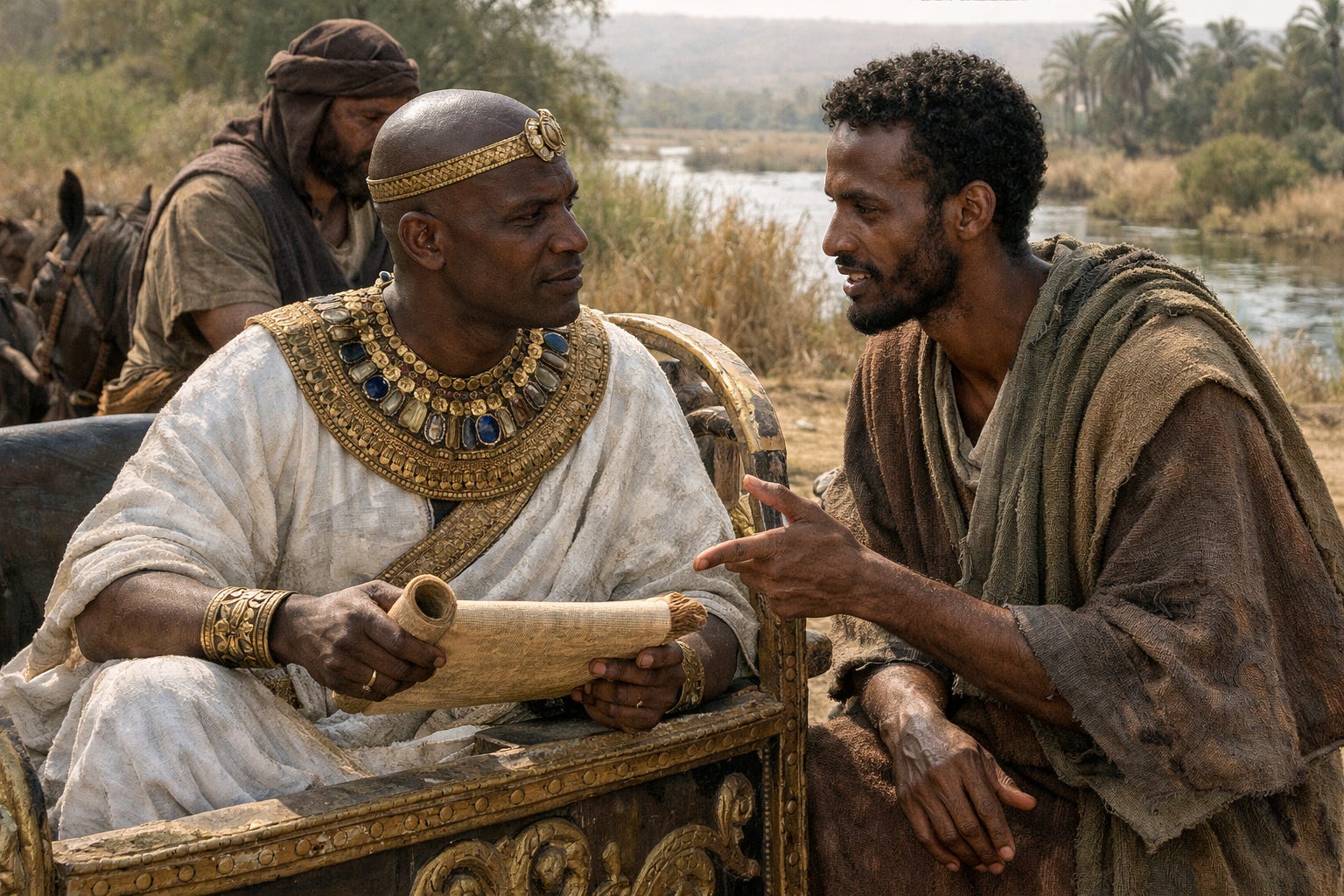
Consider the Ethiopian official in Acts 8, that mysterious figure returning from worship in Jerusalem. Philip meets him reading the book of Isaiah, and the Ethiopian asks, "How can I understand unless someone guides me?" After Philip explains the gospel, the Ethiopian responds immediately: "See, here is water. What is to prevent me from being baptized?" Nothing prevented him, and tradition says he brought Christianity to Ethiopia, where it has existed continuously for nearly two thousand years, making Ethiopian Christianity older than most European versions of the faith.
The d1esert disciples, those remarkable ascetics who fled to the Egyptian wilderness in the third and fourth centuries, were mostly African. Their sayings became the foundation of Christian monasticism. When Benedict wrote his rule, when medieval monks sought spiritual wisdom, they turned to these African pioneers. This wisdom traveled from Africa to Europe, not the other way around.
The Coptic Church of Egypt and the Ethiopian Orthodox Tewahedo Church maintained Christian teaching through centuries when Europe was still being converted. While Germanic tribes were gradually becoming Christian, Ethiopian Christians were building magnificent rock-carved churches like those at Lalibela, architectural wonders that required faith, engineering skill, and a civilization capable of achieving such monumental vision.
What happened to this history? How did we lose it?
Part of the answer lies in the tragedy of conquest and colonization. When Europeans arrived in Africa with guns, they believed themselves to be bringing light to darkness, civilization to savagery, and a few centuries later in the southern delta of American, a pervert religion to slaves. But they were actually meeting Christian communities that were older than their own. Carter G. Woodson understood how systems of oppression worked to convince both oppressor and oppressed of false superiority and inferiority, how they destroyed the potential and genius of those they enslaved.
The slave trade and its aftermath made this erasure worse. Enslaved Africans were often forbidden to read, their own traditions looked down upon, their humanity denied—even as slaveholders claimed Christian justification for their cruelty. The contradiction was resolved not by ending slavery, but by reconstructing Christianity as a white man's religion, with a white God who somehow approved of Black enslavement. As Frederick Douglass observed, "Between the Christianity of this land, and the Christianity of Christ, I recognize the widest possible difference."
Yet even in slavery's darkness, African Americans created a Christianity that recovered something of the faith's original revolutionary power. The Negro spirituals carried both grief and hope, Moses and Jesus, suffering and deliverance. "Go down, Moses, way down in Egypt land, tell old Pharaoh, let my people go" this was not just a figure of speech but theology, a recognition that the God of Scripture stands with the oppressed against their oppressors. As the prophet Amos declared: "Let justice roll down like waters, and righteousness like an ever-flowing stream" (Amos 5:24).
Albert Raboteau documented the remarkable religious world that enslaved Africans created, showing how they maintained both visible institutional religion and a rich invisible spiritual life that sustained them through unimaginable suffering. Their faith was flexible and resilient, drawing from African traditions while embracing the liberating message of the gospel.
The Black church became what E. Franklin Frazier identified as a unique institution more than a religious organization, it functioned as a complete society within American society, providing not just spiritual nourishment but social structure, economic cooperation, and political organization. It was a space of refuge, resistance, and renewal. It produced Martin Luther King Jr., whose theology of nonviolent resistance drew from Jesus's Sermon on the Mount and Gandhi's example, who reminded America that the arc of the moral universe bends toward justice. It produced Fannie Lou Hamer, who sang freedom songs in Mississippi jails and declared that nobody's free until everybody's free.
C. Eric Lincoln built on Frazier's work to show how the Black church functioned as what he called a universal institution, one that addressed all aspects of Black life spiritual needs, psychological health, and material conditions in ways that no other institution could. This complete approach to ministry represented something deep about the church's original mission.
This is not just American history; it is Christian history. The Black church's emphasis on liberation, its complete vision of salvation including both soul and society, its joyful expressiveness in worship, these recover aspects of early Christianity that European theology had sometimes lost in its partnership with empire and respectability.
Henry H. Mitchell explored how the Black preaching tradition understood that real worship must engage the whole person, body, mind, and spirit, and must address the real conditions of people's lives. This wasn't just entertainment or emotion; it was a deep theological conviction about the nature of human beings and divine encounter.
W.E.B. Du Bois wrote of the souls of Black folk, recognizing the spiritual depth and complexity of a people who had survived the Middle Passage and slavery while maintaining their humanity and dignity. The Black religious experience, he understood, contained insights into suffering, hope, and redemption that the broader culture desperately needed.
Recovering this history matters for reasons beyond historical accuracy, important as that is. It matters because Christianity's African roots remind us that the gospel goes beyond any single culture, race, or civilization. When Paul writes that in Christ "there is neither Jew nor Greek, there is neither slave nor free, there is no male and female, for you are all one in Christ Jesus" (Galatians 3:28), he is not offering empty words but describing Christianity's essential nature, a faith that breaks down the hierarchies humans create and reveals our fundamental equality before God.
It matters because the assumption that Christianity is basically European has enabled terrible things. It eased the conscience of colonizers. It provided cover for the slave trade. It enables modern Christians to imagine that white American evangelicalism represents real Christianity while African or Latin American expressions are somehow less authentic or legitimate. This is not just incorrect; it is a form of idolatry, making our own cultural expression into God Himself. Walter R. Strickland II has written about the dangers of failing to recognize Christianity's global and diverse nature, warning against the temptation to make our cultural expression the standard by which all others are judged.
It matters because African Christianity, both ancient and modern, offers gifts the global church desperately needs. The African emphasis on community over individualism challenges Western Christianity's often isolated spirituality. The integration of faith and life, the refusal to separate sacred and secular into completely separate compartments, models a complete faith. The commitment to liberation and justice recalls Christianity's prophetic edge.
John Hope Franklin documented how the history of the Black church cannot be separated from the history of Black people in America, showing how the church served as the central organizing institution through slavery, Reconstruction, Jim Crow, and the civil rights movement. To understand one, you must understand the other.
Benjamin Mays and Joseph Nicholson produced groundbreaking research on the Negro church, demonstrating its unique character and function in American life. They showed how it served purposes far beyond what white churches typically imagined—as economic network, educational institution, political training ground, and cultural preserver.
The demographic reality of global Christianity makes this recovery urgent. The typical Christian today is not a white American or European but a woman in Africa or Latin America. Christianity's center has shifted south and east. If current trends continue, by 2050 only about one-fifth of the world's Christians will be non-Hispanic whites. The faith's future is African, Asian, and Latin American. Perhaps this is not the future but the recovery of Christianity's past—a return to its Mediterranean, African, and Middle Eastern origins. Scholars like Michael Bird and Scott Harrower have noted that this demographic shift should prompt Western Christians to recognize they are no longer at the center of the Christian world, if they ever truly were.
This should produce in us not anxiety but joy. "For the body does not consist of one member but of many," Paul writes in 1 Corinthians 12:14. "If the foot should say, 'Because I am not a hand, I do not belong to the body,' that would not make it any less a part of the body." The church's diversity is not a problem but a feature, not something to be solved but a gift to be celebrated.
What would it mean for white American Christians to truly grapple with Christianity's Black history? It would mean acknowledging that we are recipients of a tradition we did not create, inheritors of wisdom from North Africa and Ethiopia and Egypt, from the African Americans who kept faith alive in slavery and the Black church that taught America about justice. It would mean approaching African Christians not as junior partners who need our expertise but as brothers and sisters from whom we have much to learn. It would mean confronting how racial hierarchy has distorted our theology and damaged our churches.
Leroy Fitts has emphasized that ignoring the Black religious experience means ignoring a vital part of Christian history and a rich source of theological insight. Henry Louis Gates Jr. has documented the deep theological and philosophical contributions of the African American religious tradition, showing how it has produced some of the most significant religious thought in American history.
It would mean something like repentance—that good biblical word that means not just feeling sorry but turning around, changing direction, beginning to walk a new path. "If we confess our sins, he is faithful and just to forgive us our sins and to cleanse us from all unrighteousness" (1 John 1:9). Confession requires honesty about what we have done and left undone, the ways we have distorted the faith and pushed aside our brothers and sisters.
But repentance is not the end of the story. It is the beginning. Beyond confession lies reconciliation, that great theme of Paul's letters. "In Christ God was reconciling the world to himself" (2 Corinthians 5:19), and we are given "the ministry of reconciliation." Reconciliation does not mean ignoring difference or pretending past wrongs did not occur. It means the hard work of truth-telling and forgiveness, of building the beloved community that Martin Luther King envisioned. Jerome Gay Jr. has written powerfully about how genuine reconciliation requires both honest acknowledgment of past injustices and a commitment to building a more just future together.
The church has always done its best work when it remembered who it is, not an ethnic club or a cultural organization but the body of Christ, drawn from every nation and tribe and tongue. On Pentecost, the Spirit enabled the disciples to speak in languages they had never learned, and the crowd heard them, each "in our own native language" (Acts 2:8). The miracle was not uniformity but unity in diversity, the Spirit creating community across boundaries that humans cannot cross alone.
This is our inheritance and our calling. To receive it, we must recover the history we have forgotten, learn the names we never knew, tell the stories we have suppressed. We must let Perpetua and Felicity stand beside Peter and Paul. We must allow Augustine and Athanasius their rightful place in our tradition. We must recognize that when we sing "Amazing Grace," we sing a song written by a former slave trader whose conversion, real as it was, came slowly and incompletely—and we must remember that enslaved Africans transformed that hymn into something more profound than its author could imagine.
Isaiah Robertson has challenged Christians to see that the story of Black Christianity is not secondary to church history but central to understanding the faith itself. Wayne Croft Sr. has shown how recognizing the contributions of African and African American Christians enriches our understanding of the entire Christian tradition, making it fuller and truer.
The truth is that Christianity has always been a Black faith and a white faith and a brown faith. It has always belonged to the enslaved and the free, the colonized and the colonizer—though it stands always with the oppressed against their oppression. It is as African as it is European, as Asian as it is American. This is not political correctness or historical revisionism. It is simply reality, the reality we must see if we are to understand the church at all.
"For he himself is our peace, who has made us both one and has broken down in his flesh the dividing wall of hostility" (Ephesians 2:14). The wall has been broken down. The question is whether we will walk through the opening, into the larger room where all of God's children gather, into the fuller truth of who we are and what we might become together.
The recovery of Christianity's Black history is not a concession to modern politics. It is a homecoming, a return to a truth that was always there, waiting to be rediscovered. It makes us not smaller but larger, not weaker but stronger, not more confused but more clear about who we are and whose we are. It reminds us that the faith we treasure was shaped by African minds and African hearts, that its survival depended on African courage, that its future lies largely in African hands.
This should not threaten us. It should free us, free us from the narrow thinking that mistakes our own cultural expression for the faith itself, free us to encounter God in new ways through our brothers and sisters, free us to become more fully what we are called to be: the church, the body of Christ, one family under heaven.
So let us learn this history. Let us teach it to our children. Let us allow it to reshape our imagination and expand our hearts. Let us approach our African brothers and sisters not with condescension but with humility, ready to receive what they have to teach us. Let us build churches that look like heaven, diverse, joyful, reconciled, free.
"Therefore, since we are surrounded by so great a cloud of witnesses," the writer of Hebrews reminds us, "let us also lay aside every weight, and sin which clings so closely, and let us run with endurance the race that is set before us, looking to Jesus, the founder and perfecter of our faith" (Hebrews 12:1-2). That cloud includes Perpetua and Augustine, the Ethiopian official and the Desert Mothers, Frederick Douglass and Fannie Lou Hamer, and countless others whose names we know and millions whose names only God remembers.
They ran their race. They kept the faith. They passed it to us, this precious, complicated, glorious inheritance. Now it is our turn to run, to keep faith, to pass it on, fuller and truer than we received it, enlarged by our recovery of what was lost, enriched by our reconciliation with one another, ready for whatever future God is preparing.
The race is long, but we do not run alone. We run together, all of us, every color and nation, the whole beautiful, broken, redeemed family of God. And that is reason for hope, for joy, for perseverance in the work still before us.
Let us run.
_________________
Visit the Urban Christian Writer's Guild on Instagram to discover the resources mentioned in this article.


