

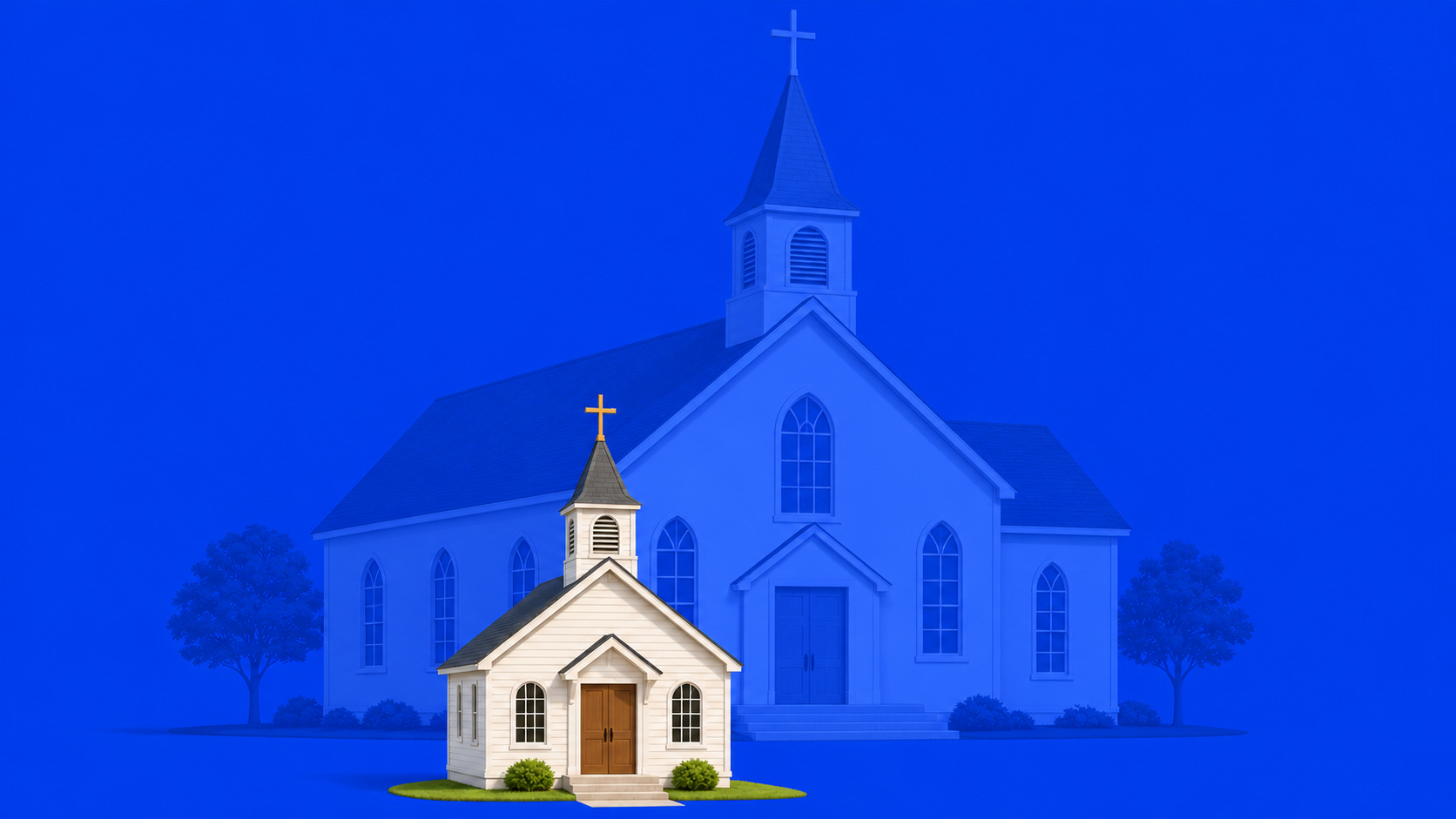
Consider the sound of ninety people singing in a room built for twelve hundred. The voices are sincere, but they rise into the vaulted ceiling and disappear. The balcony is roped off. The choir loft holds boxes. The heating bill arrives in the same envelope each month, as faithful as any deacon, and it is paid by people who are one year older than they were last winter. Nobody in the room says aloud what everyone is thinking, which is that the building has become larger than the church.
Right-Sizing Our Sanctuaries Is an Act of Faith, Not Failure.
This scene is repeating itself across the country, and it deserves a plain and tender conversation rather than a defensive one.
The Arithmetic of Decline
The numbers do not lie, though they do have nuance. Pew's 2023-24 Religious Landscape Study found that 62% of American adults identify as Christian, down from 78% in 2007, though the decline has slowed in recent years.1 The generational gap is the sharper concern. Among adults ages 18 to 24, 46% identify as Christian, compared with 80% of those 74 and older.2 Gallup reports that church membership, which hovered near 70% for six decades, fell to 47% in 2020.3 Meanwhile Lifeway Research estimates that about 4,000 Protestant churches closed in 2024 while roughly 3,800 were started.4
Our older congregations built their sanctuaries in an era of full pews and large families, and they built them well. But the people who filled those pews are aging, and their children and grandchildren have, in many cases, wandered elsewhere. Add the rising cost of living, which pushes every utility bill, insurance premium and repair estimate higher, and the strain compounds. One report from Partners for Sacred Places found that more than a quarter of congregational budgets nationwide goes to building maintenance.5 A ministry that spends a quarter of its resources keeping the lights on has a real question to answer about whether it is serving the building or the building is serving it.
Why We Resist
Resistance to scaling down is not stubbornness. It is grief wearing a practical disguise. The sanctuary holds the weddings, the funerals, the baptisms, the Easter mornings. A widow remembers where her husband sat. A deacon remembers laying the carpet with his own hands. To suggest leaving that place can feel like suggesting we forget those people. There is also the quiet fear that downsizing is surrender, a public admission of failure to a watching neighborhood. And there is the hope, honorable but often unexamined, that a revival, a new pastor or a new program will fill the pews again and vindicate the sacrifice.
These feelings deserve respect. Yet one pastor described his congregation's decision to sell as a grief process that followed a long and thorough period of discernment.6 Grief and wisdom can walk together. What cannot continue indefinitely is the pretense that nothing needs to change.
What the Bible Teaches
Scripture never equates the church with a structure. Jesus promised that where two or three have gathered in His name, He is in their midst.7 The first Christians met in the temple courts and broke bread from house to house with gladness.8 Stephen reminded the council that the Most High does not dwell in houses made by human hands.9 Peter calls believers living stones being built up as a spiritual house.10 The church is a people before it is a property.
Scripture also commends counting the cost. Jesus asked which of us, wanting to build a tower, does not first sit down and calculate whether he has enough to finish it.11 Stewardship is not a lack of faith. It is faith with its sleeves rolled up.
And Scripture honors small beginnings and small flocks. The Lord asked through Zechariah, “For who has despised the day of small things?”12 Jesus told His disciples not to be afraid, little flock, because the Father has chosen gladly to give them the kingdom.13 When the returning exiles laid the foundation of the second temple, the old men who remembered Solomon's temple wept while others shouted for joy.14 Both responses were real. Yet God, speaking through Haggai, promised that the latter glory of the house would be greater than the former.15 A smaller house is not a smaller promise.
What Scaling Down Gives Back
The benefits are concrete. A right-sized building costs less to heat, insure and repair, which frees money for what the church exists to do: benevolence, missions, discipleship, pastoral care. A full room of eighty feels alive in a way a quarter-full room of twelve hundred never can. One community leader in St. Louis observed that oversized churches can even speed the decline of the congregation itself.16 Singing is stronger, fellowship is closer, and visitors no longer feel they have stumbled into a museum.
A move can also place a congregation nearer to where people actually live, in a neighborhood that needs a witness. Some churches pair the move with shared use, renting space to a school, a food pantry or a start-up congregation. Others sell to a church plant or a community organization, so the old building keeps serving the kingdom. Congregations that would rather stay can explore merging and sharing space, which is a worthy path. But those who will neither merge nor share must be honest about the numbers.
A Hopeful Horizon
I want to close with hope, because hope is what a new building represents. A new location says that the church is alive and willing to move toward people. It says to a teenager that this congregation is not a monument to the past but a community with a future. It lets older saints pass on a legacy and not merely a mortgage, and it lets the next generation walk into a space sized for the people actually there.
The sanctuary of the future may seat a hundred. Its walls may be plain. But if the Spirit is there, and the Word is open, and the doors are wide, then it will not be a retreat. It will be a beginning, and the Lord has never despised those.
__________________
Footnotes
1. Pew Research Center, “Decline of Christianity in the U.S. Has Slowed, May Have Leveled Off,” Feb. 26, 2025. pewresearch.org/religion/2025/02/26/decline-of-christianity-in-the-us-has-slowed-may-have-leveled-off/
2. Ibid.
3. Gallup, “U.S. Church Membership Falls Below Majority for First Time,” 2021. news.gallup.com/poll/341963/church-membership-falls-below-majority-first-time.aspx
4. Lifeway Research, “Church Closures Eclipse Openings in the U.S.,” Jan. 13, 2026. news.lifeway.com/2026/01/13/lifeway-research-finds-church-closures-eclipse-openings-in-the-u-s/
5. Partners for Sacred Places, as reported in Baptist News Global. baptistnews.com/?p=173690
6. Ibid.
7. Matthew 18:20 (NASB).
8. Acts 2:46 (NASB).
9. Acts 7:48 (NASB).
10. 1 Peter 2:5 (NASB).
11. Luke 14:28 (NASB).
12. Zechariah 4:10 (NASB).
13. Luke 12:32 (NASB).
14. Ezra 3:12-13 (NASB).
15. Haggai 2:9 (NASB).
16. St. Louis Public Radio, “Empty Pews May Mean It's Time To Downsize, Religious Leaders Say.” stlpr.org/post/empty-pews-may-mean-it-s-time-downsize-religious-leaders-say