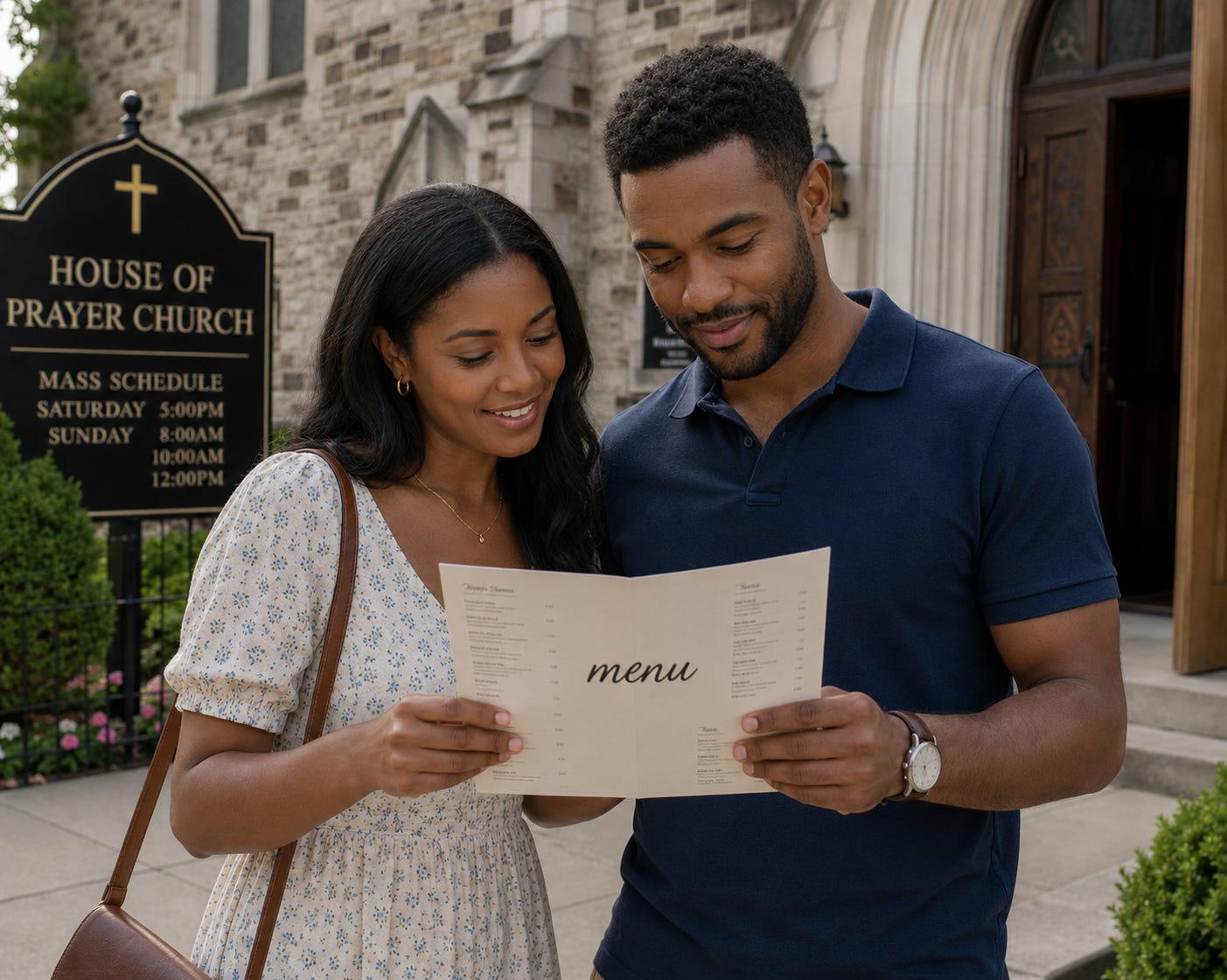
The Church Is Not a Restaurant
Consumer Christianity and the Slow Erosion of Discipleship
What if the greatest crisis facing the American church is not persecution from without, but preference from within?
Something has shifted in the way a generation comes to church. They arrive with the posture of a customer, evaluating, comparing, and calculating. The music is auditioned. The sermon is rated. The parking situation is factored in. If the coffee is good, they’ll stay another week. If the children’s program feels underfunded, they are already searching for alternatives before the benediction has landed. They have not come to encounter God. They have come to be served.
This is what scholars and practitioners have begun calling consumer Christianity, and it may be the most quietly devastating force in the contemporary American church.
The Architecture of Appetite
Consumer Christianity is not a theological position. It is a posture, a set of largely unconscious assumptions about what the church exists to do and whom it exists to serve. At its core, it treats the local congregation as a vendor of religious goods and services: worship experiences, community programming, inspiring content, and spiritual self-help. The congregant, in this framework, is not a member of a body but a subscriber to a platform. And like any subscriber, they reserve the right to cancel.
The sociologist Christian Smith identified decades ago what he called “moralistic therapeutic deism,”1 the belief that God exists primarily to help individuals feel good and live well, and that religion is a resource for personal flourishing rather than a call to cruciform discipleship. Consumer Christianity is its ecclesiological expression. It takes Smith’s therapeutic God and builds Him a campus.
The marketplace metaphors are no accident. American evangelicalism in particular has been deeply shaped by market logic since the post-war era. Churches learned to speak the language of growth, branding, and audience. Some of this was strategically wise. The instinct to make the gospel accessible is a noble one. But somewhere along the way, accessibility curdled into accommodation, and accommodation hardened into a theology of preference. Bill Hybels, Rick Warren, Andy Stanley, Craig Groeschel, and Joel Osteen are considered to be the most the most influential figures in contributing to the creation of this cultural shift.
When Church Was a Covenant, Not a Contract
My grandparents did not go to church to find a church that “worked for them.” They went to church because the church was where God’s people assembled before God’s presence, and you did not miss that. There was no consumer calculus. The question was never whether the worship team met their aesthetic expectations. The question was whether they had been faithful.
For that generation, and for most of the church’s twenty centuries before them, the Lord’s Day gathering was understood as a covenantal act. You came not primarily to receive but to participate, in worship, in confession, in the breaking of bread, in the hearing of the Word proclaimed. You came expecting that the congregation would meet God, and that God would meet the congregation. The encounter was the point. You were not the audience. You were the offering.
Augustine went to church in Hippo not because Bishop Valerius had a dynamic personality, but because the eucharistic assembly was the site of the church’s participation in the risen Christ. Medieval Christians walked miles in winter to hear the Mass, not because the experience was emotionally satisfying, but because they understood themselves to be enacting something cosmic. The Black Baptist tradition, forged in the fires of slavery, sustained through the long suffering of Jim Crow, built churches that were not venues but sanctuaries. The congregation gathered, and the Spirit moved, and lives were changed, and the community was strengthened for another week of a world that did not love them. The church was not a service they used. It was a people to whom they belonged.
What Consumer Culture Does to Discipleship
The damage consumer Christianity inflicts on discipleship is both subtle and severe.
Discipleship, at its root, is the process by which a person is formed into the image of Jesus Christ. It requires discomfort. It requires accountability. It requires the willingness to remain in a community through conflict, through seasons of spiritual dryness, through sermons that challenge rather than comfort. Discipleship is not optimized; it is endured and embraced. It is, in the language of Dallas Willard, a training in godliness that demands the reordering of the whole self, will, mind, body, and affection.
Consumer Christianity is structurally incompatible with this. When a congregant understands their relationship with a church as transactional, they leave the moment the cost exceeds the perceived benefit. But the moments that cost the most, the sermon that exposes a hidden sin, the accountability conversation that feels intrusive, the community that calls you back from a comfortable compromise, are precisely the moments in which the most formation occurs. The consumer exits at the threshold of transformation.
Pastors bear some responsibility here. Many have been trained, explicitly or implicitly, to read attendance numbers as the primary metric of faithfulness. When people leave, the instinct is to ask what the church failed to provide, rather than what the culture of discipleship failed to demand. This creates a feedback loop: the church adjusts its offering to retain consumers, which attracts more consumers, which further dilutes the conditions necessary for genuine discipleship.
The congregation grows numerically while shrinking spiritually. The budget expands while the depth contracts. The consumer exits at the threshold of transformation. Discipleship requires exactly the discomfort that consumer culture is designed to eliminate. There is also a profound ecclesiological distortion at work.
The New Testament does not know of a Christian who is not embedded in a local body. The epistles are addressed to churches. The metaphors, body, family, temple, flock, are all irreducibly communal. One does not merely attend a church. One belongs to it, is accountable within it, suffers with it, and serves through it. Consumer Christianity severs the nerve of belonging and replaces it with visitation. The person who is shopping for a church has, by definition, not yet submitted to one. And submission, to leadership, to community, to the disciplines of a particular congregation’s life together, is not incidental to discipleship. It is its very medium.
The Way Forward: Recovering a Theology of Presence
The church will not overcome consumer Christianity by becoming more appealing. It will overcome it by becoming more itself. This begins with theological recovery. Pastors must preach an ecclesiology that is robust enough to resist market logic. Congregations must understand that they have not been gathered by their preferences but by the Holy Spirit.
The church does not exist to meet felt needs. It exists to conform a people to the image of the Son, for the glory of the Father, through the power of the Spirit, and the path runs through the cross before it arrives at the crown. When people understand this, the question of whether the parking lot is convenient becomes almost comically beside the point.
It also requires structural courage. Churches must be willing to build the scaffolding of genuine discipleship, small groups that are not optional, accountability relationships that have teeth, membership covenants that actually mean something, preaching that afflicts the comfortable and not merely comforts the afflicted. This will not grow a crowd. It will grow a church. And that is a distinction worth recovering.
The African American Baptist tradition has a particular gift to offer this moment. Born in communities where the church was the only institution that belonged entirely to Black people, where the congregation was simultaneously a house of worship and a school of freedom, the Black church has historically understood itself as a covenant community rather than a voluntary association. Its members did not shop. They belonged. They sacrificed. They stayed. The tradition’s instinct toward communal faithfulness, toward the church as a redemptive institution embedded in a particular place and people, is precisely what the broader American church needs to recover.
Finally, the church must recover a thick vision of the Sunday gathering itself. Worship is not entertainment. The sermon is not a TED Talk. The table of the Lord is not a spiritual snack bar. These are the means of grace, the appointed places where the risen Christ meets His people. When congregations understand this, they do not come asking what they will get out of it. They come asking whether they are prepared to stand in the presence of the living God. That is a very different question. And it produces a very different kind of Christian.
The church does not exist to meet felt needs. It exists to conform a people to the image of the Son, and the path runs through the cross before it arrives at the crown.
Why This Matters for the Future
We are entering an era in which the cultural supports for nominal Christianity are collapsing. The social incentives that once kept lukewarm believers in the pews, respectability, community belonging, professional networks, are dissolving. In their place, following Jesus will increasingly require something that consumer Christianity cannot produce: conviction.
A church full of consumers will not survive the pressures of a post-Christian culture. Consumers leave when the cost rises. Disciples stay. The early church did not transform the Roman Empire through superior programming. It transformed it through communities of formation so compelling, so countercultural, so marked by love and suffering and resurrection hope, that they could not be ignored or explained away. Tertullian reported that the pagans said of the Christians: “See how they love one another.”2 They did not say: “See how they have optimized their weekend experience.”
The church that will bear faithful witness in the twenty-first century is the church that has done the hard work of forming disciples rather than attracting consumers. It is the church that has resisted the temptation to become whatever the market demands, and instead asked what the gospel demands. It is the church that still believes, against every cultural pressure, that Sunday morning is not a transaction but a visitation, that God Himself shows up when His people gather in His name, and that such a meeting is worth any inconvenience, any discomfort, any sacrifice.
My grandparents knew this. The question is whether we have forgotten it, or whether we still have time to remember.
Smith, Christian, and Melina Lundquist Denton. 2009. Soul Searching : The Religious and Spiritual Lives of American Teenagers. [S.l.]: Oxford University Press. https://ebook.yourcloudlibrary.com/library/oclc/detail/w8g6zz9.
Tertullian's Apology (Apologeticus), Chapter 39


