The Faith That Saved Us
How the Christian faith became the wellspring of endurance, dignity, and hope for a people who refused to be defined by their chains.
There are moments in history when survival itself becomes an act of theology. When every external system—economic, political, and social—conspires to strip away a people’s dignity, what remains is not merely resistance, but faith. The Christian faith, in particular, has done more than comfort African Americans through centuries of suffering; it has formed them. It has given structure to hope, a vocabulary for pain, and a transcendent foundation for self-worth when the world declared them worthless. For African Americans, Christianity was never a borrowed religion—it became a redemptive revolution of the soul.
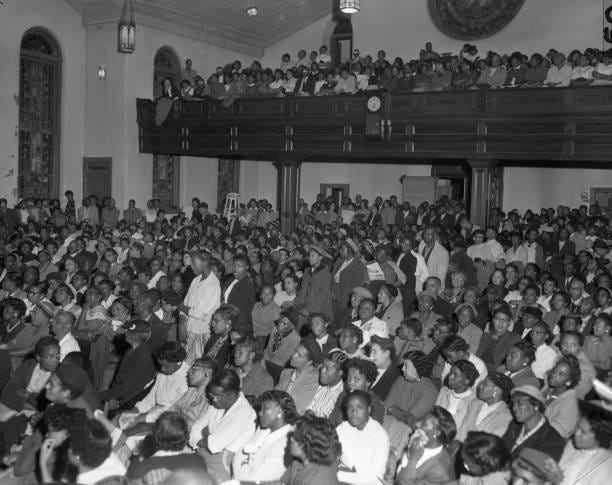
From the hush harbors of the antebellum South to the urban sanctuaries of the Great Migration, this faith has done something radical: it made Black people see themselves as image-bearers of God. It declared, in a world of auction blocks and Jim Crow signs, that Black lives were not only valuable but divinely crafted. The faith that saved them wasn’t naïve optimism—it was an incarnational realism, rooted in a God who suffers, redeems, and resurrects.
1. Faith as Survival: Harriet Tubman and the God Who Guides
Harriet Tubman’s story is not just one of courage—it is a theology of trust embodied. Called “Moses” by those she led, Tubman’s liberation work flowed directly from her unshakable belief that God guided her steps. She claimed to “hear” His voice. In an era where escape meant certain death if caught, her faith functioned as both compass and shield. She didn’t read theology; she ‘walked’ it. Tubman’s life mirrors Psalm 23:4—“Even though I walk through the valley of the shadow of death, I will fear no evil, for you are with me.” Her story reminds us that divine accompaniment can turn oppression into pilgrimage. Faith was not escapism; it was existential survival.
2. Faith as Identity: Frederick Douglass and the God Who Names
For Frederick Douglass, faith provided not refuge but revelation. When the world labeled him property, the Gospel proclaimed him personhood. Douglass’s Christianity was fiercely moral—he distinguished between “the Christianity of Christ” and “the Christianity of this land.” The former set him free; the latter tried to enslave him. In that distinction, Douglass found identity. He embodied Genesis 1:27—“So God created man in his own image.” Faith gave him a name when the system gave him a number. It became a lens through which he could say, “I am not what the slaveholder says I am; I am who God says I am.”
3. Faith as Liberation: Sojourner Truth and the God Who Speaks
Sojourner Truth understood faith as the language of liberation. Illiterate yet luminous, she preached with prophetic fire because she believed the Spirit spoke through her. “Ain’t I a Woman?” was not only a feminist cry—it was a theological assertion that God’s justice included her full humanity. Truth embodied Luke 4:18—“The Spirit of the Lord is upon me… He has sent me to proclaim liberty to the captives.” For her, Christianity was not a system to maintain but a fire to ignite. Faith gave her a platform from which to confront both slavery and sexism with the same sacred authority.
4. Faith as Foundation: Richard Allen and the God Who Builds
If Harriet Tubman embodied faith on the run, Richard Allen embodied faith that roots and rebuilds. Born into slavery, Allen purchased his freedom and went on to found the African Methodist Episcopal (AME) Church—the first independent Black denomination in America. When white Methodists forced him and his congregants from their knees in prayer, Allen did not retaliate with bitterness; he responded by building a new house of worship. His founding of the AME Church was not merely institutional; it was theological—a declaration that the same Spirit that descended at Pentecost had fallen upon Black believers, too. Allen’s faith resonates with Isaiah 58:12—“Your people will rebuild the ancient ruins and raise up the age-old foundations.” His life shows that faith not only liberates individuals but constructs communities where dignity and divine purpose are reclaimed.
5. Faith as Humanization: Rev. Dr. Martin Luther King Jr. and the God Who Redeems History
Dr. King’s theology of nonviolence was not strategy—it was eschatology. He believed that love was the most potent weapon for reshaping history because it was rooted in the nature of God. King’s dream was not simply a political vision; it was a divine mandate. He lived Philippians 2:5—“Let this mind be in you, which was also in Christ Jesus.” His understanding of the cross was both historical and personal—it revealed how redemptive suffering could expose the moral bankruptcy of hate and awaken the conscience of a nation. King taught America that the arc of the moral universe bends toward justice because the hands that hold it are nail-scarred.
6. Faith as Restoration: Fannie Lou Hamer and the God Who Sees
Fannie Lou Hamer’s refrain, “I’m sick and tired of being sick and tired,” was not despair—it was lament, that sacred form of protest before God. Her activism emerged from her faith, not apart from it. When she sang “This Little Light of Mine” facing police brutality, she testified to Psalm 27:1—“The Lord is my light and my salvation; whom shall I fear?” For Hamer, faith was the restoration of moral courage in a world intent on silencing her. It re-humanized her and those she fought for, grounding activism in divine worth.
Through each of these lives, we see that Christianity in the African-American experience was not imposed but reinterpreted, not passive but prophetic. It became a theology of survival, identity, liberation, foundation, humanization, and restoration. It was—and remains—a lived apologetic, a faith that dignifies the oppressed by affirming that God is not neutral in the struggle for justice.
And so, amid the fractures of our present age, this faith still speaks. It tells us that endurance is possible because resurrection is real. That history is not a closed circle of despair but an open story of redemption. As Paul reminds us in Romans 8:37 “In all these things we are more than conquerors through Him who loved us.”
The faith that saved me—the faith that saved us—is not one of mere survival but of resurrection. It has carried a people from chains to choirs, from fields to pulpits, from invisibility to dignity. And it continues to whisper to every weary soul: God has not forgotten you. Keep the faith that saved you, for it is still saving us all.


