The Great Falling Away?
The signs described by Paul to the Thessalonians and Timothy are not abstractions. They are the morning news.
What if the most consequential spiritual event in human history is not approaching, but already underway, and most of us are too distracted, or too comfortable, or too thoroughly shaped by the age itself, to notice?
I've been thinking about this question with increasing urgency, not from the margins of some fevered prophecy conference, but from the center of ordinary civic and cultural life. Every week I sit across from people, educated, thoughtful, well-intentioned people, who have quietly and without fanfare abandoned the faith that once organized their inner world. They haven't become atheists, exactly. They've become something more elusive: they've become people for whom the transcendent simply no longer registers. The heavens are not telling the glory of God for them. They are just the sky.
The Apostle Paul, writing to the church at Thessalonica roughly two decades after the resurrection, warned of a specific and dramatic event he called the apostasia, the great departure, the falling away.
"Let no one deceive you by any means," he wrote, "for that Day will not come unless the falling away comes first" (2 Thessalonians 2:3).
The Greek word apostasia does not merely suggest theological disagreement or denominational shuffling. It implies a deliberate, sweeping, and catastrophic defection from the faith, a mass turning away that would precede and perhaps precipitate the final crisis of history.
"For that day will not come, unless the rebellion comes first, and the man of lawlessness is revealed, the son of destruction, who opposes and exalts himself against every so-called god or object of worship, so that he takes his seat in the temple of God, proclaiming himself to be God." — 2 Thessalonians 2:3-4
Now, I want to be careful here, as I think any honest observer must be. Every generation of Christians has been tempted to believe it was the terminal generation, the one living through the last act. That temptation itself is a kind of spiritual vanity, and it has been wrong every time before. I hold that humility close.
And yet, when I read Paul's letters to Timothy, those final, urgent, almost desperate dispatches from an old man who knew his execution was near, I am struck not by their distance from our moment but by their precision. Paul describes a society in the last days with the specificity of a diagnostician who has seen the culture's bloodwork and does not like what he sees.
"But understand this, that in the last days there will come times of difficulty. For people will be lovers of self, lovers of money, proud, arrogant, abusive, disobedient to their parents, ungrateful, unholy, heartless, unappeasable, slanderous, without self-control, brutal, not loving good, treacherous, reckless, swollen with conceit, lovers of pleasure rather than lovers of God, having the appearance of godliness, but denying its power." — 2 Timothy 3:1-5
Read that list again slowly. Lovers of self. Lovers of money. Proud, arrogant, abusive. Ungrateful, unholy, without self-control. Lovers of pleasure rather than lovers of God. This is not a caricature of modern culture. This is, in many respects, the aspirational self that modern culture actively manufactures and markets. The wellness industrial complex packages self-absorption as healing. The financial media glorifies wealth accumulation as virtue. Social media has invented an entirely new architecture for pride, arrogance, and the performance of the self.
And then there is that most chilling phrase: "having the appearance of godliness, but denying its power." This is not describing outright paganism. This is describing something far more sophisticated, a religiosity emptied of the holy, a spirituality that has filed off the uncomfortable edges of actual encounter with the living God. We have become, in many quarters, a nation of people who speak with the vocabulary of faith while having quietly evacuated its claims. We do not deny God at the podium. We simply arrange our lives so that he is unnecessary.
The sociologist Christian Smith famously described the dominant theology of American teenagers, and, he came to the conclusions that they viewed their parents faith, as "Moralistic Therapeutic Deism." God exists, according to this faith, to help us feel good about ourselves and to reward nice behavior. He is a divine therapist, on call but not sovereign. He does not demand. He does not judge. He certainly does not make the kind of absolute claims that would interrupt a Saturday morning or require genuine sacrifice.

This is precisely what Paul warned Timothy about. "For the time is coming," he wrote with that quiet urgency of the condemned, "when people will not endure sound teaching, but having itching ears they will accumulate for themselves teachers to suit their own passions, and will turn away from listening to the truth and wander off into myths" (2 Timothy 4:3-4).
"For the time is coming when people will not endure sound teaching, but having itching ears they will accumulate for themselves teachers to suit their own passions, and will turn away from listening to the truth and wander off into myths." — 2 Timothy 4:3-4
Itching ears. I cannot think of a more precise description of the contemporary multi-media and spiritual marketplace. We have built entire streaming platforms, podcast networks, and social media algorithms specifically designed to find us the content that confirms what we already believe, strokes what we already feel, and never interrupts us with the hard thing. The prophets of this age do not cry out from the wilderness. They have YouTube, ring lights, and curated tiktoks. And they tell us, masterfully, beautifully, exactly what our itching ears have been longing to hear.
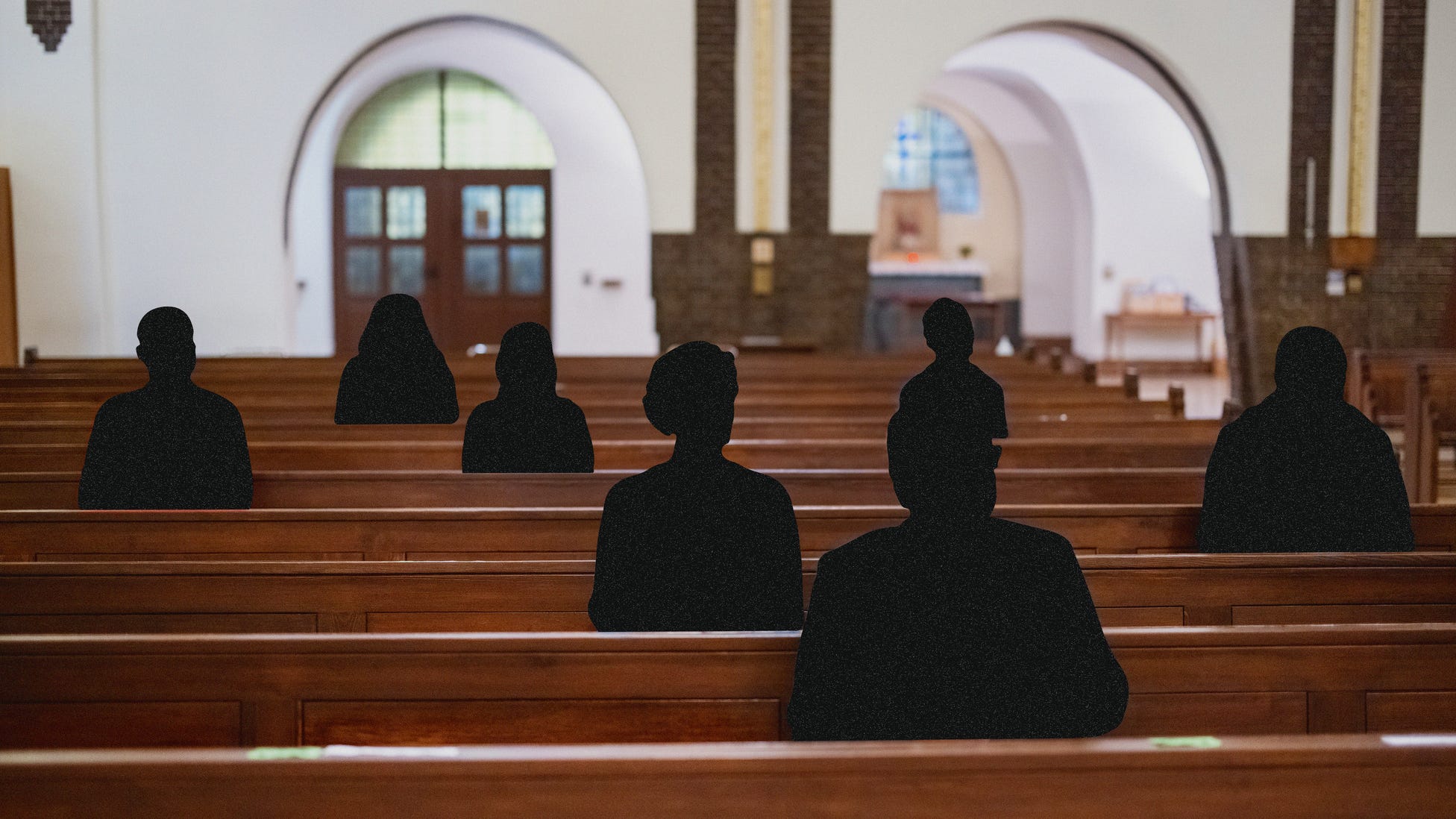
The great falling away, if that is what this is, would not look like a dramatic public apostasy. It would not look like the burning of Bibles or the razing of cathedrals. It would look like this: a slow, comfortable, fully rationalized drift away from the claims of God, conducted by people who still consider themselves spiritual, who still feel warmly about Jesus in the abstract, but who have in practice made themselves the final authority over their own lives. It would look like empty pews in aging mainline churches and megachurches that have traded the sermon on the mount for the sermon on personal optimization. It would look like a generation of young people who are, statistically, the least religiously affiliated in American history, not atheists, mostly, just nones, people for whom the whole question has become irrelevant.
Paul's description in 2 Thessalonians also introduces what he calls "the mystery of lawlessness," already at work in his day, and being restrained by some force he references with intriguing vagueness (2 Thessalonians 2:7). When that restraint is removed, he suggests, the full chaos of a world that has rejected God's ordering will be unleashed. What strikes me is the word he uses for the coming deceiver's method: signs and wonders performed in the service of falsehood, received eagerly by people who "refused to love the truth" (2 Thessalonians 2:10).
"The coming of the lawless one is by the activity of Satan with all power and false signs and wonders, and with all wicked deception for those who are perishing, because they refused to love the truth and so be saved." — 2 Thessalonians 2:9-10
Refused to love the truth. Not were unable to find it. Not lacked sufficient evidence. Refused. This is a volitional act, a moral choice, dressed up in the clothing of intellectual sophistication. I think of the ways in which our culture has made truth itself a contested category, not as an achievement of hard epistemology but as a lifestyle choice, a political affiliation, a matter of which team you're on. When truth becomes tribal, the capacity to be deceived on a massive scale becomes not just possible but inevitable.
I am not, let me be clear, making a simple partisan argument. The crisis Paul describes cuts across political lines with ruthless indifference. The prosperity gospel that has infected large swaths of conservative Christianity, the idea that God's favor manifests primarily in health, wealth, and national dominance, is as much a refusal to love the truth as any progressive theological revision. Both represent the same fundamental move: the reshaping of God in our own image, the subordination of the divine to the merely human.
Here is what I keep returning to, as someone who has spent time trying to understand what holds societies together and what pulls them apart: the health of a civilization is downstream from the health of its spiritual life. Augustine understood this. Tocqueville understood it watching America in the 1830s. The habits of the heart that make democratic self-governance possible, the capacity for self-restraint, for genuine concern for the other, for deferred gratification, for the acknowledgment of a moral order that transcends personal preference, these habits were, historically, cultivated in religious community. When that community erodes, something must fill the gap, and what has rushed in is not the neutral, secular pluralism its advocates imagined. What has rushed in is a fierce, quasi-religious politics of identity, grievance, and will-to-power.
Paul told Timothy, in the middle of that same urgent letter: "I charge you in the presence of God and of Christ Jesus, who is to judge the living and the dead, and by his appearing and his kingdom: preach the word; be ready in season and out of season; reprove, rebuke, and exhort, with complete patience and teaching" (2 Timothy 4:1-2). Out of season. That phrase lands with particular force. The faithful proclamation of the word was going to feel, Paul knew, chronically out of season — awkward, unwelcome, culturally maladroit. That is not a bug in his instruction. It is the feature. Faithfulness, in certain seasons of history, is precisely the refusal to accommodate the spirit of the age.
"I charge you in the presence of God and of Christ Jesus... preach the word; be ready in season and out of season; reprove, rebuke, and exhort, with complete patience and teaching. For the time is coming when people will not endure sound teaching." — 2 Timothy 4:1-3
So are we living through the great falling away? I don't know with certainty, and anyone who tells you they do with confidence is selling something. The New Testament itself counsels epistemic humility about eschatological timing, even the Son of Man, Jesus said, did not know the day or the hour (Matthew 24:36). What I do know is that the conditions Paul described are not hypothetical. They are present. The apostasia, the drifting away, the love of self over God, the itching ears, the accumulation of teachers who flatter rather than challenge, these are not coming. They are here, measurable, documented, statistically robust.
What does that call us to? Not panic, certainly. Not the paranoid withdrawal from culture that leaves the world to its own worst impulses. Paul's instruction to Timothy, written from a Roman prison with execution pending, was not to retreat but to endure, to preach, to do the work of an evangelist, to "fulfill your ministry" (2 Timothy 4:5). The church in Thessalonica was told, after all the apocalyptic warning, to "stand firm and hold to the traditions that you were taught" (2 Thessalonians 2:15).
"So then, brothers, stand firm and hold to the traditions that you were taught by us, either by our spoken word or by our letter." — 2 Thessalonians 2:15
There is something irreducibly hopeful in that instruction. Amid whatever era of falling away, the call is not to catastrophize but to anchor, to the ancient words, to the community of practice, to the strange and counter-cultural conviction that truth is not a construct, that love requires sacrifice, that a life of genuine faithfulness is more interesting, more difficult, and more real than the frictionless, self-curated life the age keeps promising us.
Perhaps that is the most subversive thing one can say in this particular cultural moment: that the falling away is real, that it has consequences, and that the antidote is not a smarter argument or a better political coalition, but a return to something very old, very demanding, and very true. Paul put it simply, at the end, as he always did when things were most serious:
"But as for you, continue in what you have learned and have firmly believed, knowing from whom you learned it." — 2 Timothy 3:14
Continue. In a season of departure, continuation is the act of courage. In an age of apostasia, faithfulness is the revolution.


