The Lost Art of Caring
Why Our Cold, Efficient Society Needs a Revival of Compassion
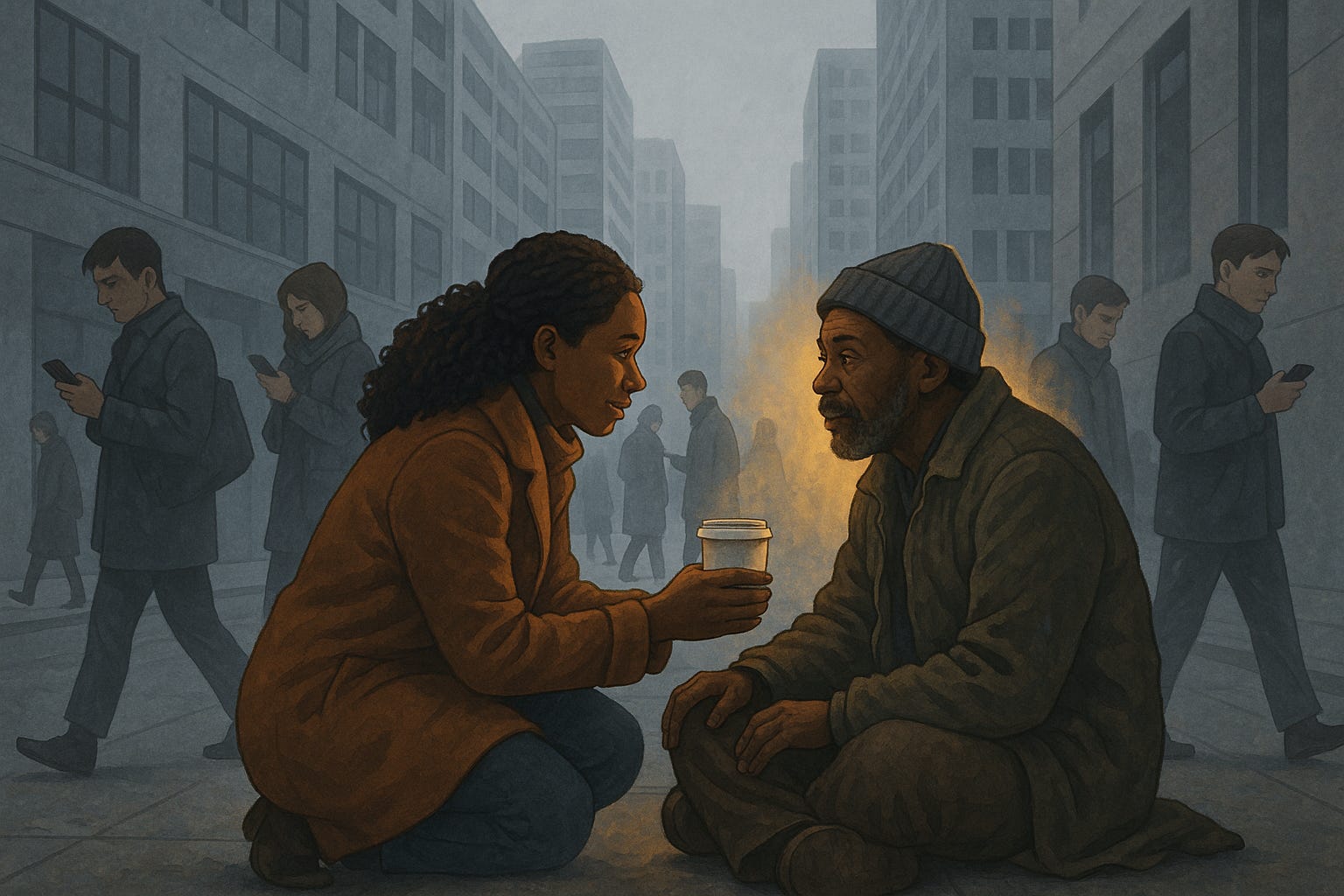
We walk past one another on city streets with eyes fixed to our screens, speak in transactional terms even about friendship, and measure worth in metrics rather than in shared humanity. Our social fabric feels frayed, the tone of public life is often cruel, and a pervasive sense of indifference seems to have settled over us like a winter fog.
In part, this is the price of our hyper-efficient modern world. We optimize for speed, productivity, and scale, but too often at the expense of empathy. We’re so busy winning the race that we forget about the person limping by the roadside. When we talk about social breakdown, we often mean institutional failures: family fragmentation, civic disengagement, economic inequality. But at the foundation of it all lies something simpler and more intimate—a failure to care.
Human societies have always needed a moral grammar that prioritizes caring for others. It’s no accident that in the biblical tradition, caring is not merely recommended; it is commanded. In Matthew 22:39, Jesus sums up the Law and the Prophets with: “You shall love your neighbor as yourself.” This is not a sentimental suggestion for a more polite society. It is a radical demand to see others as equally deserving of our time, our attention, our compassion.
Even more striking is Jesus’ description of the final judgment in Matthew 25:35-40, when he says:
“For I was hungry and you gave me food, I was thirsty and you gave me drink, I was a stranger and you welcomed me… Truly I say to you, as you did it to one of the least of these my brothers, you did it to me.”
Here caring is elevated to a holy act. Feeding the hungry, welcoming the stranger, visiting the prisoner—these aren’t mere private virtues. They’re the measure of our moral seriousness. Jesus says that to care for the vulnerable is to encounter the divine.
Contrast that with the world we see around us: polarized, suspicious, often pitiless. The strong build fortresses; the weak fend for themselves. Public discourse descends into insults and tribal sorting. Social media rewards cruelty with likes and retweets. Even many churches have become enclaves of cultural warfare rather than hospitals for the hurting.
Caring is hard. It’s slow. It doesn’t scale easily. It demands patience, humility, and the willingness to be inconvenienced. That’s precisely why it is so important, and so endangered. We cannot outsource caring to the market, the state, or an algorithm. It’s a moral capacity that must be cultivated, practiced, and passed on.
There is no policy fix for a lack of empathy. There is no app for compassion. But there is an ancient remedy: the practice of love. Real, costly love of neighbor. That means listening deeply. Making time for people who can’t pay you back. Welcoming the stranger. Forgiving those who wrong you.
So here’s my simple appeal. Look around you. Who is isolated, hurting, or overlooked? Who needs you to see them? The most important question we can ask isn’t “What’s in it for me?” but “What do they need from me?” That is the question at the heart of every caring community—and at the heart of Jesus’ vision for humanity.
If we want a more decent, humane, and hopeful society, we will need to recover the lost art of caring for one another. It starts small, with the choices you and I make every day. It costs something. But it might just be the most important work we do.


