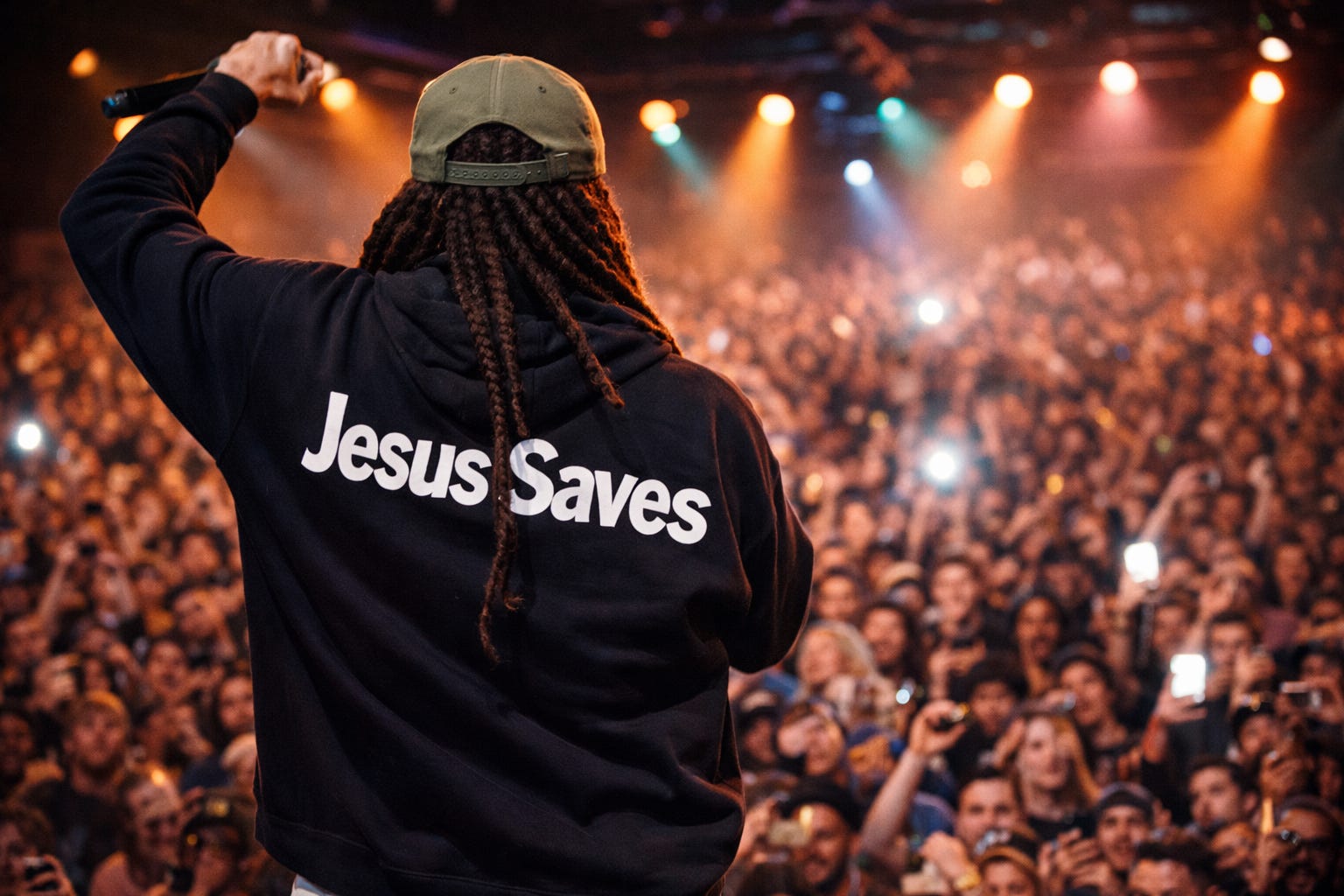
The Microphone and the Messiah
Some have long called Hip-hop a prophetic art form. Christian artists are finally positioned to prove it.
What if Jesus were an MC?
Not a metaphor. Not a thought experiment for seminary students. A genuine imaginative reckoning: What if the man from Nazareth, the one who turned the world’s value systems upside down, who ate with the despised, who spoke in parables designed to unsettle the comfortable and comfort the unsettled, had been born not in first-century Judea but in twenty-first-century Houston's Fifth Ward, Atlanta's Westside, Chicago’s South Side, or Fort Worth's Stop Six? How would he have proclaimed his message? Through what medium would he have reached the overlooked, the incarcerated, the addicted, the grieving, the young man standing on the corner at midnight with nowhere else to go?
I suspect he would have been an MC.
This is not as irreverent as it sounds. The Sermon on the Mount was not a lecture, it was a provocation, delivered not in the temple courts to the credentialed but on a hillside to the crowd, reminiscent of Public Enemy. Jesus did not write treatises. He told stories. He used the vernacular of his people, the imagery of farming and fishing and debt and wedding feasts, because he understood that truth travels best when it arrives in the native tongue of the listener’s life. The Spirit of the Lord was upon him precisely for this kind of mission.
“The Spirit of the Lord is on me, because he has anointed me to proclaim good news to the poor. He has sent me to proclaim freedom for the prisoners and recovery of sight for the blind, to set the oppressed free.” -Luke 4:18
Hip-hop, at its most serious, does exactly the same thing. It is a vernacular art form, born in the Bronx in the early 1970s among communities who had been systematically ignored by mainstream culture, and it has always carried within it a prophetic register that the church, frankly, has been too slow to recognize.
We are at a peculiar and remarkable moment in American cultural life. Religious curiosity is spiking, particularly among young people. And simultaneously, the economics and infrastructure of the music industry have shifted so dramatically that an independent Christian artist can now reach a global audience without the permission of a label, a radio station, or a gatekeeping executive. These two trends have converged into an opening, an opportunity not just for Christian hip-hop as a genre but for the Gospel itself. The question is whether the artist has the fearless imagination to walk through it.
The Unexpected Return of the Sacred
Somewhere between the mid-2000s rise of the New Atheism, which felt, for a season, like the final triumph of secular rationalism, and now, the cultural script flipped. The data are by this point well-documented. Surveys from Pew, Gallup, and a range of sociological researchers have shown that Gen Z, far from being the most thoroughly secular generation in American history, is in fact deeply and restlessly spiritual. They may not be piling into mainline Protestant churches on Sunday mornings. But they are searching. They are asking the ancient questions, about meaning, about suffering, about whether there is anything that holds the universe together, with an urgency that would not have surprised Augustine or Pascal.
What has changed is the platform where those questions are being asked. The town square of spiritual inquiry for this generation is not the sanctuary. It is the comment section of a late-night podcast, the thread beneath a viral video, the DMs exchanged after a song drops. And in that environment, the artists who can hold complexity, who can name suffering without sentimentality, who can speak of transcendence without kitsch, have an extraordinary amount of cultural authority. Hip-hop artists, in particular, have always known how to do this.
Think of the genre’s history. From its earliest days, hip-hop has engaged with theodicy, the problem of evil, the silence of God, the injustice of systems, with more unflinching honesty than most Sunday sermons. The Psalms, it is worth noting, modeled this posture long before there was a genre to describe it. David was a poet who had been to the bottom, who knew what it was to cry out to a God who seemed absent, and who insisted on voicing that experience with full force. There is a reason those poems have survived three millennia.
“I am worn out from my groaning. All night long I flood my bed with weeping and drench my couch with tears. My eyes grow weak with sorrow; they fail because of all my foes.” -Psalm 6:6–7
The opening has been there for a long time. What is new is who can now walk through it, and the tools they have been given to do so.
The Great Disintermediation
For most of the twentieth century, Christian artists who wanted to reach a mainstream audience faced a structural problem that had little to do with talent or message. The music industry was a gated system. Getting your music heard required the approval of label executives who answered to shareholders, radio programmers who answered to advertisers, and a distribution infrastructure that had no particular interest in theological disruption. Christian hip-hop, in that environment, was niche by ddefinition, confined to Christian bookstores and church conferences, speaking almost entirely to people who already believed.
That architecture is gone. Not weakened, gone. Streaming platforms have made distribution essentially free and universal. Social media algorithms reward content that provokes emotional response, which Gospel music, at its best, does with unmatched consistency. TikTok can turn a thirty-second clip of an unknown artist into a cultural moment overnight. YouTube has created a generation of listeners who discovered entire catalogs through a single algorithm-recommended video at two in the morning. The economics no longer require institutional permission.

This is the great disintermediation of culture, and it has been more democratizing than almost anything since Gutenberg. An independent Christian rapper recording in a home studio in Memphis can now put a track on Spotify on a Tuesday and have it heard in Lagos, London, and Los Angeles by Thursday. The middlemen who once decided what was commercially viable, and who rarely erred on the side of theological depth, have been substantially bypassed. The artist now speaks directly to the listener. The gatekeepers are gone. The artist now speaks directly to the listener. For those with something genuinely true to say, this is a gift of enormous consequence.
For those with something genuinely true to say, this is a gift of enormous consequence. The Apostle Paul was himself a tireless user of every available communication infrastructure, the Roman road network, the synagogue circuit, the network of house churches, the epistle as a broadcast medium. He understood that the message and the medium are inseparable. He made himself all things to all people, not out of spinelessness, but out of missionary conviction.
“I have become all things to all people so that by all possible means I might save some. I do all this for the sake of the gospel, that I may share in its blessings.” -1 Corinthians 9:22–23
He used what was available. Christian artists in 2026 have available to them a communications infrastructure of staggering reach. The question is whether they will use it with the same intentionality.
The Theology of the Cypher
What makes hip-hop uniquely suited to carrying the Gospel to this particular cultural moment is not just its reach. It is its form. Hip-hop is, at its structural core, a confessional art. The MC speaks in the first person. She narrates her own formation, the neighborhood, the losses, the temptations, the moments of grace. He catalogs his failures with an honesty that would make most pastoral memoirs look carefully managed. This confessional posture is not a stylistic accident. It is the genre’s original epistemological commitment: truth is earned through testimony, not assertion.
This happens to be exactly what the Christian tradition has always said about how genuine faith is communicated. You do not argue people into the kingdom. You witness. You tell what you have seen. The earliest Christian proclamation was not a philosophical proof, it was a report: we saw him, we touched him, we heard him. First John opens with almost breathless insistence on the sensory reality of testimony.
“That which was from the beginning, which we have heard, which we have seen with our eyes, which we have looked at and our hands have touched, this we proclaim concerning the Word of life.” -1 John 1:1
Augustine’s Confessions is, in its structure, a very long rap verse, one man’s unflinching account of his own wretchedness and the surprising grace that met him there. What hip-hop does in three minutes and forty-five seconds, Augustine did in thirteen books. The form is different. The fundamental move is the same.
Christian artists who understand this are not making compromises with secular culture. They are recovering something the church has always done when it is at its best: meeting people in the form of speech they already trust, and speaking into that form with truthfulness and depth. The error is to assume that faithfulness requires cultural irrelevance. It does not. Jesus never made that assumption. Neither did Paul. Neither should the Christian artist who has been given, by remarkable historical accident, one of the most powerful communication platforms in human history.
The Danger of Sanitization
There is, of course, a failure mode. It is the one Christian hip-hop has too often fallen into, and it must be named honestly if the moment is going to be seized rather than squandered.
The failure mode is sanitization, the tendency to smooth off every jagged edge, to resolve every tension before it has been fully felt, to produce music that is, at bottom, a consumer product for people who are already inside the church rather than a genuine artistic and spiritual reckoning that might reach anyone else. Sanitized Christian hip-hop makes the Gospel sound manageable. It makes grace sound easy. It makes doubt sound like something that can be fixed with the right chorus.
And in doing so, it inadvertently communicates the opposite of what the Gospel actually claims, that reality is harder and darker and more complex than we thought, and that the love that meets us there is therefore more astonishing, not less. Paul did not promise his readers comfort. He promised them something more disorienting and more durable: that nothing in all of creation could ultimately separate them from the love of God. That claim only lands with full force if you have first been honest about the depth of the darkness.
“For I am convinced that neither death nor life, neither angels nor demons, neither the present nor the future, nor any powers, neither height nor depth, nor anything else in all creation, will be able to separate us from the love of God that is in Christ Jesus our Lord.” -Romans 8:38–39
The young man who is not in church, who is listening at midnight, the one I keep returning to, does not need to be told that everything is going to be fine. He has heard that. He does not believe it, and he has good reasons not to. What might reach him is something different: an MC who knows what it is to be broken, who is not pretending that faith dissolves suffering, who is honest about the distance between what he believes and what he can see, and who keeps believing anyway. That is a witness. That is art.
The young man listening at midnight does not need to be told everything will be fine. He needs to hear from someone who has stood in the same darkness, and kept believing anyway. The opportunity before Christian artists right now is to be the version of themselves that is fully honest, fully skilled, and fully rooted in something that actually holds. Not to produce ecclesiastical content delivery systems. To make art. The Gospel does not need to be protected from the truth. It can handle it. In fact, it requires it.

A Generation That Is Listening
Let me end where I began, with the question of what Jesus would do. It is, I admit, a question that can be deployed cheaply, printed on rubber bracelets, deployed as a conversation-stopper, used to baptize whatever we already wanted to do. But taken seriously, it is one of the most radically disruptive questions anyone can ask. Because Jesus consistently went to the people who had been told, explicitly or implicitly, that the sacred was not for them. The lepers. The Samaritans. The women the culture had discarded. The tax collectors whom respectable society had excommunicated.
The incarnation itself is the original act of cultural contextualization. The Word did not send a memo from a safe distance. It became flesh, embedded itself in a particular language, a particular neighborhood, a particular set of social relationships, because proximity is how love actually works.
“The Word became flesh and made his dwelling among us. We have seen his glory, the glory of the one and only Son, who came from the Father, full of grace and truth.” -John 1:14
There is a generation that has been told, with remarkable consistency, that organized religion is not for them, that it is for people who are naïve, or hypocritical, or afraid of science, or politically captured. And yet they are hungry. The curiosity is there. The questions are there. What is largely absent is a credible voice speaking to them in a language they already trust, from a posture that does not require them to become someone else before they can be heard.
Christian hip-hop, at its best, can be that voice. The technology has removed the structural barriers. The cultural moment has created the hunger. What remains is the artists themselves, whether they will have the courage to be fully honest, fully skilled, and fully alive to the tradition they carry. Whether they will trust the Gospel enough to let it speak without protective sanitizing. Whether they will pick up the microphone and say what they actually know.
The commission has not changed. Only the medium has. And in every generation, God seems to find people stubborn enough and gifted enough to carry the old message through the new form.
“How, then, can they call on the one they have not believed in? And how can they believe in the one of whom they have not heard? And how can they hear without someone preaching to them? And how can anyone preach unless they are sent? As it is written: ‘How beautiful are the feet of those who bring good news!’” -Romans 10:14–15
It would not, I think, be unlike what was said on a hillside outside Jerusalem two thousand years ago, to a crowd that had come not from the synagogues but from the margins, looking for something they could not quite name. The form is different. The audience is different. The infrastructure is dramatically different.
But the message travels.


