The MisEducation of the Church
Why We Have Confused the Church's Mission and What It Will Cost Us
Every generation eventually turns to look at the church and finds something to be disappointed about. The ancient Romans thought it subversive. The medieval critics thought it corrupt. The Enlightenment intellectuals thought it irrational. And today, particularly within African American communities, a new version of the old complaint has taken hold, one that is less interested in what the church believes than in what the church does, or more precisely, what it allegedly fails to do. The charge is delivered from barbershops and social media platforms, from college campuses and community meetings, often with great passion and, just as often, from people who haven't darkened the door of a sanctuary in year, if ever.
What is striking about this criticism is not its intensity. The church has always attracted intense critics. What is striking is its specificity, the way it narrows its sights almost exclusively on the Black church and holds it accountable to a standard applied to no other religious institution in American life. White evangelical megachurches are not routinely interrogated about unemployment rates in their zip codes. Mainline Protestant congregations are not blamed for the conditions of the schools nearest their buildings. But let a Black pastor drive a nice car or build a new sanctuary while poverty persists three blocks away, and the verdict is swift and certain: the church has failed the community.
I want to take this criticism seriously. Not because it is always right, but because the fervor with which it is offered tells us something important, not merely about the church, but about how profoundly confused we have all become about what the church is actually for. We are, many of us, operating from a fundamental miseducation. And until we correct it, we will continue to have the wrong argument.
THE WEIGHT OF A MISPLACED EXPECTATION
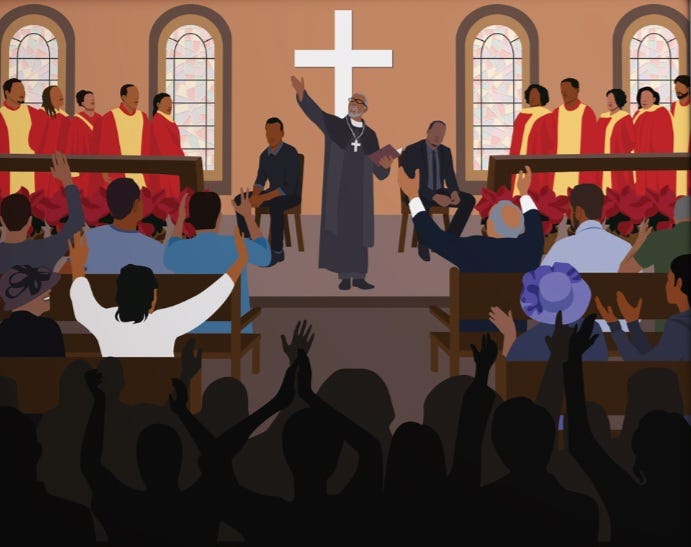
To understand why the Black church receives a brand of criticism largely unique in American religious life, you have to understand what the Black church was forced to become. When enslaved Africans were stripped of language, kinship, and every institution that orders human life, the church emerged as the one space where something like humanity could be reclaimed. It was not merely a place of worship; it was a school, a courthouse, a mutual aid society, a clandestine meeting hall, a training ground for resistance. It was, in the truest sense of the phrase, the community's everything.
In the decades after emancipation, this only deepened. The Black church built hospitals when hospitals refused Black patients. It founded schools when school doors were barred. It trained lawyers and organized boycotts and buried the dead with dignity when the rest of the nation looked away. From Richard Allen's founding of the African Methodist Episcopal Church to the prophetic ministry of Vernon Johns, and the towering witness of Martin Luther King Jr., the Black church stood at the intersection of heaven and earth in ways that were breathtaking in their scope. This history is glorious. It is also, in a peculiar way, the source of the current confusion.
The Black church was forced by history to carry a weight no institution was ever designed to bear.
What happened over the course of the twentieth century, particularly with the legislative victories of the Civil Rights era, is that the external conditions requiring the church to function as a comprehensive social institution began, slowly and unevenly, to change. The Civil Rights Act of 1964. The Voting Rights Act of 1965. The Fair Housing Act of 1968. These were not the promised land, but they were, as King himself described them, promissory notes beginning to be honored. Government institutions, universities, and civic organizations began, however imperfectly, to assume functions the church had been carrying alone.
But the expectation never changed. If anything, it calcified. The Black church was still expected to be the clinic and the counseling center and the community development corporation, while unbeknownst to a future generation of pastors, preaching the gospel, making disciples, and equipping the saints would be treated as an after thought at best, and met with indifference at worst. And increasingly, those who held this expectation most loudly were those who had least interest in the church's primary mission. The social function became the lens through which the entire institution was judged, and the spiritual mission was quietly demoted to a secondary concern, or dismissed as escapist fantasy.
"For I was hungry and you gave me food, I was thirsty and you gave me drink, I was a stranger and you welcomed me." Matthew 25:35

THE CRITICS WHO DO NOT COME
There is a curious sociological phenomenon worth naming directly: the loudest critics of the church are almost always the least invested in it. They are not the tithers who feel their resources are being mismanaged. They are not the deacons who have served for three decades and grown frustrated with institutional inertia. They are not the mothers who have sat in those pews year after year and want more for their community. Those people have critiques too, and their critiques deserve to be heard.
The harshest critics tend to be those with no skin in the game at all.
The harshest critics tend to be those with no skin in the game at all. They have made no financial investment in the institution they condemn. They have donated no hours to its ministries. They have not prayed for its leadership, attended its services, or placed their gifts at its disposal. They have simply decided that the church should be doing more, more of what they want, structured according to their personal interest, and that its failure to meet their ideological specifications is evidence of its uselessness.
This is not criticism. It is entitlement. And it is worth asking: what institution in American life is held to this standard? We do not generally demand that hospitals also serve as housing authorities, or that libraries also function as mental health clinics, simply because the neighborhood has unmet needs. We do not typically condemn the YMCA for failing to address systemic poverty. We reserve this peculiar logic almost exclusively for the church, and within American culture, most particularly for the Black church. BRIC movements are known for their criticism of the church, and yet collectively they have no history of the comprehensive support that has been synonymous with the Black church.
You cannot simultaneously refuse to invest in an institution and hold it accountable for failing to meet your absent expectations.
This is not to say the church is beyond critique. It is not. Leaders, pastors, elders, deacons, and where applicable, trustees, have abused their positions. Resources have been squandered. Some congregations have grown so inward that they have become spiritual country clubs with no meaningful engagement with the world around them. These are real failures, and they deserve honest reckoning. But honest reckoning requires honest engagement, and that is precisely what the church's most theatrical critics refuse to offer.
A FAITH THAT WILL NOT DIE
The church, it must be noted, has always had its detractors. This is not a new problem. It is, in fact, one of the most ancient features of the Christian story.
In the first century, the Roman Empire looked at this peculiar sect of Jewish followers proclaiming a crucified carpenter as the risen Lord and found the whole thing risible. Pliny the Younger wrote to Emperor Trajan around 112 AD describing Christians with something between bewilderment and contempt. Celsus composed an elaborate philosophical refutation of Christianity in the second century, convinced that reason alone would be sufficient to unravel it. The Emperor Diocletian launched systematic persecution in 303 AD, ordering Christian scriptures burned and churches demolished, confident that the movement could be extinguished by force. The sophisticated intellectual culture of Athens regarded Paul's preaching about resurrection as foolishness, the Greek word was "moria," from which we get "moron." The world has never lacked for people willing to write the church's obituary.
"For the word of the cross is folly to those who are perishing, but to us who are being saved it is the power of God."
1 Corinthians 1:18
And yet. By the end of the third century, Christianity had spread across the Mediterranean world in ways that defied every reasonable projection. By the time Constantine issued the Edict of Milan in 313 AD, the movement that Diocletian had tried to crush had become impossible to suppress. Gibbon wrote his Decline and Fall of the Roman Empire in part as an implicit argument that Christianity had hollowed out Roman civilization, and yet it was the church, not the empire, that survived. Voltaire predicted in the eighteenth century that Christianity would be extinct within fifty years. He died in 1778. The movement he dismissed as finished has since grown to encompass more than two billion people, with its most dramatic expansion occurring not in the comfortable West but in sub-Saharan Africa, Latin America, and East Asia.
The pattern is consistent enough that it ought to provoke at least a measure of epistemic humility among those who are currently composing the church's eulogy. The institution has a way of frustrating its pallbearers. Every generation has been certain it would be the one to finally see the church collapse. Every generation has been wrong.
SO WHAT IS THE CHURCH ACTUALLY FOR?
This is the question that cuts through the noise. And the answer, if we are willing to take the New Testament seriously, is not primarily what most of its critics, or, truthfully, many of its members, assume it to be.
Jesus was remarkably clear about the church's central mandate. On the night before his crucifixion, he did not commission his disciples to build a social welfare agency. He did not instruct them primarily to become a community development organization. He told them this:
"Go therefore and make disciples of all nations, baptizing them in the name of the Father and of the Son and of the Holy Spirit, teaching them to observe all that I have commanded you. And behold, I am with you always, to the end of the age." Matthew 28:19–20
This is the Great Commission. It is the organizing mandate of the church's existence. Everything else, the acts of mercy, the service to the poor, the care for the widow and the orphan, the pursuit of justice, flows from this central calling and is animated by it. The church does not serve the poor merely because poverty is a social problem to be solved. It serves the poor because it has been transformed by the love of a God who took on flesh and dwelt among us, and that transformation cannot be contained. But the mercy ministry is the overflow of the missional identity, not its replacement.
Paul, writing to the church at Ephesus, gives us an account of the church's internal architecture that is worth sitting with:
"And he gave the apostles, the prophets, the evangelists, the shepherds and teachers, to equip the saints for the work of ministry, for building up the body of Christ, until we all attain to the unity of the faith and of the knowledge of the Son of God, to mature manhood, to the measure of the stature of the fullness of Christ." Ephesians 4:11–13
The purpose of the church's leadership, Paul argues, is not primarily to run programs or provide services. It is to equip ordinary believers, the saints, for the work of ministry. The church is a school for human formation, a community of practice in which people are shaped by Scripture, prayer, worship, and fellowship into people who look increasingly like Jesus Christ. This is not a narrow, pietistic agenda. The person who looks like Jesus Christ will also care for the vulnerable, pursue justice, and love their neighbor with costly, incarnate love. But the formation has to come first, or the service becomes rootless activism that burns out and collapses under the weight of the world's need.
Luke gives us a picture of the early church's common life in Acts that is instructive:
"And they devoted themselves to the apostles' teaching and the fellowship, to the breaking of bread and the prayers. And awe came upon every soul, and many wonders and signs were being done through the apostles... And day by day, attending the temple together and breaking bread in their homes, they received their food with glad and generous hearts, praising God and having favor with all the people. And the Lord added to their number day by day those who were being saved." Acts 2:42–47
Notice what is present: teaching, fellowship, worship, prayer, and the natural outgrowth of these, generosity and communal care. And notice the result: the Lord added to their number. The early church was not growing because it had the best community programs. It was growing because it was genuinely being the church, a gathered people, formed by the gospel, bearing witness to a risen Lord.
WHY THE MISSION MATTERS
The confusion about the church's mission is not merely an intellectual error. It has pastoral and practical consequences that reverberate through communities in ways both visible and invisible.
When the church accepts the premise that its primary identity is social service provider, it sets itself up for a crisis it cannot escape. Social needs are infinite. Resources are finite. The church will always be failing by that standard, and the standard will always be moved once any particular need is met. More fundamentally, a church that has traded its spiritual mission for a social one has lost the very thing that made it capable of sustaining its service in the first place. You cannot pour from an empty cup, and a church that is no longer making disciples, no longer forming people in the character of Christ, no longer preaching the full counsel of God, that church will eventually have nothing left to give.
"But seek first the kingdom of God and his righteousness, and all these things will be added to you." Matthew 6:33
The converse is equally true, and this is the point that tends to get lost in the argument: a church that is genuinely fulfilling its primary mission will naturally and inevitably produce people who serve their communities well. The father who is being formed in the love and discipline of Christ will be a more present father. The businesswoman shaped by biblical principles of integrity and generosity will create businesses that treat their employees with dignity. The young man who has been discipled into a robust understanding of his identity in Christ will not need the street to give him a name.
The most powerful community development strategy available to the African American community, or any community, is a church full of genuinely transformed people, sent back into every sphere of neighborhood life as agents of the Kingdom of God.
The Great Commission is not fulfilled by gathering the saved and keeping them comfortable. Making disciples means going, into the neighborhood, into the school, into the prison, into the places of brokenness and need. Paul told the Roman church that he was not ashamed of the gospel because it was "the power of God for salvation to everyone who believes" (Romans 1:16). That power is not merely spiritual in a disembodied sense. It transforms whole persons, and through whole persons, communities. If your church has so retreated from the world that it is invisible to its neighbors except as a building with a parking problem, something has gone wrong, and it has gone wrong at the level of ecclesiology.
"You are the light of the world. A city set on a hill cannot be hidden. Nor do people light a lamp and put it under a basket, but on a stand, and it gives light to all in the house. In the same way, let your light shine before others, so that they may see your good works and give glory to your Father who is in heaven."
Matthew 5:14–16
The church is not a social service agency. It is not a political action committee. It is not a therapeutic support group or a community center with a cross on the roof. It is the body of Christ, the gathered and sent people of God, formed by his word, sustained by his Spirit, and commissioned to bear witness to his resurrection in word and deed until he returns. That calling is larger, more demanding, and more world-altering than anything its critics have imagined for it. The miseducation has gone on long enough. It is time to recover the real thing.


