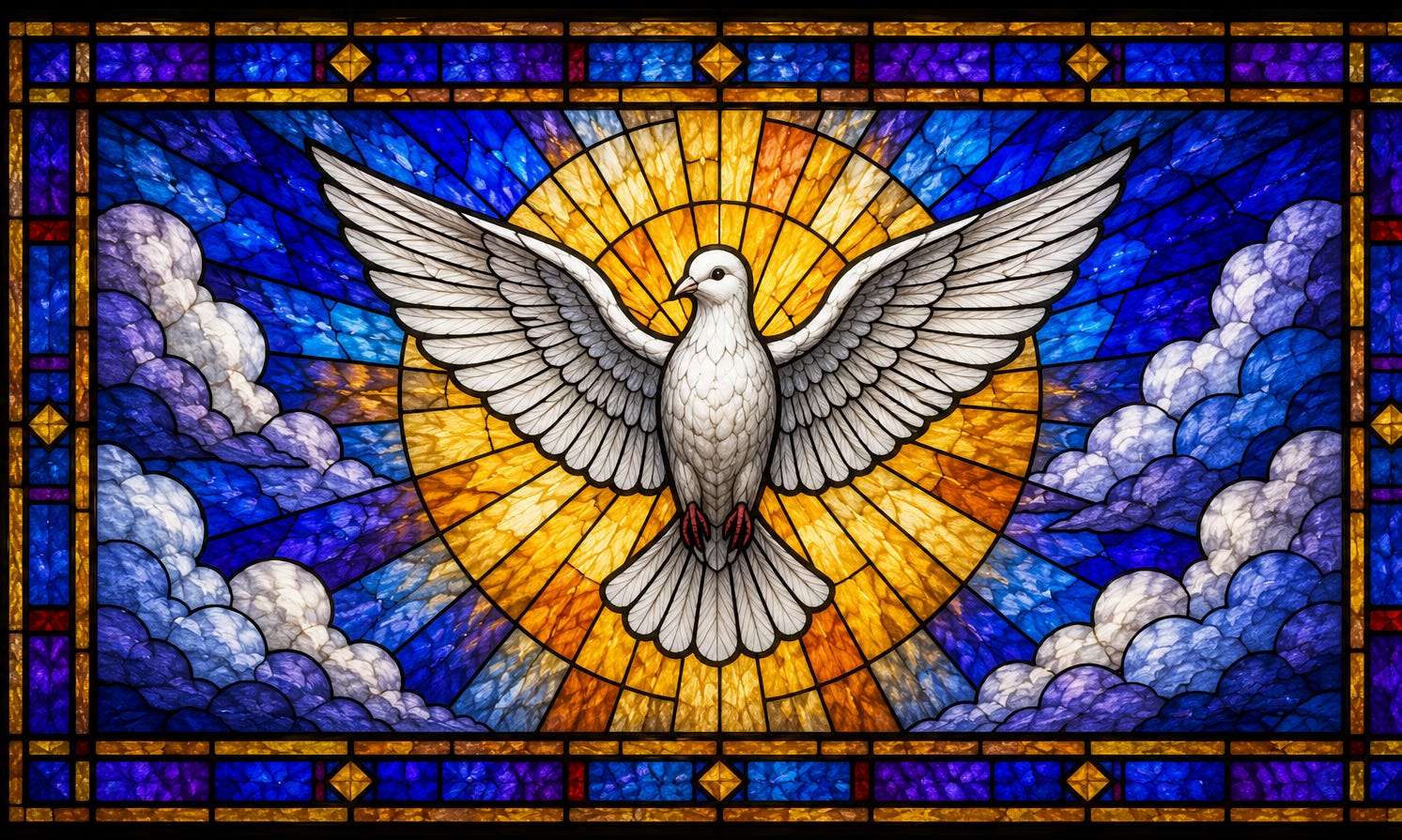
The MisEducation of the Holy Spirit & the Baptist Church
Examining the Charge: Baptist Formalism, Spiritual Vitality, and Who Owns the Spirit
PART ONE OF THREE
Some people enter a conversation carrying questions; others arrive carrying footnotes. They do not present their conclusions as contributions to a discussion but as corrections to one. They survey a tradition largely from the outside, identify what they believe it lacks, and then, with the composed confidence of a physician diagnosing a patient who never requested an appointment, prescribe the remedy. Their posture suggests not merely that they have discovered something new, but that those within the tradition have somehow overlooked what was most obvious all along.
The claim that the Black Baptist church represents a kind of spiritual deadness, intellectually respectable, emotionally tidy, but pneumatologically inert, is not a new one. It surfaces periodically in the literature, usually dressed in the language of renewal and retrieval, and it carries within it a judgment that its proponents rarely examine with the rigor they apply to everything else: the assumption that the Holy Spirit’s presence is self-evident in the places they find him and suspiciously absent in the places they do not.
That assumption deserves a serious answer. Not a defensive one, but a rigorous one. Because the questions it raises, about how the Spirit moves, where the Spirit dwells, and by what criteria the Spirit’s presence is discerned, are among the most consequential in Christian theology. And the answers the New Testament gives, answers that the pre-Augustinian church spent three centuries refining, are not the answers the critics of Black Baptist pneumatology seem to have in mind.
I. THE STRAW MAN OF BAPTIST FORMALISM
Let us begin with the diagnosis itself, because it does not survive contact with the historical record. The claim that the African-American Baptist church is a tradition of intellectual richness married to spiritual emptiness, a church with good theology but no living God, is not a description. It is a caricature. And it is a caricature that collapses the moment one actually enters the tradition.
What does the Black Baptist tradition look like from the inside? It looks like prayer meetings that begin before sunrise and do not end when the clock says they should. It looks like a preaching tradition in which the sermon is not merely a lecture but what theologian Robert Smith Jr. calls “the exegetical escorting of the hearers into the presence of God for the purpose of transformation.”1 It looks like communities that have sustained hope, love, and prophetic witness under conditions of sustained oppression for two hundred years, not through organizational efficiency, but through the kind of Spirit-wrought perseverance that Paul describes in Romans 8:9.
The Apostle Paul does not measure the Spirit’s presence by the temperature of a worship service. He measures it by the transformation of lives. “But the fruit of the Spirit is love, joy, peace, patience, kindness, goodness, faithfulness, gentleness, self-control,” he writes in Galatians 5:22–23. A tradition that has produced saints of extraordinary love and patience across two centuries of suffering is not a tradition in which the Spirit is absent. It is a tradition in which the Spirit has been working overtime.
“The same Spirit who intercedes for us with groanings too deep for words sustained a people whose suffering was too deep for adequate language.” Romans 8:26–27
There is also a theological problem with the formalism charge that goes deeper than the historical evidence. The charge assumes that spiritual vitality is detectable primarily through certain kinds of expressive worship: volume, movement, ecstatic experience. But this is not a biblical criterion. Paul tells the Corinthians, in the very passage most often cited to celebrate charismatic worship, that the Spirit distributes gifts not according to the enthusiasm of the congregation but “individually as he wills” (1 Cor 12:11). This is sovereign distribution, not a democratic spiritual economy in which the most expressive communities receive the most Spirit.
Nor does the New Testament ground the Spirit’s presence in the worshipper’s performance. It grounds it in the new birth. “Anyone who does not have the Spirit of Christ does not belong to him,” Paul writes in Romans 8:9. The Spirit’s presence is coextensive with genuine regeneration, not with any particular form of its expression. To tell a regenerate community that it lacks the Spirit because it worships differently is to confuse the Spirit’s presence with one’s preferred aesthetic of that presence.
II. NO DENOMINATIONAL PATENT ON THE SPIRIT
Pentecostal denominations do not hold a patent on the Holy Spirit, nor on the forms through which the Holy Spirit is experienced. This is not a diplomatic nicety. It is a theological fact grounded in the nature of the Third Person of the Trinity himself.
The Holy Spirit is not an institutional resource distributed through approved denominational channels. He is the sovereign Lord. Jesus says so plainly: “The wind blows where it wishes, and you hear its sound, but you do not know where it comes from or where it goes. So it is with everyone who is born of the Spirit.”8 The Spirit’s freedom is definitional. He cannot be licensed, bottled, or franchised. The moment a tradition claims exclusive or superior access to his presence, it has said something not about the Spirit but about itself.
The Finnish ecumenical theologian Veli-Matti Kärkkäinen, in his comprehensive study of global pneumatology, states the ecumenical principle with admirable directness: “No church can claim a monopoly on the Spirit, and no tradition is specifically ‘spirited.’”2 This is not relativism. It is orthodoxy. The Spirit is given to the body of Christ, not to a denomination within it.
1 Corinthians 12:6–7 “And there are varieties of activities, but it is the same God who empowers them all in everyone. To each is given the manifestation of the Spirit for the common good.”
The pre-Augustinian church never recognized a pneumatological hierarchy among Christian communities. Irenaeus, writing in the late second century, locates the Spirit not in any particular style of worship but in the community gathered around the apostolic teaching: “Where the Church is, there is the Spirit of God; and where the Spirit of God is, there is the Church and every kind of grace.”3 The criterion is apostolic faithfulness, not expressive intensity.
The earliest Christian manual of church order, the Didache, dated between 80 and 120 AD, already provides guidelines for testing prophets and discerning Spirit-inspired speech.4 Its very existence is evidence that the early church did not equate passionate spiritual expression with guaranteed Spirit-presence. They knew that enthusiasm can be manufactured. The Spirit cannot.
III. THE SPIRIT AS INSTRUMENT: A DANGEROUS REDUCTION
Here we arrive at the most theologically serious problem in the literature under review, and it is one that deserves to be named plainly. Embedded within certain frameworks for charismatic renewal, including some Bapticostal formulations, is an implicit pneumatology that treats the Holy Spirit less as the Third Divine Person of the Holy Trinity and more as a spiritual resource that can be accessed, activated, and experienced through the right combination of elements: the right music, the right emotional environment, the right ritual sequence, the right congregational expectation.
This is not an uncharitable reading. It is a structural description of what happens when experience is elevated to the level of theological authority alongside Scripture. When the Spirit’s presence is identified primarily through its felt effects, and when those felt effects become the criterion by which a congregation’s spiritual vitality is measured, the Spirit has been functionally reduced from divine Person to experiential outcome. He is no longer the One who blows where he wills. He is the One who shows up when the conditions are right.
John 4:24 “God is spirit, and those who worship him must worship in spirit and in truth.”
The New Testament is unambiguous about the Spirit’s personal, sovereign, and irreducible divinity. Paul describes the Spirit as the One who searches the depths of God (1 Cor 2:10–11), who intercedes with divine comprehension (Rom 8:27), and who distributes gifts according to his own sovereign will (1 Cor 12:11). The Spirit is not the church’s instrument. The church is the Spirit’s instrument.
Basil of Caesarea, the great Cappadocian theologian writing in 375 AD, understood this with crystalline clarity. In his treatise On the Holy Spirit, Basil argues that the Spirit’s dignity is inseparable from his activity in sanctification and regeneration: “Should we not exalt him who is divine in nature, unbounded in greatness, powerful in his energies?”5 For Basil, the Spirit’s presence cannot be manufactured, because the Spirit is not a force, he is God. And God is not summoned by technique.
“The Spirit’s presence cannot be manufactured, because the Spirit is not a force. He is God. And God is not summoned by technique.” — Basil of Caesarea, On the Holy Spirit, 9.22
This is precisely why Paul issues his extraordinary warning in 1 Thessalonians 5:19–21: “Do not quench the Spirit. Do not despise prophecies, but test everything; hold fast what is good.” Notice the sequence. Paul affirms the Spirit’s activity. He also commands discernment. The two imperatives are inseparable because the Spirit can be quenched and spiritual experience can be counterfeited. A pneumatology that cannot account for the difference between genuine Spirit-presence and manufactured spiritual intensity has not solved the problem of lifeless formalism. It has created an equally dangerous alternative.
John, the beloved apostle, makes the discernment imperative even more urgent: “Do not believe every spirit, but test the spirits to see whether they are from God, for many false prophets have gone out into the world” (1 John 4:1). A tradition that has learned, through centuries of oppression and institutional pressure, to test what it receives before it endorses it has not suppressed the Spirit. It has obeyed the apostle.
LOOKING FORWARD
The first charge against the Black Baptist tradition, that it is spiritually inert, pneumatologically hollow, a museum of good doctrine without the living God, has not survived scrutiny. The New Testament measures the Spirit’s presence by transformation, not temperature. The pre-Augustinian church located the Spirit in apostolic faithfulness, not expressive intensity. And the claim that any single denomination holds preferential title to the Spirit’s presence is contradicted by the very nature of the One whose defining characteristic is sovereign, uncontrollable freedom.
But the conversation is not finished. A deeper set of questions remains. If the Spirit cannot be manufactured, what happens when a theological framework effectively treats him as though he can be? If personal spiritual experience is being elevated to a level of authority the pre-Augustinian church never assigned it, what are the consequences? And what does it mean when a critique of an entire tradition turns out, on closer examination, to be a projection of personal preference rather than an exercise in theological discernment? Part Two takes up those questions directly.
COMING NEXT: Part Two examines the pneumatology of projection, the methodological problem with elevating Experience as a theological authority, and what the early church fathers actually taught about how the Spirit operates in the life of the congregation.
____________________
FOOTNOTES
Robert Smith Jr., Doctrine That Dances: Bringing Doctrinal Preaching and Teaching to Life (Nashville: B&H Academic, 2008), 35.
Veli-Matti Kärkkäinen, Pneumatology: The Holy Spirit in Ecumenical, International, and Contextual Perspective (Grand Rapids: Baker Academic, 2002), 18.
Irenaeus of Lyon, Against Heresies, 3.24.1, trans. Alexander Roberts and William Rambaut, in Ante-Nicene Fathers, vol. 1, ed. Alexander Roberts and James Donaldson (Buffalo, NY: Christian Literature Publishing, 1885).
Didache 11.7–12, in The Apostolic Fathers, trans. Bart D. Ehrman, Loeb Classical Library 24 (Cambridge, MA: Harvard University Press, 2003). Commonly dated 80–120 AD.
Basil of Caesarea, On the Holy Spirit, 9.22, trans. David Anderson (Crestwood, NY: St. Vladimir's Seminary Press, 1980), 38.


