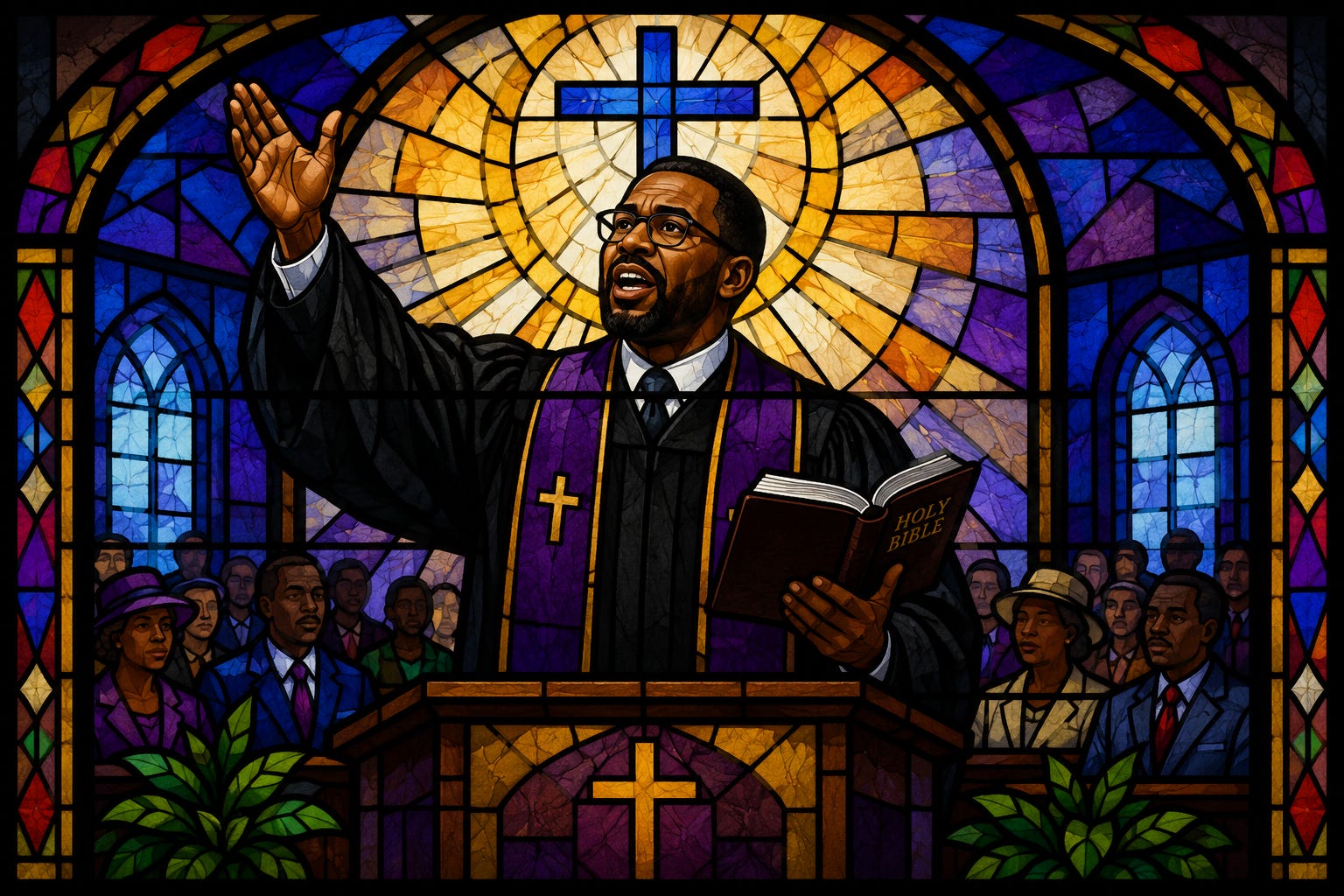
The MisEducation of the Holy Spirit in the Baptist Church Pt. 3
Orthodoxy Was Never Lost: A Series Summary
PART THREE OF THREE
Parts One and Two established that the formalism charge does not survive scriptural scrutiny, that no denomination holds a patent on the Spirit, that certain charismatic frameworks risk instrumentalizing the Third Person of the Trinity, and that the Spirit’s communal, eschatological, and discerning dimensions, all present in the Black Baptist tradition, are precisely what gets lost when experience becomes the dominant pneumatological criterion. Part Three draws the threads together.
THE METHODOLOGICAL PROBLEM: A FRAMEWORK THE CHURCH FATHERS WOULD NOT RECOGNIZE
A further difficulty with certain Bapticostal formulations deserves theological attention. The framework of four co-equal sources of theological authority, Scripture, Experience, Reason, and Tradition, is borrowed, consciously or not, from the Wesleyan Quadrilateral, a concept retrospectively systematized by Albert Outler1 in 1964 to describe John Wesley’s implicit theological method.
It is a Methodist framework, not a biblical or patristic one. The pre-Augustinian church’s actual framework for theological authority was the Rule of Faith, the apostolic deposit of teaching preserved in the Scriptures and the continuous witness of the apostolically founded communities. In that framework, Experience is not a source of theological authority alongside Scripture. It is the arena in which Scripture’s authority is received and felt. The moment Experience is elevated to the level of a co-equal authority with Scripture, a door opens that the pre-Augustinian church spent considerable energy keeping shut.
Irenaeus’ entire polemic against the Valentinian Gnostics rests on a single argument: the Gnostics claimed that their pneumatic experiences gave them access to a deeper truth than the common apostolic faith provided.2 The structure of that claim is identical to any argument that makes experiential access to the Spirit a criterion for evaluating the Spirit’s presence in a community. It does not matter how orthodox the intention. The structural problem remains.
The Black Baptist tradition’s instinctive insistence that spiritual claims be tested by the Word is not theological timidity. It is Irenaean orthodoxy. It reflects a hard-won wisdom about the difference between what God does and what we want God to be doing, a wisdom that communities under pressure learn earlier and more painfully than communities of privilege.
WHAT THE BLACK BAPTIST CHURCH HAS ALWAYS KNOWN
There is an irony at the center of this entire conversation that deserves to be named. The African-American Baptist tradition is being told it needs a pneumatological upgrade by a culture of theological commentary that has, in many of its most prominent expressions, spent the last generation arguing that the church needs to reconnect with its primal spiritual vitality. The Black Baptist church did not lose that vitality. It never abandoned it. It simply refused to let experiential enthusiasm become the measure of its orthodoxy.
Cheryl J. Sanders of Howard University has argued that the history of the Holy Spirit in Black church culture must be read through the lens of communal suffering and Spirit-sustained perseverance. The Spirit who intercedes with “groanings too deep for words”3 is the Spirit who sustained the hush harbors, the prayer meetings, the spirituals, the nonviolent marches, and the Sunday mor ning sermons in which people who had every earthly reason to despair walked out with hope renewed. That is not formalism. That is what the Spirit-filled church looks like when it has been tested by fire.
The Black Baptist preaching tradition has always understood that the sermon is a Spirit-event, not because of what the preacher does with his voice, but because of what the Spirit does with the Word. Paul describes his own apostolic preaching this way: not in “plausible words of wisdom, but in demonstration of the Spirit and of power, so that your faith might not rest in the wisdom of men but in the power of God.” The Black Baptist tradition has been making exactly that argument from its pulpits for two hundred years.
Acts 2:17–18 "And in the last days it shall be, God declares, that I will pour out my Spirit on all flesh, and your sons and your daughters shall prophesy... even on my male servants and female servants in those days I will pour out my Spirit."
N.T. Wright, reflecting on the Spirit’s role as the agent of heaven and earth overlapping, writes that those “in whom the Spirit comes to live are God’s new Temple,”4 places where the divine and the human meet. That description fits the Black Baptist congregation gathered in prayer as precisely as it fits any congregation on earth. The Spirit does not consult zip codes, denominational affiliations, or worship styles before deciding where to make himself at home.
Michael F. Bird, whose Evangelical Theology is among the most comprehensive recent systematic theologies in the evangelical tradition, warns that too many churches have become functionally “binitarian,”5 neglecting the Spirit’s indispensable role in the life of the church. The question is not how often the Spirit is named. It is whether the community’s actual life, its prayer, its proclamation, its formation of disciples, its care for the poor, its prophetic witness, bears the marks of the Spirit’s presence. By that measure, the African-American Baptist tradition does not need to borrow pneumatological credibility from anyone.
CONCLUSION: THE SPIRIT HAS NOT LEFT THE BUILDING
The African-American Baptist tradition has never lacked the Holy Spirit. It has lacked, at various moments, the kind of expressive worship that certain observers have decided is the Spirit’s calling card. That is a different claim. And it is a claim the New Testament, the pre-Augustinian church fathers, and two centuries of Black Baptist testimony all refuse to endorse.
The Holy Spirit is the Third Person of the Holy Trinity. He is not a product. He is not a program. He is not the outcome of the right liturgical sequence or the right emotional environment. He is the sovereign Lord who blows where he wills, who intercedes for the saints with groanings that exceed language, who distributes his gifts according to his own inscrutable wisdom, and who has been at work in the African-American Baptist church since the first enslaved person whispered a prayer in a Carolina hush harbor and felt, against all earthly evidence, that God had heard.
The call to pneumatological renewal is legitimate. Every tradition needs it. But renewal begins with honest diagnosis, and honest diagnosis requires looking at the evidence rather than the aesthetic. The evidence in the African-American Baptist tradition, its prayer life, its preaching, its formation of disciples, its prophetic social witness, its extraordinary capacity for love under suffering, is the evidence of the Spirit’s sustained presence over the long arc of a people’s history.
To call that formalism is not discernment. It is miseducation. And the Spirit, who is truth, will not leave it uncorrected.
SERIES SUMMARY
This three-part series began with a simple question: does the African-American Baptist church lack the Holy Spirit? The question is simple; the answer required engaging the New Testament, the early church fathers, and the full theological architecture of both the traditions making the charge and the tradition receiving it. What the series has argued, across three installments, is this:
• The formalism charge is a caricature. The Black Baptist tradition’s prayer life, preaching, suffering-formed holiness, and prophetic social witness are evidence of the Spirit’s sustained presence, not spiritual deficiency.
• No denomination holds a patent on the Spirit. The Spirit blows where he wills. He is not licensed, franchised, or denominationally distributed. The pre-Augustinian church located the Spirit in apostolic faithfulness, not expressive intensity.
• Certain frameworks instrumentalize the Spirit. When experience is elevated to co-equal authority with Scripture, the Holy Spirit risks being treated as a spiritual outcome produced by the right conditions rather than as the sovereign Third Person of the Trinity.
• Projection is not theology. A critique grounded in the elevation of one tradition’s experiential norms to universal spiritual standards is autobiography with footnotes, not pneumatological discernment.
• The Wesleyan Quadrilateral is a Methodist import. The early church’s framework was the Rule of Faith. Experience and reason are instruments of reception, not independent theological authorities alongside Scripture.
• The Black Baptist church has always known the Spirit. The hush harbors, the prayer meetings, the spirituals, the preaching tradition, the Civil Rights movement, the formation of saints under suffering, these are the Spirit’s fingerprints. They require no external validation.
This conversation will continue. It must. The questions it raises, about how the Spirit is discerned, how experience is properly weighed, how traditions learn from one another without one subordinating the other, are not settled questions. They are live ones. And live questions deserve rigorous, honest, and theologically serious engagement.
That is what this series has attempted. Whether it has succeeded is, appropriately, for others to judge. But the judgment, like all genuine theological discernment, must be made by criteria the Spirit himself has authorized, not by the preferences we have learned to call the Spirit’s presence.
“To call that formalism is not discernment. It is miseducation. And the Spirit, who is truth, will not leave it uncorrected.”
ENDNOTES & SOURCES
1. Albert C. Outler, “The Wesleyan Quadrilateral, In John Wesley,” Wesleyan Theological Journal 20, no. 1 (Spring 1985): 7–18. Outler himself later expressed regret that the term had taken on a life beyond his intentions.
2. Irenaeus of Lyon, Against Heresies, 1.6.1–2, trans. Alexander Roberts and William Rambaut, in Ante-Nicene Fathers, vol. 1, ed. Alexander Roberts and James Donaldson (Buffalo, NY: Christian Literature Publishing, 1885).
3. Cheryl J. Sanders, “The Historiography of the Holy Spirit in Black Church Culture,” Berkley Forum, Georgetown University (2021).
4. N.T. Wright, Simply Christian: Why Christianity Makes Sense (New York: HarperOne, 2006), 121.
5. Michael F. Bird, Evangelical Theology: A Biblical and Systematic Introduction (Grand Rapids: Zondervan, 2013), 612–613.


