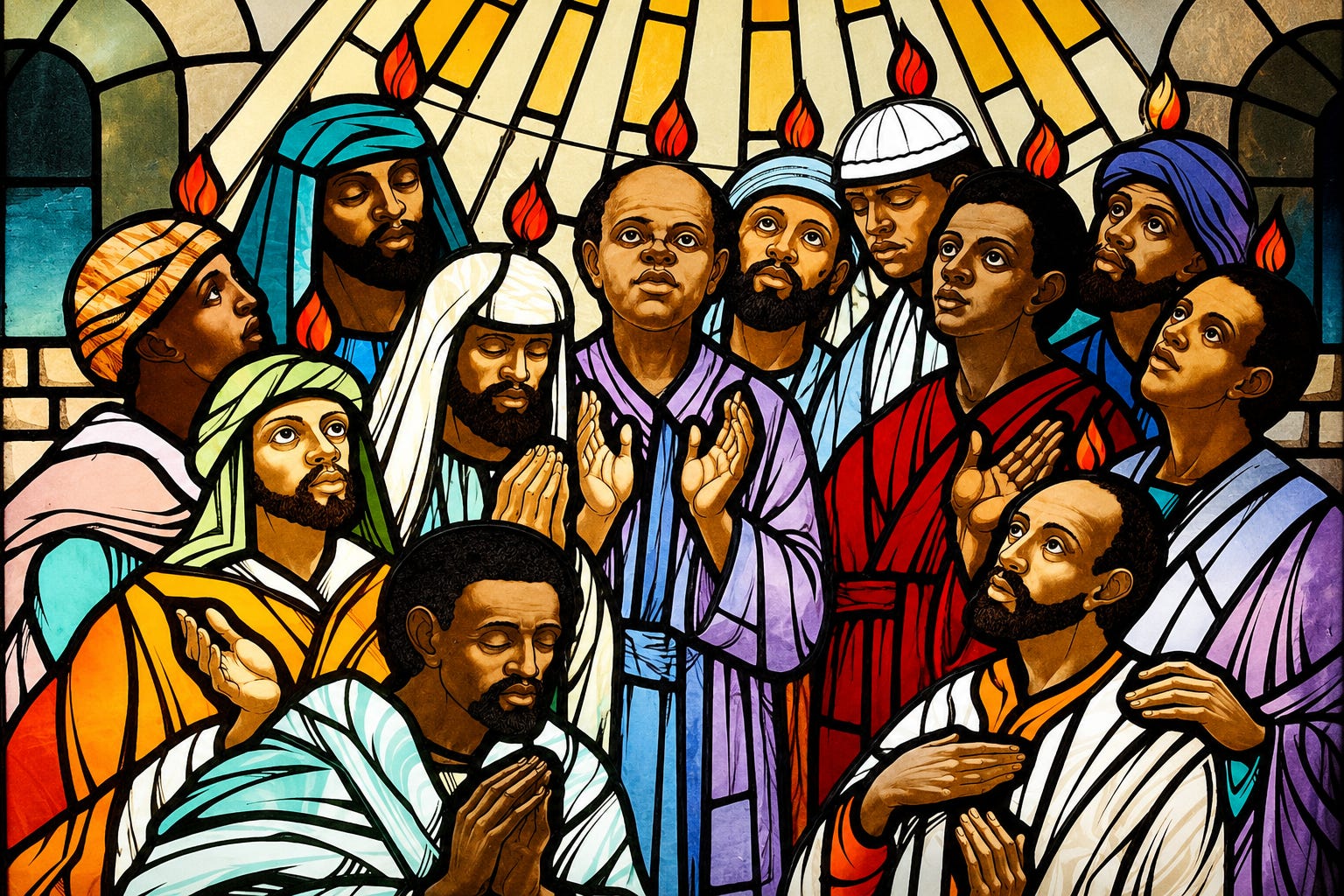
The MisEducation of the Holy Spirit in the Baptist Church Pt. 2
Presence, Projection, and the Pneumatological Poverty of Telling the Black Baptist Church It Does Not Know God
PART TWO OF THREE
Part One established that the charge of formalism against the African-American Baptist church does not survive scriptural or historical scrutiny, that no denomination holds a patent on the Spirit’s presence, and that certain charismatic frameworks risk reducing the Third Person of the Trinity to a spiritual resource activatable by the right conditions. Part Two presses deeper into the theological architecture that underlies those errors, and into what the New Testament and the early church fathers actually teach about the Spirit’s presence in congregational life.
PROJECTION DRESSED AS PNEUMATOLOGY
There is a pattern worth naming in critiques of Black Baptist pneumatology that deserves more honest examination than it typically receives. The critique begins with a genuine personal experience, the writer has encountered Spirit-empowered worship in a Pentecostal or charismatic context and found it transformative. That experience is real and should be honored. But something happens in the move from personal testimony to theological prescription. The experience becomes the standard. And the standard, once established, gets projected onto traditions that do not share the same experiential vocabulary.
What begins as “I encountered the Spirit in this way” becomes “communities that do not encounter the Spirit in this way are spiritually deficient.” This is not theology. It is autobiography with footnotes. And when it is directed at the African-American Baptist tradition, a tradition that has its own centuries-deep experiential vocabulary, its own history of encountering the living God, its own testimony of Spirit-wrought perseverance, it becomes something more troubling: the imposition of personal preference upon a community that did not invite the imposition.
The early church already knew this danger. Irenaeus spent considerable energy combating the Valentinian Gnostics, who claimed that their personal pneumatic experiences gave them access to a deeper spiritual reality than the common apostolic faith could provide. Their argument was structurally identical to any argument that elevates a particular form of Spirit-experience above the community’s shared apostolic inheritance. Irenaeus’ response was categorical: the Spirit who truly speaks always confirms the apostolic Rule of Faith, never transcends it or supplements it with superior private experience.1
Irenaeus writes that, “the Church had received this preaching and this faith, as I have said, and although scattered throughout the whole world, yet preserves it as though occupying but one house.”2 What holds the church together is not shared spiritual experience but shared apostolic teaching. A critique of the Black Baptist tradition that rests on the claim that certain experiential norms are missing has imported a pneumatological standard the pre-Augustinian church would not have recognized.
WHAT THE NEW TESTAMENT AND EARLY CHURCH ACTUALLY TEACH
If personal spiritual preference cannot serve as the criterion of Spirit-presence, what can? The New Testament is not silent on this question, and neither is the early church. Their answers are richer, more demanding, and more honest about the Spirit’s freedom than most of the contemporary pneumatological literature acknowledges.
The New Testament’s primary criterion for the Spirit’s presence is not experiential intensity. It is transformation. The Spirit’s presence is evidenced by regeneration (Titus 3:5–6), by the progressive transformation of character into the image of Christ (2 Cor 3:18), by the fruits Paul catalogs in Galatians 5, and by the community’s capacity to love one another and bear witness to the risen Christ in the world. These are costly criteria. They take time. And they are the criteria by which the African-American Baptist tradition has, across two centuries, produced an extraordinary testimony.
2 Corinthians 3:17–18 "Now the Lord is the Spirit, and where the Spirit of the Lord is, there is freedom. And we all, with unveiled face, beholding the glory of the Lord, are being transformed into the same image from one degree of glory to another. For this comes from the Lord who is the Spirit."
The pre-Augustinian church developed this pneumatology with considerable theological precision. Irenaeus identifies the Spirit as the agent of the church’s unity, apostolicity, and holiness, the Spirit is present where the apostolic teaching is faithfully preserved and the community is being formed into the image of Christ. Tertullian insists that the Spirit’s work is always in service of the proclaimed Word, never autonomous from it. The Spirit inspires the Scriptures, illuminates their meaning, and applies their claims to the hearts of hearers.
Basil of Caesarea argues that the Spirit’s presence within the community is evidenced above all by sanctification: "The Spirit is the source of holiness, a spiritual light, and he offers his own light to every mind in its search for truth."3 The Spirit who transforms sinners into saints is not the Spirit of enthusiastic worship alone. He is the Spirit of costly character formation. When the African-American Baptist church has produced, through generations of suffering, through the Civil Rights movement, through the sustained practice of nonviolent love under conditions of violent oppression, men and women of extraordinary spiritual character, it has produced exactly the evidence Basil would have recognized.
Origen of Alexandria, writing in the early third century, develops a rich theology of the Spirit’s role in the hearing of Scripture during communal worship. The Spirit who inspired the biblical text is the same Spirit who opens the hearer’s ears to receive it. This means that every service in which the Word of God is faithfully proclaimed and genuinely received is a Spirit-event, not by virtue of its emotional temperature but by virtue of the Spirit’s own sovereign activity in the community of the Word.
THE COMMUNAL, ESCHATOLOGICAL, AND DISCERNING DIMENSIONS OF THE SPIRIT
Three dimensions of New Testament pneumatology are conspicuously absent from critiques that reduce the Spirit’s presence to experiential style, and they deserve explicit attention because each of them is a particular strength of the African-American Baptist tradition.
The first is the Spirit’s communal character. Paul does not give the Spirit to outstanding individuals as a mark of their superior spiritual attainment. He gives the Spirit to the body. “To each is given the manifestation of the Spirit for the common good.” The Spirit’s gifts are not personal trophies. They are community-building instruments, distributed to serve the whole.
The Black Baptist church’s pneumatology has always been communal in precisely this sense, a community interceding together, sustaining together, bearing one another’s burdens together.
The second is the Spirit’s eschatological character. Paul describes the Spirit as the first installment, the guarantee of the age to come (2 Cor 1:22; Eph 1:13–14). The Spirit is the presence of the future, the power of God’s new creation breaking into the present age. This means the Spirit is inherently oriented toward the full renewal of all things, including social structures and conditions of injustice. The Black Baptist tradition’s prophetic social witness, its long history of connecting Spirit-empowered worship to Spirit-empowered justice, is not a departure from pneumatology. It is pneumatology.
Romans 8:22–23 "For we know that the whole creation has been groaning together in the pains of childbirth until now. And not only the creation, but we ourselves, who have the firstfruits of the Spirit, groan inwardly as we wait eagerly for adoption as sons, the redemption of our bodies."
The third is the Spirit’s discerning character. The New Testament does not command uncritical openness to all spiritual experience. It commands both openness and discernment in the same breath. Paul says do not quench the Spirit, and test everything. John says do not believe every spirit, test the spirits. The Didache already provides criteria for distinguishing genuine prophets from fraudulent ones. The African-American Baptist tradition’s careful theological testing of spiritual claims is not the enemy of Spirit-filled life. According to the New Testament and the earliest post-apostolic documents, it is a requirement of it.
LOOKING FORWARD
The pneumatology of projection fails not because the Spirit is absent from the traditions it critiques, but because it has mislocated the Spirit’s presence. Locating the Spirit primarily in a particular emotional register and then reading that register back onto the New Testament and the early church fathers is a hermeneutical reversal that the patristic tradition consistently refused. The Spirit’s communal, eschatological, and discerning dimensions, all three conspicuously present in the Black Baptist tradition, are precisely the dimensions that get flattened when experience becomes the dominant pneumatological criterion.
One methodological problem remains to be examined: the framework that often undergirds these critiques borrows a four-source model of theological authority that the pre-Augustinian church would not have recognized, and that introduces structural vulnerabilities the early Gnostic controversies teach us to take seriously. Part Three addresses that methodological problem directly, gathers the threads of the full argument, and arrives at a conclusion about what the African-American Baptist church has always known.
COMING NEXT: Part Three examines the Wesleyan Quadrilateral as an imported Methodist framework, draws together the full theological argument, and concludes with a series summary and reflection on what the Black Baptist church has known and practiced all along.
_____________
ENDNOTES & READING SOURCES
1. Irenaeus, Against Heresies, 1.6.1–2. Irenaeus identifies the Valentinian appeal to private pneumatic experience as the defining error of Gnostic pneumatology.
2. Irenaeus of Lyon, Against Heresies, 1.10.1, trans. Alexander Roberts and William Rambaut, in Ante-Nicene Fathers, vol. 1, ed. Alexander Roberts and James Donaldson (Buffalo, NY: Christian Literature Publishing, 1885).
3. Basil of Caesarea, On the Holy Spirit, 16.38, trans. David Anderson (Crestwood, NY: St. Vladimir’s Seminary Press, 1980). 9.22
4. Origen of Alexandria, Homilies on Luke, 1.1, trans. Joseph T. Lienhard, Fathers of the Church 94 (Washington, DC: Catholic University of America Press, 1996).
5. Didache 11.8, in The Apostolic Fathers, trans. Bart D. Ehrman, Loeb Classical Library 24 (Cambridge, MA: Harvard University Press, 2003).


