THE OPPORTUNITIES OF DENOMINATIONAL WORK
Recovering a Vision for Baptist Collaboration in the Twenty-First Century
Ask a pastor why his church belongs to no association, no convention, no fellowship of accountability, and he will often answer with the language of purity: we do not want the bureaucracy, the politics, the diluted doctrine, the compromise. There is real wisdom buried in that instinct. But there is also a quieter, more corrosive error hiding beneath it, the assumption that the local congregation was built to stand alone. Scripture never assumes this. The New Testament church was a network before it was ever an institution, and the history that follows the apostles is a story of churches finding one another, correcting one another, and building things together that no single congregation could have built alone. This is what denominational work is, at its best: not bureaucracy for its own sake, but the disciplined, structured cooperation of local churches acting as one body across distance. It deserves a second look.
What Denominational Work Actually Means
Denominational work is often reduced in the popular imagination to conventions, committees, and conference programs, the administrative furniture of institutional religion. That is a surface reading. At its root, denominational work is the covenanted cooperation of autonomous local churches around shared doctrine, shared mission, and shared accountability. It is the structural answer to a theological question: if the church is one body with many members, as Paul insists, how do geographically scattered congregations actually function as one body rather than merely sharing a label?
In practice, denominational work takes the form of associations, conventions, and conferences that pool resources for missions and education, establish credentialing and ordination standards, coordinate disaster and benevolence response, and provide a collective voice on matters too large for any single pulpit. Within the Baptist tradition specifically, this cooperation has always had to negotiate a built-in tension, since Baptists hold local church autonomy as a near-sacred conviction while simultaneously affirming that the church universal is bigger than any one congregation. Denominational work is the practical machinery Baptists built to honor both convictions at once.
The New Testament Vision of Collaborating Churches
The New Testament does not present a scattered archipelago of unrelated congregations. It presents a network, bound by doctrine, correspondence, financial partnership, and shared leadership. When a doctrinal dispute threatened to fracture the Gentile mission, the church did not resolve it locally. Representatives from Antioch traveled to Jerusalem, where apostles and elders gathered in council, deliberated, and issued a joint letter binding on churches far beyond either city.
"Then it seemed good to the apostles and the elders, with the whole church, to choose men from among them to send to Antioch with Paul and Barnabas... it seemed good to us, having become of one mind, to select men to send to you." (Acts 15:22, 25)
This is denominational work in embryo: translocal deliberation producing a decision binding on multiple congregations, communicated by trusted delegates. Paul's letters extend the pattern. He organized a multi-church collection for the famine-stricken saints in Jerusalem, coordinating congregations in Macedonia, Achaia, and Galatia around a single act of shared generosity that crossed ethnic and geographic lines.
"For I know your readiness, of which I boast about you to the people of Macedonia, namely, that Achaia has been prepared since last year, and your zeal has stirred up most of them." (2 Corinthians 9:2)
Paul treated this collection as a matter of theological importance, not mere charity. It was proof, he insisted, that the church was one body across ethnic and regional lines, a point he underscored when he recalled that the Jerusalem apostles had asked only that he and Barnabas "remember the poor," a request he was "eager to do" (Galatians 2:10). Elsewhere, Paul instructed the church at Colossae to exchange letters with the church at Laodicea, an early instance of shared theological literature circulating between congregations (Colossians 4:16). His metaphor of the body, with its many members and one Spirit, was never meant to apply only within a single congregation's walls (1 Corinthians 12:12-27). It described the church universal, and it demanded structures capable of expressing that unity in practice, not merely in sentiment.
Collaboration in the Early Church, 71 to 350 AD
The generations following the apostles did not abandon this pattern of cooperation; they institutionalized it. Around 96 AD, the church at Rome, through its elder Clement, wrote a substantial letter to the church at Corinth, addressing a leadership dispute there. That a distant congregation felt both the standing and the responsibility to intervene in another church's internal conflict reveals how thoroughly translocal accountability was assumed rather than argued for.
A decade or so later, Ignatius of Antioch, being transported to Rome for execution, wrote letters to churches in Ephesus, Magnesia, Tralles, Philadelphia, Smyrna, and Rome itself, along with a personal letter to Polycarp of Smyrna. These letters circulated among congregations and articulated a vision of unity centered on bishop, elders, and deacons, an early attempt to give translocal cooperation a durable structure rather than leaving it to occasional correspondence. The Didache, composed around the same period, gives instructions for how congregations should receive and test traveling teachers and apostles, evidence of an itinerant ministry network that connected otherwise isolated house churches.
By the late second century, this network faced its first great doctrinal test in the rise of Gnosticism, and the church's answer was collaborative rather than merely local. Irenaeus of Lyons, writing against the Gnostic teachers, appealed not to his own authority but to the collective, traceable teaching of churches founded by the apostles, listing the succession of Roman bishops as evidence of a shared, guarded deposit of faith stretching across the empire. When a dispute arose over the proper date for celebrating Easter, Bishop Victor of Rome and Polycrates of Ephesus convened regional synods across Asia, Palestine, Pontus, and Gaul to deliberate the question, a controversy resolved not by imperial decree but by a web of bishops in correspondence and council.
The third century brought both plague and persecution, and the church's response again ran through cooperative structures. Cyprian of Carthage convened repeated councils to address the crisis of Christians who had lapsed under persecution, corresponding at length with the church at Rome to coordinate a unified policy rather than allowing every congregation to improvise its own terms of restoration. Cyprian's treatise on the unity of the church, written in the heat of this controversy, remains one of the earliest sustained arguments that the bishops, though many, hold one undivided office, an argument built entirely to justify translocal cooperation over congregational isolation. When plague ravaged Carthage and Alexandria, bishops organized systematic relief efforts across congregations, a pattern historians credit with contributing to the church's remarkable growth during a period of empire-wide catastrophe.
This three-century trajectory of councils, correspondence, and coordinated relief reached its most visible expression in 325 AD, when roughly two hundred and fifty bishops, representing congregations from Spain to Persia, gathered at Nicaea to resolve the Arian controversy. Nicaea was not an aberration. It was the natural culmination of a habit of translocal deliberation the church had practiced since the Jerusalem council three centuries earlier. What changed at Nicaea was scale and imperial sponsorship, not the underlying conviction that no single congregation, however faithful, possessed the whole counsel of God alone.
The Purpose of Denominational Work
Denominational cooperation exists for reasons that have not changed since Clement wrote to Corinth. First, it provides doctrinal accountability, a check against the isolated congregation drifting slowly into error with no one positioned to notice or intervene. Second, it enables the pooling of resources for work no single church can sustain alone, foreign missions, theological education, publishing, and disaster relief chief among them. Third, it establishes shared standards for ordination and credentialing, protecting congregations from having to individually vet every minister who arrives at their door. Fourth, it amplifies the church's public voice on matters of justice and conscience that exceed any one pulpit's reach, a function the Black Baptist tradition in America understood with particular clarity, since it was denominational cooperation, not isolated congregations, that built schools, funded missionaries, and eventually gave institutional shape to the civil rights movement.
The Opportunities Before Us
Properly understood, denominational structures represent enormous untapped opportunity rather than dead weight. Theological education becomes affordable when seminaries are funded cooperatively rather than by individual congregations attempting to train their own clergy from scratch. Church planting accelerates when networks share proven models, pooled capital, and mentorship pipelines rather than leaving every planter to reinvent the process alone. International partnerships allow small congregations to participate meaningfully in global mission through a shared infrastructure they could never build unilaterally. Disaster and benevolence response moves faster and reaches further when coordinated across hundreds of congregations rather than improvised parish by parish. And increasingly, denominational bodies are positioned to negotiate the shared challenges of the digital era, from streaming and publishing rights to the responsible use of artificial intelligence in ministry formation, questions no individual pastor can resolve well in isolation.
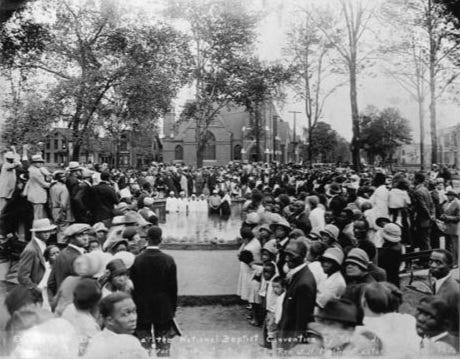
There is also a formational opportunity easy to overlook. Denominational life exposes younger pastors to mentors, models, and traditions beyond their home congregation, a kind of apprenticeship that isolated churches simply cannot replicate. The National Baptist Convention, USA, founded in 1895 through the merger of three earlier Black Baptist conventions, exists as a case study in this kind of opportunity realized. What began as a pragmatic pooling of mission, education, and publishing resources among Reconstruction-era congregations became an institutional backbone sturdy enough to help fund historically Black colleges and eventually to lend organizational infrastructure to a movement that reshaped American law.
The Challenges We Must Name
None of this should obscure the real and recurring failures of denominational structures. Bureaucratic drift is real; institutions built to serve churches can slowly begin demanding that churches serve the institution instead. Financial mismanagement and scandal at the convention level erode trust that took generations to build and can take mere months to destroy. The distinctly Baptist tension between congregational autonomy and convention cooperation never fully resolves, and it periodically produces genuine conflict over how much authority a national body may claim over a local church's affairs. Younger generations, formed by nondenominational and digitally native church models, often experience denominational structures as slow, distant, and irrelevant to their immediate ministry needs. And denominational bodies remain vulnerable to political entanglement, allowing partisan alignment to overshadow the theological convictions that were supposed to hold the cooperation together in the first place.
Reimagining Denominational Work for the Twenty-First Century
The Baptist tradition does not need to abandon denominational cooperation to survive the twenty-first century, but it does need to reimagine the shape that cooperation takes. The rigid, top-heavy convention model built for a print-and-committee era can coexist with looser, faster networks organized around specific missional tasks, such as church planting cohorts, disaster response teams, or shared digital training platforms, without requiring uniformity on every secondary matter. Associations at the local and regional level, historically the most nimble layer of Baptist cooperation, deserve renewed investment as the connective tissue between congregation and convention. Transparency in finance and governance is no longer optional; a generation formed by public accountability in every other institution of its life will not extend automatic trust to a denomination that cannot demonstrate it has earned that trust.
Perhaps most importantly, denominational identity in the century ahead will likely be sustained less by institutional loyalty and more by demonstrated mission. Congregations, particularly younger ones, are increasingly willing to cooperate around shared work even when they are unwilling to cooperate around shared bureaucracy. A denomination that organizes itself primarily around what it builds together, church plants, seminaries, relief networks, mentorship pipelines, rather than what it defends institutionally, has the best chance of recovering what Clement, Ignatius, Irenaeus, Cyprian, and the bishops at Nicaea understood by instinct: that the church was never meant to go it alone.
____________
Research Sources
1. Acts 15:22-25, New American Standard Bible (NASB).
2. 2 Corinthians 8-9, NASB.
3. Galatians 2:9-10, NASB.
4. Colossians 4:16, NASB.
5. 1 Corinthians 12:12-27, NASB.
6. Clement of Rome, 1 Clement, c. 96 AD, in Michael W. Holmes, ed., The Apostolic Fathers in English (Grand Rapids: Baker Academic, 2006).
7. Ignatius of Antioch, Letters to the Ephesians, Magnesians, Trallians, Philadelphians, Smyrnaeans, Romans, and to Polycarp, c. 107 AD, in Holmes, The Apostolic Fathers.
8. The Didache, c. late first to early second century, in Holmes, The Apostolic Fathers.
9. Irenaeus of Lyons, Against Heresies, Book III, c. 180 AD.
10. Eusebius, Ecclesiastical History, Book V, on the Quartodeciman controversy and the synods convened by Victor of Rome and Polycrates of Ephesus, c. 190s AD.
11. Cyprian of Carthage, On the Unity of the Catholic Church, c. 251 AD; and Cyprian's correspondence with Rome regarding the lapsed, in Ante-Nicene Fathers, vol. 5.
12. Eusebius, Ecclesiastical History, Book VII, on plague relief coordinated by Dionysius of Alexandria and Carthaginian bishops.
13. Eusebius, Life of Constantine, and the Council of Nicaea proceedings, 325 AD.
14. Justo L. González, The Story of Christianity, vol. 1 (New York: HarperOne, 2010).
15. Everett Ferguson, Church History, Volume One: From Christ to the Pre-Reformation (Grand Rapids: Zondervan, 2013).
16. C. Eric Lincoln and Lawrence H. Mamiya, The Black Church in the African American Experience (Durham: Duke University Press, 1990), on the founding and function of the National Baptist Convention, USA, 1895.
17. Bill J. Leonard, Baptist Ways: A History (Valley Forge: Judson Press, 2003), on the tension between congregational autonomy and denominational cooperation in Baptist life.


