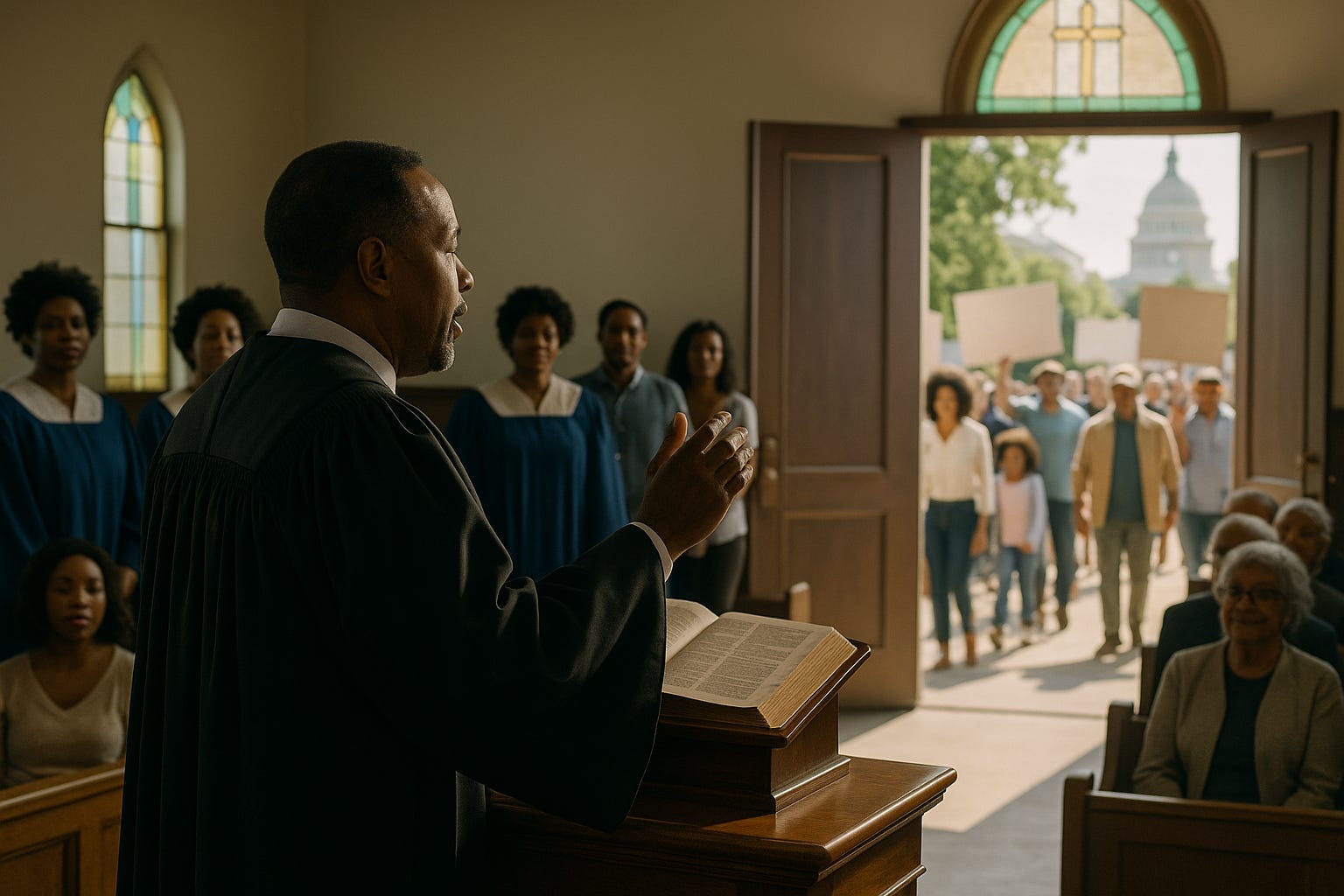
The Pulpit and Protest
The Political Witness of African-American Christianity
Every nation needs a conscience. In America, that role has often been played—not by universities or think tanks—but by the Black church. From brush arbors to brick sanctuaries, the pulpit has been a place where Scripture became sociology, where theology met public policy, and where the democratic experiment was reminded of its own first principles. The Black church’s political witness is not a detour from its mission; it is what happens when the gospel is preached among people who know what it means to be denied dignity and yet refuse to surrender hope.
From Abolition to Civil Rights: A Tradition of Moral Clarity
Nineteenth-century pulpits did not simply interpret the Bible; they interpreted America. Richard Allen’s African Methodist Episcopal movement created the organizational sinews for self-governance. Frederick Douglass learned to speak with prophetic cadence in church halls before he electrified the nation. Sojourner Truth—equal parts abolitionist and activist—embodied the audacious claim that Christian orthodoxy and African-American freedom were not rivals but allies. These leaders did not chiefly argue policy; they declared a human fact: all persons bear the image of God, and any law that renders some people property is not merely imprudent—it is blasphemous.
The civil rights era carried this moral grammar into the 20th century. Martin Luther King Jr. spoke as a Baptist pastor before he spoke as an American icon. Fannie Lou Hamer’s thunderous testimonies reached past the procedural knots of politics to a deeper moral reality: you do not need a Ph.D. to know injustice when it sits at your kitchen table. Skeptics sometimes reduce the movement to savvy organizing and media strategy. But what made it compelling was liturgical—the hymns, the altar calls, the funerals. A sacramental seriousness suffused the public square. Marches looked like processions; jail cells became chapels.
A Theology of Justice Rooted in Scripture
The Black church draws from a set of biblical wells that have never run dry. There is the imago Dei of Genesis, anchoring the language of dignity. There is the Exodus, a narrative of deliverance that teaches oppressed people to trust the God who sees and acts. There are the prophets—Amos and Micah—who insist that worship without justice is noise. And there is the New Testament’s scandalous ethic of enemy love: victory that refuses vengeance.
Crucially, this is not “anything-goes” spirituality. It is thickly orthodox. A high view of Scripture and a higher view of Christ’s authority gave the movement ballast. The point was not merely to win rights; it was to become a different kind of people—truth-telling, self-controlled, nonviolent. The church functioned as a moral gymnasium. It trained citizens in habits—patience, discipline, courage—that made democracy possible. Politics was an extension of discipleship.
When Prophecy Meets Partisanship
If the past offers clarity, the present offers crosswinds. Today’s political ecosystem monetizes outrage and rewards ineptitude. Many churches—Black and white—feel tugged toward one partisan tribe or the other. The danger is not political engagement per se; the danger is political captivity. When the church’s moral vision is reduced to a party platform, it loses precisely what gave it power: its capacity to critique everyone in the name of a higher loyalty.
The Black church has always known better. Its best leaders have been nonpartisan without being apolitical. They pursued an ethic, not an echo chamber. They organized voter drives and policy campaigns, then sang hymns that reminded congregants that Caesar is never Lord. The point was not to be above politics, but to be beyond the binaries—rooted in a tradition that can bless what is just and rebuke what is cruel, whichever jersey the offender wears.
What the Moment Requires
Our era asks the church to do three difficult things at once.
First, re-center the theological story. Cable news disciples faster than catechisms. Congregations need intentional “civic discipleship”: teaching on the imago Dei, the limits of state power, neighbor love, truth-telling, sexual fidelity, stewardship. A people formed by these commitments will approach policy with humility, realism, and moral resolve.
Second, rebuild mediating institutions. The political witness of the Black church has always moved from pulpit to basement—food pantries, legal clinics, counseling groups, tutoring programs. These are not PR; they are proofs. Quiet competence in the neighborhood creates credibility in the statehouse.
Third, model a different political temperament. The movement that sang spirituals while being beaten will not be impressed with performative outrage. The church can reintroduce the country to moral seriousness paired with emotional maturity—soft hearts, thick skin. Refuse the algorithm’s demand for perpetual escalation. Practice the overlooked virtues: forbearance, listening, steel in the spine without poison in the veins.
The Old Future
What made the pulpit powerful in the abolition and civil-rights eras was not novelty; it was fidelity. A community rooted in Scripture and ordered toward love became a factory of citizens who could withstand humiliation without surrendering dignity. That is precisely the skill set our democracy lacks now.
So the assignment is not primarily to find the next charismatic leader or craft the perfect policy slate. The assignment is to become again what the Black church at its best has always been: a school of virtue and a sanctuary of courage; a place where prayers turn into programs, and programs turn into laws; a place where the Word of God is spoken plainly and the image of God is defended relentlessly.
America still needs a conscience. If the pulpit remembers its first love, protest will remember its first purpose—not rage for its own sake, but the steady, patient labor of building a more just common life. In that work, the Black church’s witness is not a relic. It is a roadmap.


