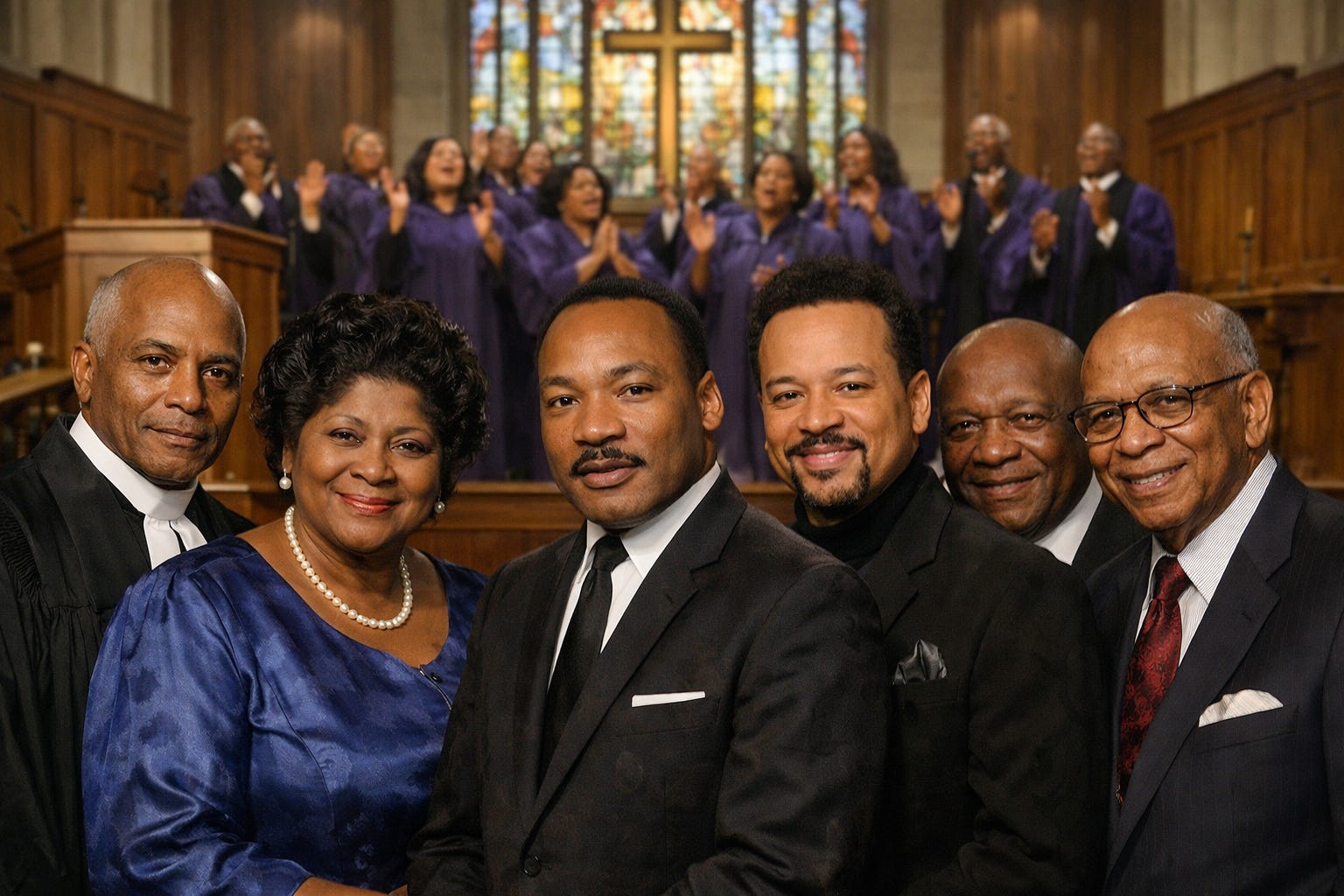
The Soul of American Christianity
How the Black Church Transformed Our Understanding of the Gospel

The story of American Christianity cannot be told without placing the African-American church at its very center. This isn't merely a matter of historical accuracy or cultural appreciation, though both are essential. It's about recognizing that the Black church has fundamentally reshaped how we understand the Christian message itself, drawing out truths that others had overlooked or forgotten, and drawing new life from the scriptures that had grown stale through comfortable repetition.
When enslaved Africans first encountered Christianity in America, they did something remarkable. Rather than simply accepting the slaveholder's version of the faith, a distorted gospel that somehow blessed bondage and preached obedience to earthly masters, they looked deeper into the biblical text and found something else entirely. They discovered a God who "has sent me to proclaim freedom for the prisoners and recovery of sight for the blind, to set the oppressed free" (Luke 4:18). They recognized in the Exodus story their own narrative, and in Jesus's crucifixion, they saw a God who understood suffering from the inside.
This wasn't just a different interpretation. It was a theological revolution that recovered something essential about Christianity that the comfortable had forgotten: that the gospel is fundamentally about liberation, that God has a "preferential option" for the oppressed, and that true faith cannot coexist with injustice. A liberation that is only experienced as the result of salvation, which comes by confessional faith in Jesus Christ alone.
Consider the contribution to our understanding of Jesus himself. While much of European Christianity had become abstract and philosophical, debating the fine points of doctrine in comfortable seminaries, African-American preachers and theologians were encountering Christ as a living presence in the midst of suffering. Dr. Martin Luther King Jr. didn't just apply Christian ethics to politics; he revealed how the cross and resurrection speak to the project of human dignity and collective liberation.
These weren't mere applications of Christian truth to social circumstances. They were profound theological insights that revealed dimensions of scripture that others had missed. When African-American Christians read "Blessed are those who mourn, for they will be comforted" (Matthew 5:4), they understood mourning not as a private sorrow but as a collective grief that could be transformed into hope. When they sang "We Shall Overcome," they were doing theology, proclaiming that "the arc of the moral universe is long, but it bends toward justice," as King said, because God is on the side of the oppressed.
The musical contribution alone would justify our attention. Gospel music didn't just add a new genre to the American songbook, it transformed worship itself. The spirituals sung in fields and secret gatherings encoded both pain and hope, theological depth and revolutionary yearning. Songs like "Swing Low, Sweet Chariot" and "Wade in the Water" weren't mere entertainment; they were biblical interpretation set to music, expressions of worship, survival strategies, and acts of resistance all at once.
Gospel music taught American Christianity how to worship with the whole body, how to let joy and sorrow intermingle, how to make praise a form of protest and protest a form of praise. When Mahalia Jackson sang "Precious Lord, Take My Hand" at the funeral of Martin Luther King Jr., she was performing theology as profound as any systematic treatise. Thomas Dorsey, the father of gospel music, understood that the good news needed to be embodied, felt in the bones, not just understood in the mind.
This embodied faith extended to preaching. The African-American preaching tradition developed a distinctive style, call and response, rhythmic cadence, emotional intensity, that wasn't just rhetorical flourish. It was based on a deep understanding that the Word must become flesh in the congregation, that truth must be experienced communally, that the sermon is a participatory event where the Spirit moves through preacher and people together. "Faith comes from hearing the message," Paul writes in Romans 10:17, and the Black church understood that hearing must engage the whole person.
More importantly, Black preachers developed a hermeneutic, a way of reading scripture, that insisted on the Bible's relevance to immediate circumstances. When Frederick Douglass taught himself to read, he found in the Bible a condemnation of slavery, not its justification. When Gardner C. Taylor, often called the "dean of American preaching," opened scripture, he revealed layers of meaning that spoke to both eternal truths and contemporary struggles. This wasn't eisegesis, reading into the text what isn't there. It was reading the text with eyes unclouded by privilege, seeing what had always been there.
The Black church's contribution to biblical justice cannot be overstated. While other Christian traditions often separated spiritual salvation from earthly conditions, African-American Christianity insisted that the two were inseparable. How could it be otherwise? The prophet Amos thunders, "Let justice roll on like a river, righteousness like a never-failing stream!" (Amos 5:24). James writes, "Suppose a brother or a sister is without clothes and daily food. If one of you says to them, 'Go in peace; keep warm and well fed,' but does nothing about their physical needs, what good is it?" (James 2:15-16).

The Civil Rights Movement wasn't a political campaign that happened to involve churches. It was a theological movement that understood the imago Dei, the image of God in every person, demanded political action. When Rosa Parks refused to give up her seat, she was performing practical theology. When John Lewis spoke of "good trouble," he was articulating a biblical ethic of prophetic witness. The movement's insistence on nonviolence came directly from Jesus's Sermon on the Mount, interpreted through the African-American experience of suffering that refuses to be overcome by bitterness.
This contribution continues today. When Bryan Stevenson speaks about mercy and justice, drawing on his grandmother's faith to fuel his work with the incarcerated, he continues a tradition centuries old. When William Barber II leads the Poor People's Campaign, calling forth a "Third Reconstruction," he stands in a lineage of prophetic witness that stretches back through King to Douglass to the unnamed preachers who first proclaimed freedom in the slave quarters.
The African-American church has taught American Christianity what it means to be human. In a society built on the lie that some people are less than fully human, Black Christians insisted on the dignity that comes from being created in God's image. They taught that this dignity cannot be granted or withdrawn by earthly powers, it is inherent, God-given, inviolable. As the Psalmist declares, "I praise you because I am fearfully and wonderfully made" (Psalm 139:14).
This isn't just theology for Black people. It's theology for everyone, a correction to the distortions that privilege creates in how we read scripture and understand our faith. The white church has often needed the Black church to call it back to the gospel's true demands. During slavery, during Jim Crow, during the Civil Rights era, and today, African-American Christians have served as the conscience of American Christianity, asking uncomfortable questions and refusing comfortable answers.
As we look at the distinguished contribution and culture of Christianity within the African-American context, we should feel both gratitude and humility. Gratitude for the gifts of music, preaching, theological insight, and moral courage. Humility in recognizing how much we still have to learn, how many ways the Black church continues to call us toward a fuller, truer understanding of what it means to follow Christ. This isn't a comfortable theology. But it's a necessary one, and it comes from a tradition that has earned the right to speak through centuries of faithful witness in the midst of suffering.
The African-American church has given American Christianity its soul, or perhaps more accurately, it has helped recover the soul that was always meant to be there. As we sing the spirituals, as we hear the cadences of Black preaching, as we join in movements for justice, we are not just appreciating a cultural contribution. We are encountering the living Christ who remains, as always, closest to those who suffer, and who speaks most clearly through those who refuse to let suffering have the final word.
"The Spirit of the Lord is on me," Jesus read in the synagogue, "because he has anointed me to proclaim good news to the poor" (Luke 4:18). The African-American church heard that proclamation and believed it. In doing so, they transformed not just their own faith, but ours as well. For that, we should all say: Amen, and amen.


