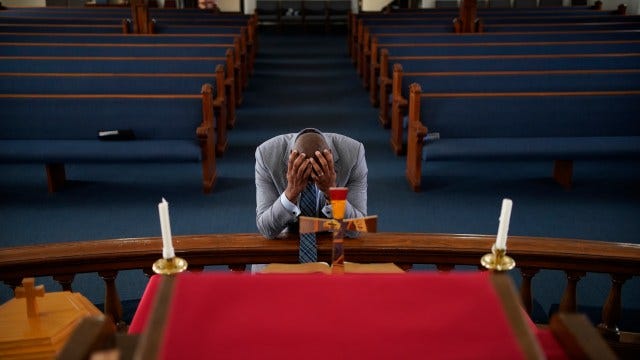
The Tragedy of the Gifted Underachiever
Why pastoral faithfulness matters more than we think
A few months ago, a distinguished pastor friend shared with me a story that has haunted me ever since. He spoke of a fellow minister—a man blessed with extraordinary gifts in the pulpit, sent to shepherd a congregation in the early 90s, ripe with possibility in his early 20s. He passed away with seemingly a couple of decades of pastoring left in him. However, the pastor confessed near the end of his life that he had massively underachieved. Not in the world's terms, mind you. His church had respectable attendance. His sermons were well-received. But by his own measure, against the standard of what he knew God had called him to do, he had fallen devastatingly short.
This confession strikes at something we rarely discuss in church circles: the quiet tragedy of the underachieving pastor. We talk about pastoral burnout, about the challenges of ministry in a secular age, about the loneliness of leadership. But we seldom speak candidly about those who simply fail to steward well the extraordinary trust placed in their hands.
The phenomenon isn't new. Scripture is littered with cautionary tales of men who possessed divine calling yet squandered it through various forms of distractions, misplaced energy, and self-sabotage. What's instructive isn't merely that they failed, but how they failed—and what their failures reveal about the human tendency to undermine our own highest purposes.
Consider Samson, that Herculean figure who strides through the book of Judges like a force of nature. Here was a man marked from birth for divine service, endowed with supernatural strength, set apart as a Nazirite. Yet Judges 16 records his pathetic end: "He did not know that the Lord had left him." What brought him low? Uncontrolled appetites. A pattern of moral compromise so ingrained that he couldn't recognize his own spiritual erosion. His was the tragedy of the man who confused momentary passion with lasting purpose, who allowed unchecked desire to hollow out his calling from within.
How many pastors have we known—brilliant, charismatic, genuinely called—who similarly allowed some unexamined habit to metastasize? Not always dramatic moral failure, though sometimes that too. More often, it's the unchecked patterns that seem manageable until they're not: the pornography quietly viewed, the drinking that becomes slightly too necessary, the emotional affairs that don't quite cross the line until they do. Like Samson, they wake one day to discover their strength has departed, and they never noticed when it left.
Then there's the underachievement born of vice—that ancient word we've nearly lost. Achan's story in Joshua 7 remains startling in its directness. After Jericho's fall, when explicit instructions forbade taking plunder, Achan saw "a beautiful robe from Babylonia, two hundred shekels of silver and a bar of gold" and coveted them. His rationalization must have seemed reasonable at the time: Who would miss these items? Didn't he deserve something for his service? But his secret vice—the love of things, the appetite for more—brought catastrophe not just on himself but on the entire community.
I think of pastors I've known who nursed their own secret vices: jealousy of colleagues with larger churches, bitterness over perceived slights, greed masked as "wise stewardship." These aren't the dramatic sins that make headlines. They're the quiet toxins that poison a ministry from within, that turn shepherd into hireling, that make a man's preaching ring hollow because his private ambitions contradict his public message.
Perhaps most common, though, is the underachievement born simply due to the lack of discipline. The failure isn't moral or vice-driven—it's the slow slide into comfort, the gradual acceptance of "good enough." Eli the priest serves as Scripture's cautionary exemplar. First Samuel 3:13 records God's judgment: "For I told him that I would judge his house forever for the iniquity he knew of, because his sons made themselves vile, and he did not restrain them." Eli wasn't wicked. He was weak. He knew what needed to be done but lacked the fortitude to do it. He chose peace over righteousness, comfort over confrontation.
How many pastoral careers quietly dim not through scandal but through this slow erosion of the undisciplined preacher? The sermon preparation that grows more cursory each year. The pastoral visits that become less frequent. The prayer life that withers to a professional routine. The leadership that defaults to maintaining what is rather than pursuing what could be. These pastors aren't bad men. They're tired men who have convinced themselves that coasting is the same as serving.
Yet here's what grips me about that unnamed pastor's deathbed confession: he knew. He understood the gap between his calling and his achievement. And this awareness points us toward what truly matters in ministry—and what constitutes real achievement in the first place.
The Faithful Servant
In Matthew 25:23, Jesus doesn't praise the servant who generated the most impressive returns. He commends faithfulness: "Well done, good and faithful servant! You have been faithful with a few things; I will put you in charge of many things. Come and share your master's happiness!" The word "faithful" appears twice in this brief sentence, and that repetition isn't accidental. Faithfulness is both the means and the measure of kingdom success.
This isn't a lowering of standards; it's a clarification of them. The pastor with extraordinary gifts in a prominent church and the pastor with modest gifts in a struggling congregation face the same fundamental question: Have you faithfully steward what was entrusted to you? The gifted preacher who underachieves doesn't fail because his church stayed small or his sermons went unnoticed by the wider world. He fails because he didn't faithfully deploy his gifts in service of the people God sent him to serve.
True achievement in ministry is faithfulness to the specific, unrepeatable opportunity God places before you. Every pulpit is a sacred trust. Every congregation is a garden given into your care. Every Sunday is a fresh invitation to participate in God's redemptive work. As Paul writes in Colossians 3:23-24, "Whatever you do, work at it with all your heart, as working for the Lord, not for human masters, since you know that you will receive an inheritance from the Lord as a reward. It is the Lord Christ you are serving."
That phrase "with all your heart" demolishes our excuses. It doesn't ask whether your church is large or small, urban or rural, growing or declining. It asks whether you are investing your full self in the work before you. Are you preaching to *these* people with everything in you? Are you shepherding *this* congregation with your whole heart? Are you treating *this* moment as the sacred opportunity it actually is?
First Corinthians 4:2 strips away any ambiguity: "Now it is required that those who have been given a trust must prove faithful." Required. Not suggested, not preferred—required. The steward's sole obligation is faithfulness to his charge. The results, the metrics, the comparative success—these belong to God. But faithfulness? That's on us.
I think often of Jeremiah, sent to prophesy to a nation that would not listen, faithful through decades of apparent failure. Or of Ezekiel, performing strange enacted parables before a stubborn people. Or of Hosea, commanded to embody in his own painful marriage the story of God's faithful love. None of these men would be lauded by our contemporary metrics of ministerial success. Yet Scripture presents them as exemplars precisely because they remained faithful to their specific, difficult callings.
The pastoral vocation is less like running a corporation and more like tending a garden that belongs to someone else. The gardener doesn't create the life in the garden; he cultivates what God causes to grow. But he must cultivate faithfully—pruning and watering, planting and weeding, season after season. Second Timothy 2:6 reminds us that "the hardworking farmer should be the first to receive a share of the crops." Notice: hardworking. Faithfulness isn't passive. It's the daily, disciplined, diligent deployment of your gifts in service of your calling.
To my brothers who stand behind pulpits each Sunday: You have been given much. A sacred text to proclaim. People hungry for truth. A calling from the living God. Don't let uncontrolled habits hollow out your ministry from within. Don't nurture secret vices that contradict your public message. Don't slip into the comfortable mediocrity of "good enough."
Instead, embrace the liberating clarity of faithfulness. Model the faithfulness of men like the Apostle Paul, Seth Doyle, McKinley Jackson, Sr., William J. Shaw, Tony Evans, Jeffrey A. Johnson, Sr., and John Jenkins. Preach to the ten people in your country church with the same diligence you'd bring to ten thousand. Shepherd the difficult congregation with the same care you'd lavish on an easy one. Study Scripture with intensity not to impress others but to feed souls. Pray not for a larger platform but for a more faithful heart.
As Peter writes in 1 Peter 5:2-4, "Be shepherds of God's flock that is under your care, watching over them—not because you must, but because you are willing, as God wants you to be; not pursuing dishonest gain, but eager to serve; not lording it over those entrusted to you, but being examples to the flock. And when the Chief Shepherd appears, you will receive the crown of glory that will never fade away."
The Chief Shepherd will return. The books will be opened. And the question won't be whether you achieved what *you* imagined for your ministry. It will be whether you faithfully stewarded what *He* entrusted to you. May we all, when our time comes, hear those words: "Well done, good and *faithful* servant." That would be achievement enough for any life.


this is powerful brother...full of conviction and encouragement. Bless you sir!
Such a necessary topic, thank you for this