The Unavoidable Uncomfortable Necessity for Church Mergers
Why the future of Black Christianity in America may depend on congregations learning to die to themselves.
PART ONE: A House Divided Against Itself
The Diagnosis
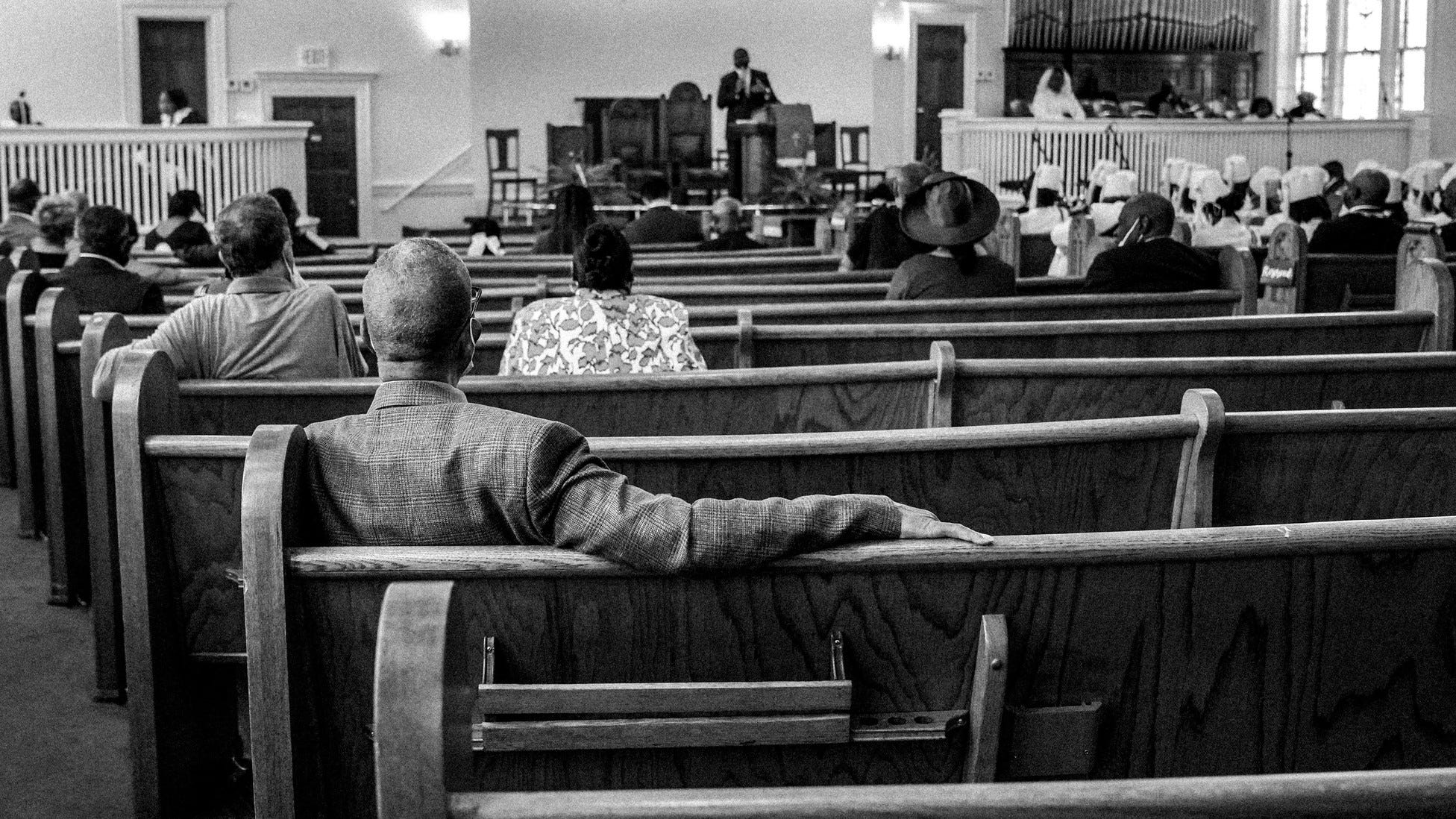
What does it sound like when a church is dying? Not the dramatic collapse of scandal or schism, but the slow, dignified fade of an institution that simply cannot find a way forward? It sounds like this: fifteen voices singing "Blessed Assurance" in a sanctuary built for three hundred. It sounds like the pastor's weary announcement that there will be no Sunday school this week because Sister Johnson, who has taught the children's class for forty years, is in the hospital and there is no one to replace her. It sounds like the creak of wooden pews that once groaned under the weight of packed congregations but now sit empty enough to echo. I've heard this sound in small wood-frame churches off farm roads in East Texas, buildings where the mothers of the church still wear their white usher gloves, where paper funeral home fans still flutter in the summer heat, where the hand-clapping and call-and-response carry a dignity that no contemporary worship team has ever quite replicated. And I've heard it in stately brick sanctuaries in cities like Atlanta, Baltimore, and Chicago, grand institutions built by communities that scraped together nickels and faith in an era when Black Americans couldn't worship anywhere else and so built something magnificent of their own. The sound is different in each place, but the meaning is the same: something precious is slipping away, and we are running out of time to save it.
The pews that once groaned under the weight of families now echo with absence. The senior choir labors through anthems that fewer and fewer people remember. The pastor, often graying, often exhausted, often doing the work of three people on the salary of none, looks out at a flock that is more memory than movement.
This is the landscape of Black Christianity in America in 2026, and it is forcing a reckoning that makes most of us deeply uncomfortable. Because the question is no longer whether these churches will change, but whether they will have the humility to die to themselves in order to live, and fulfill the Great Commission.
The Vanishing Pipeline
Let's start in Marshall, Texas, where a pattern that once seemed as dependable as the seasons has quietly collapsed. For generations, historically Black colleges like Wiley College served as wellsprings for rural congregations across the Piney Woods and the Red River Valley. Young seminarians, full of fire and the Holy Ghost, would take pulpits in Longview, Tyler, Carthage, and the dozens of small towns scattered across East Texas. It was an ecosystem of mutual benefit rooted in community and covenant: churches got energetic young leadership; aspiring pastors got experience, a congregation that would forgive their inevitable mistakes, and the kind of formation that can only come from serving real people in hard circumstances. That pipeline has run dry.
I spoke with a pastor from Marshall, my grandfather’s hometown, and he told me they were finding student ministers less interest in pastoring in East Texas, both current students and recent graduates."They'll do youth ministry in Dallas," he said quietly. "They'll take associate positions in Houston. But pastor a church of forty people in a town with one stoplight and a Dairy Queen? They're just not interested."
And who can blame them entirely? The average rural pastor in these communities makes $35,000 a year, if the church can pay at all. Many Black rural pastors are bivocational, working at the local school district or the county courthouse to make ends meet, preaching on Sunday and stretching a budget on Monday. The parsonage needs a new roof. There's no money for youth ministry because there are no youth. The nearest hospital is thirty miles away. The cultural isolation is real. And the weight of being the only institutional anchor left in a hollowing-out community, after the bank closed, after the grocery store left, after the factory shut down, falls squarely on the church and the pastor's already burdened shoulders.
These young ministers have done the calculus, and they've chosen differently than their predecessors. They want staff positions at growing churches where there's a real salary, benefits, and other ministers to share the spiritual and emotional load. They want proximity to good schools, cultural amenities, and the possibility that their spouse might find meaningful work beyond the township. They've watched their mentors age quickly under the weight of rural ministry and decided, perhaps reasonably, that they want something different.
The rural Black church, meanwhile, grays and shrinks and eventually can no longer heat the sanctuary in December. And with it goes something irreplaceable, not just an institution, but a living archive of survival, resistance, worship, and communal memory that no digital record can fully preserve.
When Yesterday's Model Meets Tomorrow's Indifference
But let's not pretend this crisis is confined to country roads and cotton fields. Drive into any major American city and you'll find established Black congregations facing their own particular form of obsolescence, one born not of geography but of institutional stubbornness.
These are churches with history, magnificent histories, in fact. They were stations on networks of mutual aid. Their pastors marched. Their sanctuaries hosted voter registration drives. Their bulletins announced civil rights meetings hidden in the language of Bible study. Names like Greater Mount Zion, St. Paul Missionary Baptist, New Hope AME, Triumphant Church of God in Christ carry the weight of decades of sacrifice, survival, and sacred community.
But walk in on a Sunday morning and the sanctuary built for 600 holds 80. The average age appears to be somewhere past retirement. The music is stately, traditional, and entirely disconnected from what any person under forty is listening to. The sermon may be excellent, there is still formidable preaching in these pews, but the infrastructure around it has calcified. The bathrooms are original to the Kennedy administration. The website, if there is one, hasn't been updated since the Obama years. The children's ministry is a single Sunday school class taught by a faithful woman in her seventies who deserves more help than she's getting.
These churches know they are in trouble. But here is the painful truth: many of them have actively chosen to remain in trouble. Over the past two decades, they've watched other congregations embrace contemporary worship alongside traditional expressions, invest in children's programming, create young adult ministries with genuine energy, and use technology not as a gimmick but as a sincere tool for connection. And many of these established churches have looked at all of that and said, quietly but firmly: no thank you. They opted to allow a handful of individuals selfishly entertain themselves at the expense of the church's future and purpose.
This isn't entirely about worship style, though style matters more than we admit. It is about a fundamental failure of imagination and will. It is about church leaders who confused faithfulness with preservation, who mistook the vessel for the content, who when faced with the choice between the comfort of familiarity and the discomfort of mission, chose familiarity and called it faithfulness.
What these congregations have produced is a church that the new generation has looked at clearly and said, with respect but without ambiguity: we don't want that. Not because the theology is wrong. Not because the legacy isn't honored. But because the expression of that legacy has been allowed to become a museum exhibit rather than a living movement. And museums, however beautiful, do not make disciples.
The Great Migration to Megachurches
Meanwhile, a different and more quietly devastating kind of sorting is happening, one that should trouble the Black church far more than it currently does. Across urban and suburban America, predominantly white megachurches are experiencing a significant influx of educated, professional African-Americans in their twenties and thirties, and surprisingly, some in their fifties plus. These are not reluctant integrationists. These are young believers making clear-eyed pragmatic decisions about where to invest their faith, their families, their tithes, and their gifts.
The logic is not complicated: these megachurches have what smaller, historically Black congregations often cannot provide. They have well-resourced children's ministries with trained staff, vetted volunteers, structured curricula, and child-to-adult ratios that make every parent feel secure. They have young adult communities that actually contain young adults, in numbers sufficient to form genuine friendships and find spouses. They have small groups organized around every conceivable life stage and interest. They have clean facilities, professional-grade production, pastoral counseling staff, financial wellness ministries, and digital infrastructure that meets people where they actually live.
They also offer something subtler but equally powerful: a kind of congregational anonymity. You can attend, serve, even lead without being recruited onto every committee simply because you're one of twelve people under fifty who showed up. You can be a person in the pew rather than the perpetual answer to an institutional staffing crisis. Now, let me be clear, members should be challenged to be a part of a ministry. But it shouldn't be a desperate guilt trip simply because no one else wants to do it.
I spoke with a young attorney in Atlanta who left the church she grew up in, a storied congregation on the West Side, for a predominantly white megachurch in the northern suburbs. "I love my home church," she told me. "I love the people, the preaching, the history. But they cannot compete with a church that has three full-time children's ministers and a parking lot that doesn't flood when it rains. And honestly? I got tired of being asked to chair every committee just because I'm under forty and breathing."
What is happening here is a kind of institutional extraction, driven not by racism but by resource disparity and organizational capacity. The megachurches aren't targeting these members, they're simply building robust ministry ecosystems and watching people vote with their feet. But the effect is profoundly consequential: a slow hemorrhaging of the most educated, most resourced, most organizationally gifted young adults from the very institutions that need them most. This quiet exodus must be addressed.
The Black church has historically been what C. Eric Lincoln and Lawrence Mamiya described as "the central institutional sector in Black communities," the one institution that Black Americans owned, controlled, and shaped entirely on their own terms.¹ It was the launchpad for nearly every major civil rights leader, the schoolhouse during segregation, the incubator for Black business and professional networks, the sanctuary in the most literal sense, a place of physical and psychological safety in a hostile world. When it loses its most gifted young members to congregations that, whatever their virtues, do not share that particular history and burden, something is lost that cannot be easily replaced.
This is not a call for separatism. Integration in the body of Christ is a genuine theological good. But there is a difference between integration and extraction, between genuine partnership and quiet institutional cannibalism. The megachurches gain talented, committed members. These historically Black congregations are losing the very people who might have led their renewal.
____________
¹ C. Eric Lincoln and Lawrence H. Mamiya, The Black Church in the African American Experience (Durham: Duke University Press, 1990), 35. Kindle edition.


I wonder if there was a way to "census" data demographically? Perhaps a centralized .org of pastoral peers offering guidance to churches to target, with alacrity, the issues you've raised.