The Weight We Carry
How the Black Church Bears America's Moral Conscience While Sustaining Its Own Soul
I was recently inspired by a presentation given by Isaiah Robertson during the Black Church Empowered live stream. The following piece is dedicated to the saints that have gone before us. And to the generation watching us today. May we too bare the burden of these times with the same dignity and hope in Jesus Christ that kept our forefathers.
~~~~~~~
There's a particular kind of exhaustion that comes not from physical labor but from carrying the weight of a people's survival across generations. It's the weariness that settles into institutions asked to be everything—sanctuary and school, hospital and hope, political forum and prayer closet—because no other institution would serve that purpose.
I'm thinking about the African-American church, that peculiar and magnificent institution that has shouldered burdens no religious body should have to bear alone, yet has done so with a grace that indicts and inspires the rest of us in equal measure.
The Foundation Built on Stolen Ground
The story begins, as so many American stories do, with an original sin that echoes across centuries. Men and women were stolen from their homelands, stripped of their names, their languages, their gods. They were reduced, in the cold calculus of commerce, to property. Yet even in the hull of slave ships, even in the brutality of auction blocks, even in the backbreaking labor of cotton fields, something stubborn and sacred persisted.
The enslaved found in the gospel of Jesus Christ what their captors had tried to deny them: their fundamental humanity. "There is neither Jew nor Gentile, neither slave nor free, nor is there male and female, for you are all one in Christ Jesus" (Galatians 3:28). These weren't just words of distant comfort. They were revolutionary claims, explosives planted beneath the foundations of a society built on racial hierarchy.
The invisible institution—those secret gatherings in woods and cabins where enslaved people worshiped beyond the watchful eyes of masters—became the crucible in which African-American Christianity was forged. Here was a people who, having lost everything that could be taken, discovered what could not be stolen: the image of God within them, that imago Dei no whip could erase.
The Black church emerged not as one denomination among many, but as the sole institution wholly owned and controlled by African Americans. It was mother and father to the orphaned, university to the excluded, bank to the dispossessed, and hospital to the sick. As the Psalmist wrote, "God sets the lonely in families" (Psalm 68:6), and the church became that family when all others had been torn asunder.
But more than any material provision, more than any social function it performed, the African-American church carried the sacred burden of being the sole keeper and dispenser of hope to an abducted and oppressed people. When every human institution had failed them, when the law offered no protection, when society offered no dignity, when the future appeared to be only more of the same brutality—the church held forth the hope of the gospel. It proclaimed that "the Spirit of the Lord is on me, because he has anointed me to proclaim good news to the poor. He has sent me to proclaim freedom for the prisoners and recovery of sight for the blind, to set the oppressed free" (Luke 4:18). This was not mere religious platitude but existential lifeline. The church alone sustained the belief that their suffering was not God's design, that deliverance would come, that "weeping may stay for the night, but rejoicing comes in the morning" (Psalm 30:5). It nurtured the conviction that "our present sufferings are not worth comparing with the glory that will be revealed in us" (Romans 8:18), that this world's cruelties were not the final word. No other institution shouldered this weight—not government, not schools, not civic organizations. The Black church alone bore the responsibility of keeping hope alive in hearts that had every earthly reason to despair.
This was a burden no single institution should bear. Yet bear it they did, because there was no alternative, no backup, no other safety net. The church carried the full weight of a people's survival.
The Prophet's Mantle: Speaking Truth When Silence Would Be Safer
But the African-American church was never content merely to survive. Rooted in the prophetic tradition, it took upon itself another burden: to be America's moral conscience, to speak truth to power when silence would have been so much safer.
Consider the courage this required. In a nation where Black bodies could be lynched with impunity, where speaking up could mean death, the Black church dared to preach that all people are created equal, that injustice anywhere is a threat to justice everywhere, that "righteousness exalts a nation, but sin condemns any people" (Proverbs 14:34).
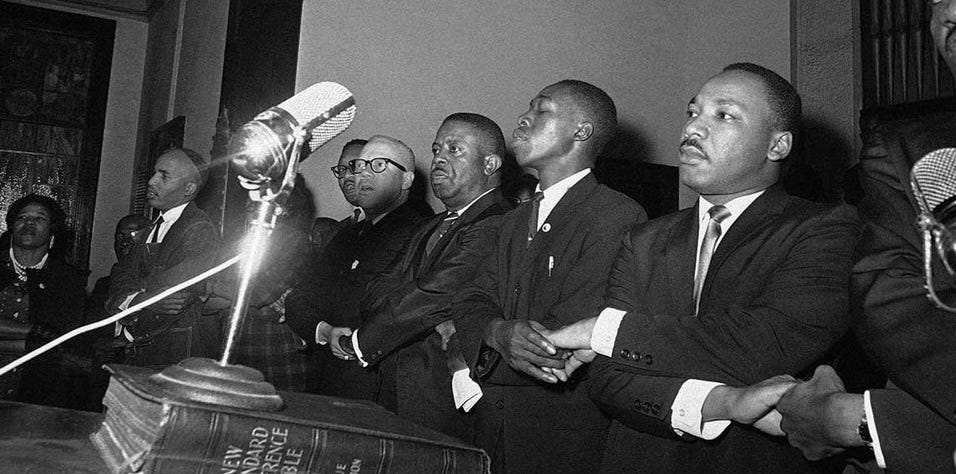
From Nat Turner to Martin Luther King Jr., from Harriet Tubman to Fannie Lou Hamer, the church produced prophets who channeled the spirit of Amos: "Let justice roll on like a river, righteousness like a never-failing stream!" (Amos 5:24). They refused to let America rest comfortably in its hypocrisy, refused to let the nation enjoy its prosperity while built on oppression.
This prophetic witness came at immeasurable cost. Churches bombed. Pastors murdered. Congregants beaten, jailed, killed. Yet they persisted, embodying Paul's words: "We are hard pressed on every side, but not crushed; perplexed, but not in despair; persecuted, but not abandoned; struck down, but not destroyed" (2 Corinthians 4:8-9).
What's remarkable—what should humble those of us who have never had to show such courage—is that this prophetic witness was offered not in bitterness but in love. The Black church called America to be better not because it hated America, but because it believed in America's stated ideals even when America did not. It offered the nation the possibility of redemption, held out hope that "if my people, who are called by my name, will humble themselves and pray and seek my face and turn from their wicked ways, then I will hear from heaven, and I will forgive their sin and will heal their land" (2 Chronicles 7:14).
This is the peculiar genius and burden of the Black church: to love a nation that did not love it back, to call that nation to righteousness while being denied the most basic rights of citizenship, to believe in justice when all evidence suggested justice was a mirage.
The weight of being America's conscience—of having to teach America what it means to be American—while simultaneously fighting for one's own survival is a burden that would have crushed institutions made of lesser moral substance.

The Call to the Watchtower: A Time for Prayer and Spiritual Warfare
And now, in our present moment, with old demons resurgent and new challenges emerging, the Black church finds itself weary. The prophetic voice grows hoarse from generations of crying out. The burden-bearing institution staggers under accumulated weight.
This is when we must remember that even prophets need retreat. Even Elijah, after his confrontation with the prophets of Baal, fled to the wilderness and cried out to God, "I have had enough, Lord" (1 Kings 19:4). God's response was not rebuke but refreshment—food, water, rest, and then a still small voice.
The Black church today needs what it has always needed but rarely been allowed: time to retreat, to pray, to fast, to listen for that still small voice amid the cacophony. The call now is not first to the streets—though that time will come again—but to the upper room, to the prayer closet, to the place of intercession.
"The weapons we fight with are not the weapons of the world. On the contrary, they have divine power to demolish strongholds" (2 Corinthians 10:4). Before we can confront the powers and principalities in the world, we must confront them in prayer. Before we can speak truth to power, we must hear truth from God.
This is not retreat from the prophetic calling but preparation for it. This is not abandonment of justice work but recognition that sustainable justice work flows from deep spiritual wells. "Those who hope in the Lord will renew their strength. They will soar on wings like eagles; they will run and not grow weary, they will walk and not be faint" (Isaiah 40:31).
The church must pray for discernment, for the Holy Spirit to lead in ways human wisdom cannot anticipate. It must intercede for the nation, for leaders, for the vulnerable, standing in the gap as the prophet Ezekiel described: "I looked for someone among them who would build up the wall and stand before me in the gap on behalf of the land" (Ezekiel 22:30).
It must fast—not the performative fast that Jesus condemned, but the fast Isaiah praised: "to loose the chains of injustice and untie the cords of the yoke, to set the oppressed free and break every yoke... to share your food with the hungry and to provide the poor wanderer with shelter" (Isaiah 58:6-7).
And it must move as the Spirit leads, not according to political calculations or cultural trends, but in obedience to the One who said, "My thoughts are not your thoughts, neither are your ways my ways" (Isaiah 55:8).
Trust Forged in the Furnace
The final word must be trust—not the cheap trust that has never been tested, but the trust forged in furnaces of affliction. The African-American church knows this trust intimately. It is the trust of Shadrach, Meshach, and Abednego, who told the king, "If we are thrown into the blazing furnace, the God we serve is able to deliver us from it... But even if he does not... we will not serve your gods" (Daniel 3:17-18).
Even if he does not. There is the heart of faith that has sustained the Black church through centuries of trial. Trust in God regardless of outcomes. Faithfulness whether deliverance comes in this generation or the next.
This is the trust expressed in Habakkuk's great profession of faith: "Though the fig tree does not bud and there are no grapes on the vines, though the olive crop fails and the fields produce no food, though there are no sheep in the pen and no cattle in the stalls, yet I will rejoice in the Lord, I will be joyful in God my Savior" (Habakkuk 3:17-18).
The circumstances may not change immediately. The opposition may not relent. The vindication may not come in our lifetime. But the God who brought the Israelites out of Egypt, who sustained them through wilderness wanderings, who brought Jesus through the grave to resurrection—that God is faithful still.
"Let us not become weary in doing good, for at the proper time we will reap a harvest if we do not give up" (Galatians 6:9). The harvest may not be today. The proper time may not be now. But it will come. This is the promise on which the Black church has staked everything, again and again, generation after generation.
The weight is heavy. The burden is real. The weariness is justified. But so is the hope, so is the faith, so is the love that endures all things. The Black church has carried America's moral weight for centuries. Now, in this season, it must remember to cast its own burdens on the Lord, for "his yoke is easy and his burden is light" (Matthew 11:30). Pray. Fast. Listen. Move as the Spirit leads. Trust God, no matter what. This has always been the way through. It remains the way still.
The weight we carry is heavy. But we do not carry it alone. "The Lord is my strength and my shield; my heart trusts in him, and he helps me" (Psalm 28:7). In that trust, in that help, in that divine strength lies not just survival, but the promise of ultimate victory—not by might, nor by power, but by the Spirit of the Lord.


