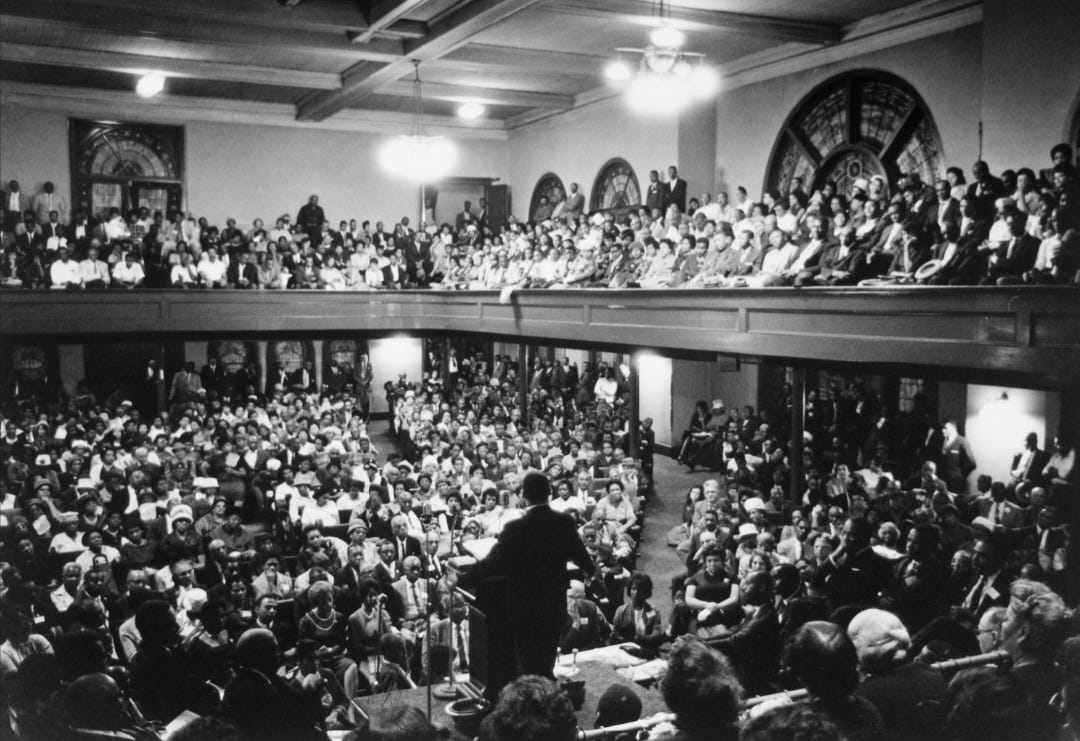
Truth with Power
Distinctives of the African-American Preaching Tradition
There are few traditions in American life as enduring, as profound, and as vital as the preaching tradition of the African-American pulpit. It is not merely a mode of religious expression; it is a cultural inheritance, a moral compass, and, in many ways, one of the deepest wells of American democracy itself. When we look at the African-American pulpit, we are not only listening to sermons—we are encountering a form of truth-telling that has long married biblical orthodoxy with moral urgency, producing a voice that is at once theological, political, poetic, and pastoral.
This tradition was born in conditions of cruelty. Slaveholders attempted to use religion as an instrument of control, withholding portions of scripture, suppressing the Exodus narrative, and distorting the gospel into a justification for bondage. But the Word of God proved stronger than chains. Enslaved men and women discovered that when read in its fullness, scripture was not the property of the oppressor but the liberating Word of the living God. From the hush harbors to brush arbors, from secret gatherings to independent churches, they grasped the gospel’s power for freedom and hope. What began as a forbidden fire soon became the very force that sustained a people’s faith, sharpened their resilience, and shaped their communal identity.
The genius of the African-American preacher was to transform adversity into artistry. Denied access to formal seminaries and universities, early Black preachers became autodidacts, digging deep into the text, drawing on oral tradition, weaving scripture with song, and embodying the rhythms of hope in their very cadence. Over time, they mastered and perfected every method of preaching. Consider the variety of excellence:
In E.V. Hill, we find the fire of evangelistic proclamation, thundering with urgency and conviction.
In Joseph H. Jackson, a rigorous expository method, laying bare the meaning of the text with clarity.
In Caesar Clark, a narrative preacher who told the story of scripture in a way that drew listeners into its world.
In Martin Luther King Jr., prophetic preaching that carried the moral imagination of the Hebrew prophets into the streets of America.
In Tony Evans, the teaching preacher, methodical, expository, and committed to making doctrine practical for daily life.
In A. Louis Patterson, the pastoral preacher, whose words embraced a congregation with the balm of care and encouragement.
In Gardner C. Taylor, a conversational preacher, whose sermons moved like symphonies—subtle, elegant, persuasive.
In Francis Grimké, a liturgical preacher, reminding us of reverence, order, and the church’s rootedness in biblical orthodox Christian practice.
No single style can contain the tradition, because the African-American pulpit has always been capacious—able to encompass celebration and lament, intellect and emotion, orthodoxy and improvisation. Yet one constant holds: a deep dependence on and commitment to scripture. For all the rhetorical brilliance, it has never been rhetoric for its own sake. It has been scripture read, prayed, sung, embodied, and applied—truth with power.
This preaching shaped more than worship services. It formed a people. It inspired spirituals, gospel music, and civic movements. It became the moral center of Black America, fueling campaigns for abolition, civil rights, and human dignity. When political leaders faltered, the pulpit stood. When the academy lost its way, the pulpit endured.
And yet, the African-American pulpit is not without its present challenges. In recent decades, a strain of liberal theology—often imported from European contexts—has made inroads into some corners of Black preaching. This theology, with its suspicion of biblical authority and its tendency to relativize orthodoxy, risks cutting the tradition from its deepest roots. The consequence has been confusion: sermons more captive to political fashion than eternal truth, pulpits shaped more by sociology than by scripture. The tragedy is not merely theological drift but the loss of the very distinctiveness that has given the African-American church its resilience and moral clarity.
The lesson of history is unmistakable: whenever the pulpit has held fast to the full counsel of God, the community has flourished in strength and hope. Whenever the pulpit has been diminished—by censorship in slavery, by accommodation in segregation, or by theological drift in recent years—the community has suffered. The future of the African-American church, and indeed the broader African-American community, depends on preachers who once again proclaim scripture with conviction, wisdom, and joy.
The African-American pulpit at its best is not only a gift to Black America; it is a gift to America. It is one of the clearest voices of truth with power that this nation has ever produced. And as with the past, so with the future: when the pulpit is at its best, the people are at their best.


