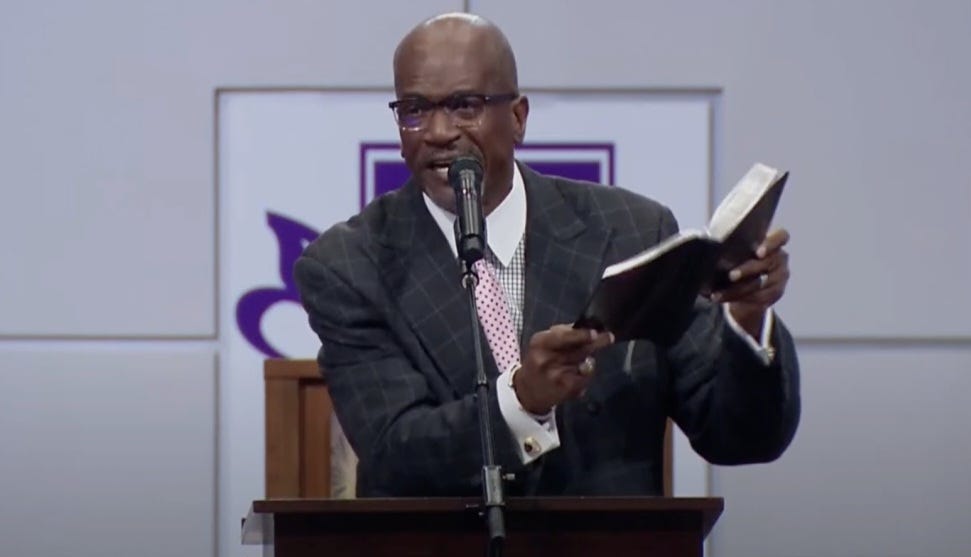
What Are You Preaching?
When the News Cycle Invades the Pulpit, the Gospel Pays the Price
What is the most dangerous thing happening in American Christianity right now? You might point to declining attendance, the exodus of younger generations, or the slow institutional decay of historic denominations. All of these deserve serious attention. But I want to propose something that sits beneath all of them, something quieter and more corrosive than any of the crises we tend to name. The most dangerous thing happening in the American church right now is that a growing number of pastors have forgotten what they were called to preach.
This is not a failure of courage, though courage is often missing. It is not primarily a failure of intellect, though intellectual laziness has done its damage. It is a failure of identity, a creeping uncertainty about what the pulpit is actually for. And into that uncertainty, the news cycle has moved like a tenant who never intended to be a guest.
Every Sunday in America, congregations gather beneath the weight of events they have already watched, scrolled through, and argued about all week. The border. The economy. The court decisions. The political controversies that shimmer on every screen and crackle through every conversation. And a pastor, looking out at those anxious faces, faces a temptation as old as ministry itself: to be relevant rather than faithful, to speak to the moment rather than to eternity.
"Do not be conformed to this world, but be transformed by the renewal of your mind, that by testing you may discern what is the will of God, what is good and acceptable and perfect." (Romans 12:2)
The Apostle Paul issued that warning to a congregation living under the thumb of Rome, surrounded by an empire that generated its own relentless news cycle of power, spectacle, and fear. His answer was not silence about the world. It was the renewal of the mind through the Gospel. That is a distinction the contemporary church has nearly lost.
THE INFILTRATED PULPIT
To be clear about what is happening: the problem is not that pastors discuss current events. The prophets of Israel addressed their historical moment with surgical precision. The problem is when current events cease to be the occasion for Gospel proclamation and become the substance of it, when the sermon is essentially a baptized op-ed, dressed in scriptural language but driven by the urgency of this week's headlines.
We see this across the theological spectrum, and it would be dishonest to pretend otherwise. On one side, pastors have become political commentators in clerical dress, offering partisan analysis with a few proof texts stapled to the end. Their congregations come away knowing which candidates God presumably favors and which cultural enemies they should oppose, but they leave with no encounter with the living Christ. On the other side, pastors have traded the Gospel for a therapeutic vision of justice, preaching a social project that sounds prophetic but has quietly evacuated the cross. In both cases, something has been lost, something irreplaceable.
What has been lost is the center. And the center, as Paul understood it, is not a concept or a cause. It is a Person.
"When the pulpit becomes a platform for anything other than Jesus Christ and Him crucified, the congregation is left with bread that does not satisfy and water that does not quench."
The hunger in the pew is real, but it is not a hunger for political clarity. People can get that from a thousand podcasts and cable news channels. The hunger in the pew, often unexpressed, often mistaken even by the people who carry it, is a hunger for a word from God. And the word God gave is not a platform. It is a proclamation.
WHAT PAUL PREACHED, AND WHY
We do not have to guess at what the center of Christian preaching ought to be. Paul, writing to the divided, fractious, culturally conflicted church at Corinth, tells us with remarkable explicitness. He begins in the first chapter:
"But we preach Christ crucified, a stumbling block to Jews and folly to Gentiles, but to those who are called, both Jews and Greeks, Christ the power of God and the wisdom of God." (1 Corinthians 1:23–24)
Notice what Paul is doing here. He is standing in the middle of a city that ran on wisdom, Greek philosophy was not merely an academic exercise in Corinth; it was a status symbol, a social currency. The Corinthians valued sophisticated, impressive rhetoric. And Paul is telling them that the message he has been given will not satisfy that appetite. Christ crucified is a stumbling block to the religiously serious and foolishness to the intellectually proud.
He does not apologize for this. He does not try to make the Gospel more palatable by dressing it in the city's preferred categories. He doubles down. Then, as if to preempt any confusion about what he meant, he tells them in the second chapter how he had approached his own preaching ministry among them:
"For I decided to know nothing among you except Jesus Christ and him crucified." (1 Corinthians 2:2)
This is one of the most stunning methodological statements in the New Testament. Paul is not saying he was intellectually narrow or that other subjects have no value. He is saying that when he stood before that congregation, he had made a prior decision, a decision made before he ever spoke a word, about what would occupy the center. Everything else would either orbit that center or be left out.
The word translated "decided" carries weight. It is a deliberate, pre-committed choice. Paul is describing an act of intellectual and spiritual will. He had refused to let the cultural sophistication of his audience, their desire for novelty, their hunger for a more fashionable message, dislodge Christ from the center of his proclamation. In a congregation where people were aligning themselves behind celebrity teachers, "I follow Paul," "I follow Apollos," "I follow Cephas" (1 Cor. 1:12), Paul insists that the preacher is never the point. The crucified Christ is the point.
This was not rhetorical timidity. Earlier in his ministry, Paul had debated the philosophers in Athens, engaging their poets and their altars (Acts 17:22–31). He knew how to speak to a cultured audience. His decision in Corinth was not the result of an inability to engage; it was the result of a conviction about what Christian proclamation must never surrender.
WHAT OUGHT TO BE PREACHED
If Paul's declaration in 1 Corinthians 2:2 is taken seriously, it does not produce a thin or impoverished pulpit. Quite the opposite. Christ crucified is not a small subject. Preaching the crucified and risen Christ means preaching the whole counsel of God, the holiness that makes the cross necessary, the love that made it possible, the resurrection that makes it triumphant, and the coming kingdom that makes it not merely historical but eschatological.
"For I did not shrink from declaring to you the whole counsel of God." (Acts 20:27)
The whole counsel of God includes the hard passages about human sinfulness. It includes the prophetic texts that speak to justice and the poor. It includes the epistles that address how believers are to live in households, cities, and empires. None of this is excluded from faithful preaching. But all of it is situated within the framework of what God has done in Jesus Christ, not the other way around.
The difference matters enormously in practice. A pastor who begins with Christ crucified and then addresses immigration will say something fundamentally different from a pastor who begins with an immigration policy and then looks for scriptures to support it. A pastor who begins with the resurrection and then speaks to race will say something fundamentally different from one who begins with racial politics and then reaches for biblical language to amplify it. The starting point is not cosmetic, it determines the destination.
What the congregation most needs on any given Sunday is not commentary on the week's headlines. They need to encounter the living God, to be confronted with their own sinfulness and insufficiency, to receive the staggering good news that in Christ crucified that sinfulness has been dealt with finally and completely, and to be sent back into the week as people who know something the world does not. That encounter, that collision between human frailty and divine grace, is what genuine preaching produces. Nothing else the pastor might say can substitute for it.
"So faith comes from hearing, and hearing through the word of Christ." (Romans 10:17)
WHY IT MATTERS, THE STAKES OF THE PULPIT
Some will argue that this is a false choice, that faithful pastors can preach the Gospel and engage current events simultaneously. And in one sense, they are right. The problem is not engagement with the world; it is displacement of the Gospel. But the false-choice argument often functions as permission to slowly migrate, week by week, toward a pulpit that is increasingly shaped by what is trending rather than what is true. And the congregation rarely notices the drift until it is very far downstream.
The stakes are not merely ecclesiastical. When the pulpit abandons the Gospel, congregations lose the only resource that is genuinely equal to the weight of their lives. They can get political commentary elsewhere. They can find social analysis elsewhere. They can find self-help and therapeutic affirmation on virtually every platform in human history. What they cannot find anywhere else in the world, what exists nowhere else in the cosmos, is the word that declares them forgiven, loved, and held by the God who made them. Strip that from the pulpit and you have an institution that is essentially redundant. Worse, you have people sitting in pews week after week, thinking they are hearing from God, when in fact they are being offered a religious gloss on the preacher's political or cultural preferences.
The prophet Jeremiah saw something like this in his own moment, and his language was not gentle:
"The prophets prophesy falsely, and the priests rule at their direction; my people love to have it so, but what will you do when the end comes?" (Jeremiah 5:31)
The indictment lands on prophets, priests, and people alike. A congregation that has been trained to want its cultural biases confirmed from the pulpit will often resist a pastor who tries to return to the center. But the pastor's calling is not to give the congregation what it wants. It is to give them what they need. And what they need is Christ.
There is also a long-term institutional consequence that tends to be underappreciated. Congregations that are built around a political identity or a cultural cause tend to fracture when the political landscape shifts or when the cause evolves in directions the congregation did not anticipate. The Gospel-centered church, by contrast, has a center that does not move. Its anchor is not a party platform or a social movement. Its anchor is the risen Christ, the same yesterday, today, and forever (Heb. 13:8). That kind of stability is not a retreat from the world. It is the only kind of engagement with the world that can sustain itself across generations.
"The congregation cannot live on the bread of commentary. They need the bread of life, and the preacher is the one person in their week who has been called to serve it."
A WORD TO THE PREACHER
If you stand in a pulpit, if men and women sit before you week after week, trusting that what you are about to say has been given to you from somewhere beyond yourself, then Paul's declaration in 1 Corinthians 2:2 is not a historical curiosity. It is a mirror. What have you decided to know? What have you decided to center? Before you preach your next sermon, before you open the news app to find your illustration or choose your text based on what is currently controversial, it is worth sitting with that question in silence.
The news cycle will always produce material. The cultural moment will always present itself as urgent. The congregation will sometimes signal, through the questions they ask, the responses they give, the social media posts they share, that they want you to address what everyone else is already addressing. The pressure is real and the temptation is understandable.
But there is a different kind of urgency the preacher must learn to feel, the urgency of the Gospel itself. Paul, writing to his young protégé Timothy, did not tell him to be relevant. He told him:
"Preach the word; be ready in season and out of season; reprove, rebuke, and exhort, with complete patience and teaching." (2 Timothy 4:2)
In season and out of season, when it is convenient and when it is not, when it lands well and when it does not, when the cultural moment seems to welcome it and when it seems to demand something else entirely. That is the charge. Not to be relevant. Not to be impressive. Not to be culturally attuned. To preach the word.
And the word, as Paul so plainly declared, is Jesus Christ, and him crucified. Everything else the preacher has to offer is, at best, commentary. At worst, it is noise. The congregation sitting in those pews has enough noise. What they are waiting for, even if they cannot name it, is the one word that the preacher alone has been called to carry.
The question is not whether that word is still relevant. The question is whether the preacher still believes it.


