When Nothing Remains Sacred
The disruption of a St. Paul church by protesters reveals something troubling about our societies shift from reverence
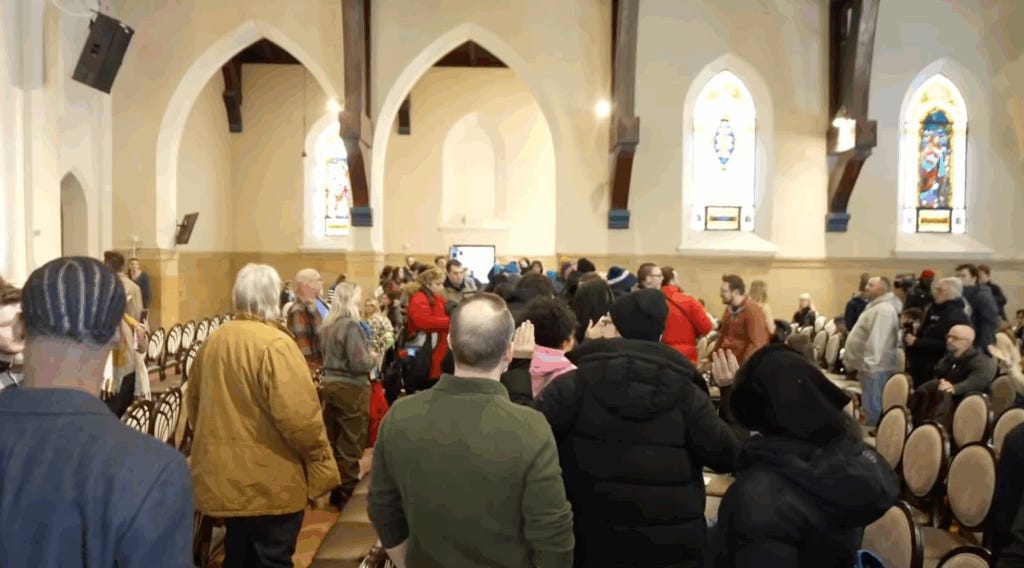
There's a scene I can't shake from last week's news: protesters storming into a church in St. Paul, Minnesota, their chants echoing off vaulted ceilings, congregants frozen mid-prayer, the service dissolving into chaos. The cause was immigration enforcement—ICE operations that had separated families, detained community members, ignited righteous anger. The anger was understandable. The location was not.
I don't write this to dismiss the protesters' grievances. Immigration policy in America has long been marked by cruelty masquerading as order, and when people feel unheard, they reach for megaphones wherever they can find them. But in choosing to breach the sanctuary, these activists crossed a threshold that civilizations have recognized for millennia: the boundary between the civic and the sacred.
Sacred spaces—churches, synagogues, mosques, temples—serve a purpose that transcends their weekly function. They are places where we acknowledge something beyond ourselves, where the urgent surrenders momentarily to the eternal, where we practice the difficult art of sitting with mystery rather than shouting certainty. When we violate these spaces, we don't just disrupt a service. We erode one of the few remaining zones in American life where contemplation can still triumph over consumption, where silence can still speak.
The protesters in St. Paul believed, perhaps genuinely, that their cause justified the intrusion. This is the dangerous calculus of our age: that if your grievance is great enough, no space is off-limits, no norm too precious to shatter. It's a logic that works only until someone with a different grievance—and perhaps a darker motivation—adopts the same reasoning.
The Inconsistent Reverence
America's relationship with houses of worship has always been contradictory, a mix of profound respect and periodic violence that reveals our ongoing struggle with our own ideals. We are a nation that puts "In God We Trust" on our currency while routinely profaning the places where that trust is actually cultivated.
Consider two moments from our history, separated by a century but linked by this tension. During the Civil War, Union General William Sherman, in his march through Georgia, specifically ordered his troops to spare churches and cemeteries. Even amid the total warfare that defined his campaign, Sherman recognized certain boundaries. Churches were not strategic targets; they were repositories of community memory and meaning. His restraint reflected a broader 19th-century understanding that some places stood apart from politics, that sanctuary meant something.

Contrast this with the 1963 bombing of the 16th Street Baptist Church in Birmingham, Alabama, where Klansmen murdered four young girls—Addie Mae Collins, Cynthia Wesley, Carole Robertson, and Denise McNair—as they prepared for Sunday service. The bombers chose that church precisely because it was sacred, because destroying it would terrorize an entire community. They understood that violating a sanctuary wounds more deeply than other violence because it shatters the assumption that some places, at least, are safe.
The African-American church has endured repeated assaults precisely because it has been more than just a place of worship—it has been the institutional backbone of Black community life, the organizing hub of civil rights movements, the space where dignity was affirmed when the outside world denied it. The 2015 shooting at Mother Emanuel AME Church in Charleston, South Carolina—not Charlotte—where Dylann Roof murdered nine worshippers including Rev. Clementa Pinckney, was an attempt to destroy that institutional strength. Roof sat through Bible study for an hour before opening fire, a perverse exploitation of the church's openness, its practiced hospitality.
Jewish synagogues have faced similar patterns of violation. The 2018 Tree of Life shooting in Pittsburgh, the 2019 Poway synagogue attack—these were assaults not just on individuals but on the Jewish practice of gathering, studying, praying together. The attackers understood that synagogues represented continuity, that destroying them was a way of saying: you don't belong here, your traditions have no place in this country.
These violent intrusions differ in scale and intent from what happened in St. Paul, but they exist on the same continuum of disrespect for sacred space. Once we normalize the idea that political urgency justifies disrupting worship—regardless of the politics involved—we accelerate down a slope we may not be able to climb back up.
The Contagion of Precedent
Here's what worries me most: precedent is contagious. When one group successfully disrupts a church service and receives supportive coverage, others take note. The tactics spread, but the motivations multiply unpredictably.
If immigration activists can storm St. Paul churches, then anti-abortion protesters will feel justified disrupting services at progressive congregations. If climate activists can interrupt worship, then Second Amendment advocates might do the same at churches that support gun control. The logic becomes universal, and universally corrosive.
We're already seeing this pattern across institutional life. School board meetings have become shouting matches. City councils require security. Even hospital administrators face harassment at their homes. Each breach makes the next one easier, each violation of norms becomes the new normal.
The tragedy isn't just that these disruptions happen, but that they become self-perpetuating. When both sides claim victim status and moral emergency, when everyone's cause is so righteous that normal rules don't apply, then the space for actual dialogue collapses. And when dialogue fails, violence fills the vacuum. It's not alarmist to say that if we continue validating the disruption of sacred spaces, someone will eventually bring more than chants to a sanctuary. The examples from Birmingham and Charleston prove that this isn't speculation—it's pattern recognition.
A Society That Forgets How to Revere the Sacred
What does it say about the trajectory of a society when it can no longer maintain boundaries around the sacred? I'd argue it reveals a civilization losing its capacity for reverence, replacing it with a perpetual adolescent rebellion where nothing is respected unless it serves our immediate purposes.
Reverence isn't passivity. It's the recognition that some things are worthy of protection precisely because they transcend our momentary political passions. A society that can't honor sacred spaces is a society that has forgotten how to honor anything beyond its own urgency.
The German theologian Romano Guardini wrote that "the church is not an institution devised and built by men...it is a reality proceeding from God." Whether or not you share that specific theology, the principle holds: communities need spaces that point beyond themselves, that aren't subject to the shifting winds of political fashion, that remain standing when everything else is contested.
When we lose these spaces—either through violence or through the gradual erosion of their specialness—we lose something essential to human flourishing. We become a society of nothing but politics, where every square foot is contested territory, where there's nowhere to retreat for reflection, restoration, or the practice of mercy.
Rebuilding the Walls
So what can churches do to deter these disruptions while remaining true to their calling of openness?
First, they must resist the temptation to turn sanctuaries into fortresses. The answer to disruption isn't to lock the doors and install metal detectors, transforming churches into airports. That would be a victory for those who wish to destroy sacred space—just achieved through different means.
Instead, churches should invest in what I'd call "practiced hospitality." This means trained greeters and ushers who can identify potential disruptions early and engage with dignity. It means establishing clear protocols that respect both the sanctity of worship and the humanity of those who might interrupt it. The biblical model here is Jesus himself, who cleared the temple courts of money-changers (John 2:13-17) not because commerce was inherently evil, but because it had no place in that particular space. The principle is differentiation—some activities belong elsewhere.
Churches should also reclaim the language of sanctuary in both its meanings. Yes, historically, sanctuary meant offering protection to those fleeing persecution—a tradition many churches have revived in the face of harsh immigration enforcement. But sanctuary also means a place set apart, protected from intrusion. These meanings aren't contradictory. A church can offer refuge to the vulnerable while maintaining that worship services themselves remain undisrupted.
Perhaps most importantly, churches need to practice what they preach about de-escalation. When disruptions occur, the response should embody the teachings that brought people to that sanctuary in the first place. In Romans 12:18, Paul writes, "If it is possible, as far as it depends on you, live at peace with everyone." Note the realism—"if it is possible," "as far as it depends on you." Peace isn't guaranteed, but the obligation to pursue it remains.
This might mean training clergy and lay leaders in conflict de-escalation, in techniques that can transform a potential confrontation into a conversation. It might mean having designated responders who can invite protesters to meet afterward, who can say, "Your grievance deserves to be heard, but not here, not now—let us hear you properly."
Jesus's teaching in Matthew 5:9 provides both challenge and comfort: "Blessed are the peacemakers, for they will be called children of God." Not peacekeepers, which is passive, but peacemakers, which is active and difficult work. Making peace with someone disrupting your worship requires extraordinary restraint and grace—exactly the kind of witness that churches should offer a fractured world.
The Return to Reverence
I find myself returning to Psalm 122: "I rejoiced with those who said to me, 'Let us go to the house of the Lord.' Our feet are standing in your gates, Jerusalem. Jerusalem is built like a city that is closely compacted together. That is where the tribes go up...Pray for the peace of Jerusalem: 'May those who love you be secure.'"
The Psalmist understood something we're forgetting: that sacred spaces are where we practice being at peace with one another, where we rehearse the unity we hope to achieve in the broader world. When we disrupt those spaces, we don't just interrupt a service—we damage our capacity for the very reconciliation we claim to seek.
The protesters in St. Paul believed they were serving justice. I don't question their sincerity. But justice pursued at the expense of reverence ultimately serves neither. What we need now is a recovery of the understanding that some spaces, some moments, some practices exist beyond politics—not because politics doesn't matter, but because if everything becomes political, then nothing remains to bind us together when our politics divide.
The tragedy isn't that people are passionate about immigration policy or any other cause. The tragedy is that we've lost the wisdom to channel that passion appropriately, to recognize that the urgency of our cause doesn't justify any means we choose to pursue it.
If we can't maintain sanctuary—both as a physical space and as a concept—then we're left with nothing but the raw contest of wills, where the loudest voice or the most dramatic gesture wins. And in that world, the most vulnerable among us—the very people these protesters claimed to defend—lose most of all. The church doors in St. Paul will open again this Sunday. The question is what kind of society will walk through them.


I've struggled with how to address this publicly, so thank you for helping me clarify my thoughts. I tend to lean on the wisdom of those I respect. In seeking a proof text for how I should feel, I found myself, as most have, in 1 Timothy 2:1-4. So my focus, and prayers, has tended towards "those in authority". To pray that they be granted repentance and wisdom so that we might live a quiet and peaceful life.
Unfortunately, I fear that in chasing that peace, I miss the wisdom of how I ought to respond . Your observation here was truly helpful: "The tragedy is that we've lost the wisdom to channel that passion appropriately, to recognize that the urgency of our cause doesn't justify any means we choose to pursue it".
Thank you...