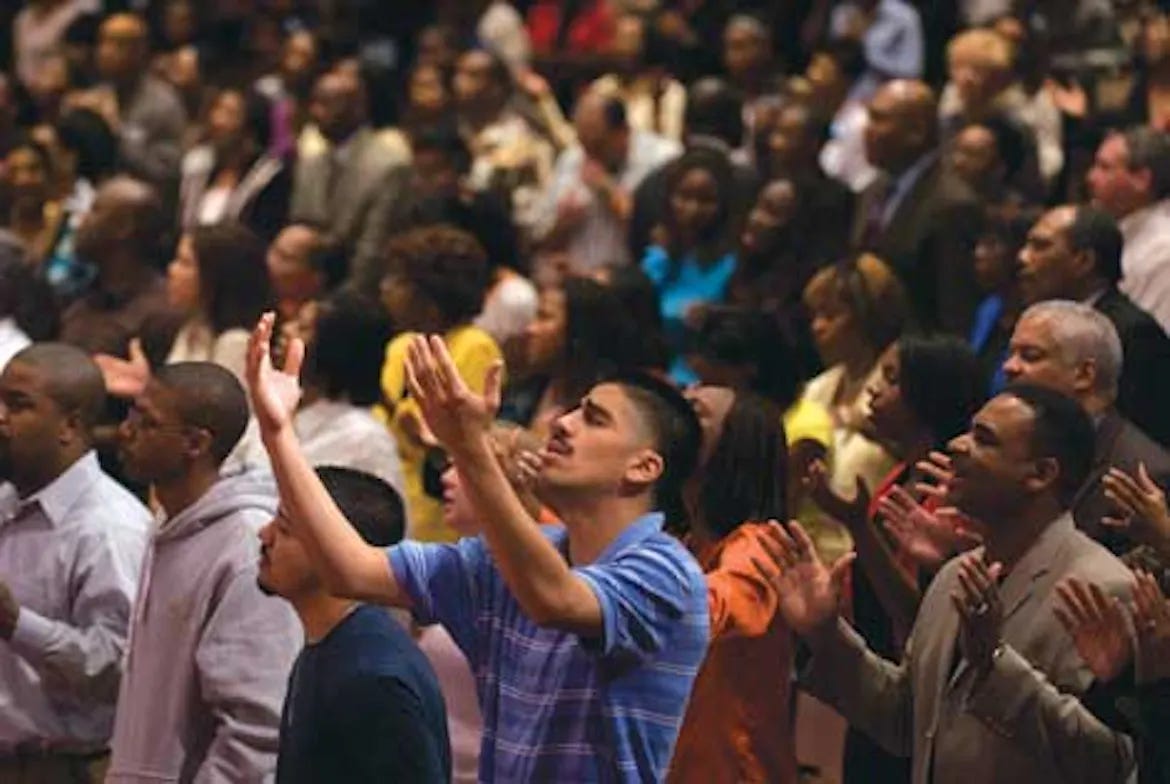
Worship as Resistance
How the simple act of praising God has always been the most profound way to confront the powers of darkness, despair, and domination.
There is a quiet revolution that happens every Sunday morning, though it rarely makes the news. In a culture addicted to self-expression, where politics often becomes a substitute for piety and consumerism baptizes our desires, ordinary believers gather in sanctuaries, storefronts, and living rooms to do something profoundly subversive—they worship.
Worship, in its truest form, is an act of resistance to and rejection of the world.
When the prophet Daniel refused to bow to Babylon’s golden idol and instead knelt toward Jerusalem three times a day (Daniel 6:10), he wasn’t merely practicing private devotion—he was practicing defiance. His prayers were a declaration that Nebuchadnezzar was not ultimate, that empires rise and fall but “the Most High rules the kingdom of men” (Daniel 4:17). Worship in Babylon was Daniel’s protest march, his public theology.
We often think of resistance in political terms—marches, manifestos, and movements—but the Bible paints a broader picture. Worship is the human declaration that God alone deserves the throne. In Egypt, when Pharaoh tightened his grip on Israel, Moses’ first demand was not for freedom in general but for freedom to worship: “Let my people go, that they may hold a feast to me in the wilderness” (Exodus 5:1). True liberation, in other words, is liturgical. That is to say to worship the true God is to dethrone false ones.
Worship in the Age of Distraction
We live in an era of competing liturgies. Algorithms shape our attention. Advertisements form our affections. Politics defines our identities. Philosopher James K.A. Smith observes that the mall, the stadium, and the screen are modern temples forming us into worshipers of autonomy and appetite. In such a world, to gather with others and sing, “You are worthy, O Lord, to receive glory and honor and power” (Revelation 4:11), is to push back against the cultural catechism that says, “I am the center.”
Every hallelujah sung in faith is a protest against despair. Every bowed head is a rebuke to pride. Every dollar offered in the plate resists the tyranny of greed. Every sermon faithfully preached is a counter-narrative to the noise of the age.
When the early Christians refused to burn incense to Caesar and instead proclaimed, “Jesus is Lord,” they were not making a purely spiritual statement. They were challenging the very architecture of Roman power. Their worship gatherings were underground acts of sedition against idolatry and empire. And for that, many paid with their lives.
The Sacred History of African-American Worship
Throughout America’s history, no group has demonstrated the transformative impact and power of worship more than African-American congregations. From the hush harbors of slavery to the spirited gatherings of the modern Black Church, worship has been both sanctuary and strategy—an embodied theology of hope. When the world denied their humanity, these congregations sang of divine dignity: “I am fearfully and wonderfully made” (Psalm 139:14). When laws declared them less than equal, they lifted their voices to the God who “shows no partiality” (Acts 10:34). Their hymns and hollers were not escapist; they were emancipatory. In the cry of “Guide my feet while I run this race,” one hears echoes of Israel’s song at the Red Sea and Paul’s conviction that “we are more than conquerors through him who loved us” (Romans 8:37). Their worship was the drumbeat of resilience, the sound of faith that refused to bow to Pharaoh, Jim Crow, or despair.
Historical Echoes
During the dark centuries of American slavery, songs like “Steal Away to Jesus” and “Swing Low, Sweet Chariot” were not only expressions of faith but coded messages of hope and resistance. The brush arbor became the temple of liberation. The shout became the sermon. In those hidden meetings, enslaved men and women declared that Pharaoh would not have the last word. Their faith, forged in suffering, gave rise to a gospel that sustained generations: “Our help is in the name of the Lord, who made heaven and earth” (Psalm 124:8).
In the Civil Rights Movement, churches became headquarters for justice. African-American preachers reminded America that worship and protest are not opposites but partners. Singing “We Shall Overcome” was itself a prayer of defiant faith. Kneeling to pray in Selma or Montgomery was as politically charged as standing at a podium. Their liturgy of love was stronger than the politics of hate.
Even today, when cynicism masquerades as sophistication, the gathered worshiping community remains the world’s most enduring counterculture. When the church lifts its voice in praise, it declares that there is still truth, still beauty, still goodness, still God.
The Subversive Simplicity of Sunday
The next time you walk into church, consider what you’re really doing. You’re entering a resistance meeting. You’re pledging allegiance not to a flag but to a kingdom “not of this world” (John 18:36). You’re standing shoulder to shoulder with saints and sinners who have decided that hope is more powerful than hate and grace more enduring than greed.
In worship, you are training your heart to see reality rightly. You are learning, again and again, that “the Lord reigns; let the earth rejoice” (Psalm 97:1). And by rejoicing, you are resisting the forces that would have you despair.
The world tells us to curate our image; worship tells us to confess our sin. The world says you are what you buy; worship says you are who Christ has redeemed. The world urges you to climb; worship invites you to kneel. This is why tyrants fear worship. It reminds people that their souls are not for sale, and the would be kings that their word is not final.
The Final Act of Defiance
In the end, worship will be the final act of resistance. Revelation envisions a day when every empire, economy, and idol will crumble, and the redeemed will cry, “Salvation belongs to our God who sits on the throne, and to the Lamb!” (Revelation 7:10). That song will be the last protest, the eternal Amen to every act of faithfulness throughout history. This is our eschatological hope.
Until then, we worship not because the world is perfect but because God is worthy. And every time we do, heaven leans in and hell trembles.
To worship in our time—amid polarization, distraction, and despair—is to stand with Moses in Egypt, Daniel in Babylon, the church in Rome, the saints in Selma, the Christians in Nigeria, and the God and neighbor loving, biblically orthodox believers across America today. It is to say, against every false messiah and rival claim: “As for me and my house, we will serve the Lord.” (Joshua 24:15). Worship is not retreat from the world. It is resistance for the sake of it.


